 Add to Chrome
 Add to Firefox
 Add to Edge
Do Heavy Tails Help Diffusion? On the Subtle Trade-off Between Initialization and Training
May 13, 2026
Recent works have proposed incorporating heavy-tailed (HT) noise into diffusion- and flow-based generative models, with the goals of better recovering the tails of target distributions and improving generative diversity. This motivation is intuitive: if the data are heavy-tailed, HT noise may appear better matched than light-tailed (LT) Gaussian noise. However, replacing Gaussian noise by HT noise also changes the underlying estimation problem. In this paper, we revisit this paradigm through a combined theoretical and empirical study, establishing sampling-error bounds for two representative diffusion models driven by HT and LT noise. We show that HT noise makes the statistical estimation problem harder, leading to less favorable sampling-error bounds. We support these findings with experiments on synthetic and real-world datasets, empirically recovering the predicted error trade-off. Our results call into question a growing design trend in generative modeling and challenge the use of HT noise to improve rare-region exploration.

Tessellation Localized Transfer learning for nonparametric regression
Jan 02, 2026Transfer learning aims to improve performance on a target task by leveraging information from related source tasks. We propose a nonparametric regression transfer learning framework that explicitly models heterogeneity in the source-target relationship. Our approach relies on a local transfer assumption: the covariate space is partitioned into finitely many cells such that, within each cell, the target regression function can be expressed as a low-complexity transformation of the source regression function. This localized structure enables effective transfer where similarity is present while limiting negative transfer elsewhere. We introduce estimators that jointly learn the local transfer functions and the target regression, together with fully data-driven procedures that adapt to unknown partition structure and transfer strength. We establish sharp minimax rates for target regression estimation, showing that local transfer can mitigate the curse of dimensionality by exploiting reduced functional complexity. Our theoretical guarantees take the form of oracle inequalities that decompose excess risk into estimation and approximation terms, ensuring robustness to model misspecification. Numerical experiments illustrate the benefits of the proposed approach.
Laplace Transform Based Low-Complexity Learning of Continuous Markov Semigroups
Oct 18, 2024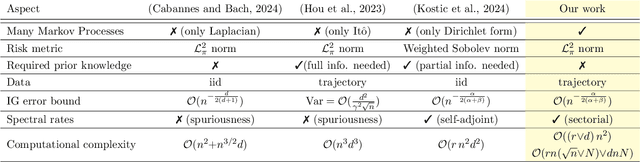
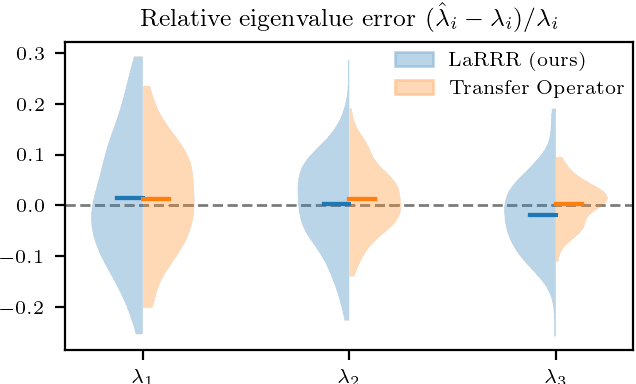
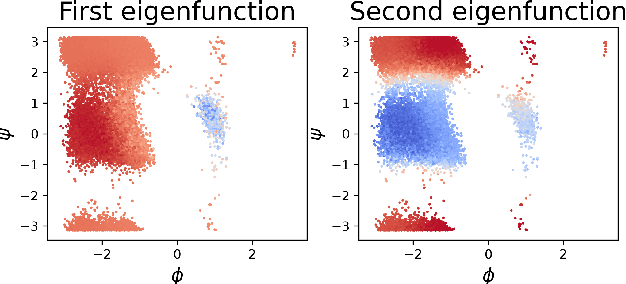
Markov processes serve as a universal model for many real-world random processes. This paper presents a data-driven approach for learning these models through the spectral decomposition of the infinitesimal generator (IG) of the Markov semigroup. The unbounded nature of IGs complicates traditional methods such as vector-valued regression and Hilbert-Schmidt operator analysis. Existing techniques, including physics-informed kernel regression, are computationally expensive and limited in scope, with no recovery guarantees for transfer operator methods when the time-lag is small. We propose a novel method that leverages the IG's resolvent, characterized by the Laplace transform of transfer operators. This approach is robust to time-lag variations, ensuring accurate eigenvalue learning even for small time-lags. Our statistical analysis applies to a broader class of Markov processes than current methods while reducing computational complexity from quadratic to linear in the state dimension. Finally, we illustrate the behaviour of our method in two experiments.