 Add to Chrome
 Add to Firefox
 Add to Edge
Toward Scalable and Valid Conditional Independence Testing with Spectral Representations
Dec 22, 2025
Conditional independence (CI) is central to causal inference, feature selection, and graphical modeling, yet it is untestable in many settings without additional assumptions. Existing CI tests often rely on restrictive structural conditions, limiting their validity on real-world data. Kernel methods using the partial covariance operator offer a more principled approach but suffer from limited adaptivity, slow convergence, and poor scalability. In this work, we explore whether representation learning can help address these limitations. Specifically, we focus on representations derived from the singular value decomposition of the partial covariance operator and use them to construct a simple test statistic, reminiscent of the Hilbert-Schmidt Independence Criterion (HSIC). We also introduce a practical bi-level contrastive algorithm to learn these representations. Our theory links representation learning error to test performance and establishes asymptotic validity and power guarantees. Preliminary experiments suggest that this approach offers a practical and statistically grounded path toward scalable CI testing, bridging kernel-based theory with modern representation learning.

Geometric implicit neural representations for signed distance functions
Nov 10, 2025\textit{Implicit neural representations} (INRs) have emerged as a promising framework for representing signals in low-dimensional spaces. This survey reviews the existing literature on the specialized INR problem of approximating \textit{signed distance functions} (SDFs) for surface scenes, using either oriented point clouds or a set of posed images. We refer to neural SDFs that incorporate differential geometry tools, such as normals and curvatures, in their loss functions as \textit{geometric} INRs. The key idea behind this 3D reconstruction approach is to include additional \textit{regularization} terms in the loss function, ensuring that the INR satisfies certain global properties that the function should hold -- such as having unit gradient in the case of SDFs. We explore key methodological components, including the definition of INR, the construction of geometric loss functions, and sampling schemes from a differential geometry perspective. Our review highlights the significant advancements enabled by geometric INRs in surface reconstruction from oriented point clouds and posed images.
FLOWING: Implicit Neural Flows for Structure-Preserving Morphing
Oct 10, 2025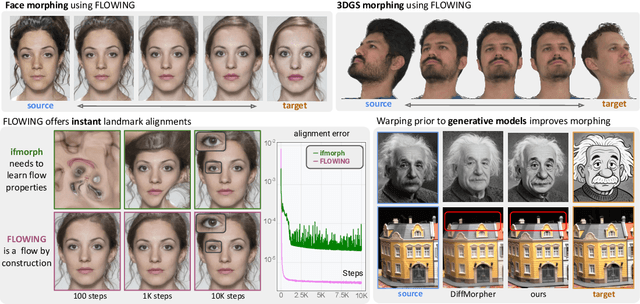
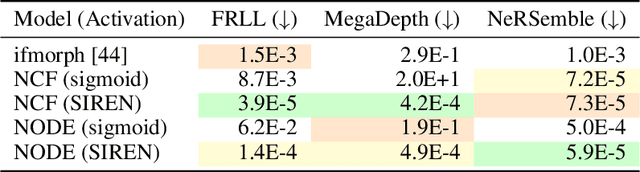
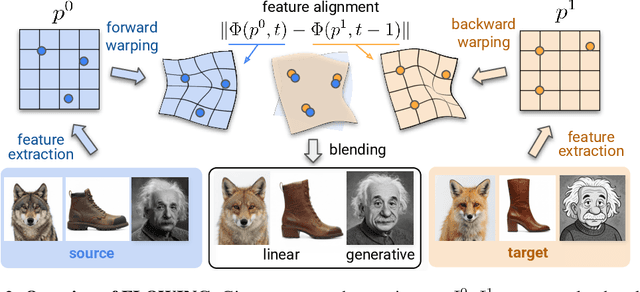
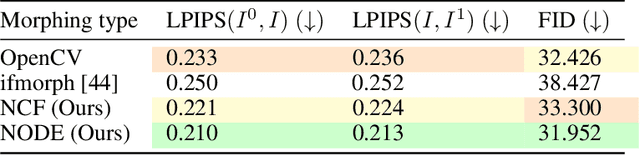
Morphing is a long-standing problem in vision and computer graphics, requiring a time-dependent warping for feature alignment and a blending for smooth interpolation. Recently, multilayer perceptrons (MLPs) have been explored as implicit neural representations (INRs) for modeling such deformations, due to their meshlessness and differentiability; however, extracting coherent and accurate morphings from standard MLPs typically relies on costly regularizations, which often lead to unstable training and prevent effective feature alignment. To overcome these limitations, we propose FLOWING (FLOW morphING), a framework that recasts warping as the construction of a differential vector flow, naturally ensuring continuity, invertibility, and temporal coherence by encoding structural flow properties directly into the network architectures. This flow-centric approach yields principled and stable transformations, enabling accurate and structure-preserving morphing of both 2D images and 3D shapes. Extensive experiments across a range of applications - including face and image morphing, as well as Gaussian Splatting morphing - show that FLOWING achieves state-of-the-art morphing quality with faster convergence. Code and pretrained models are available at http://schardong.github.io/flowing.
Neural Implicit Morphing of Face Images
Aug 26, 2023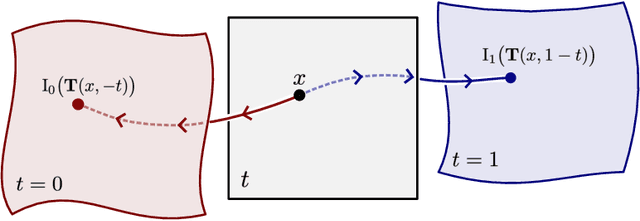
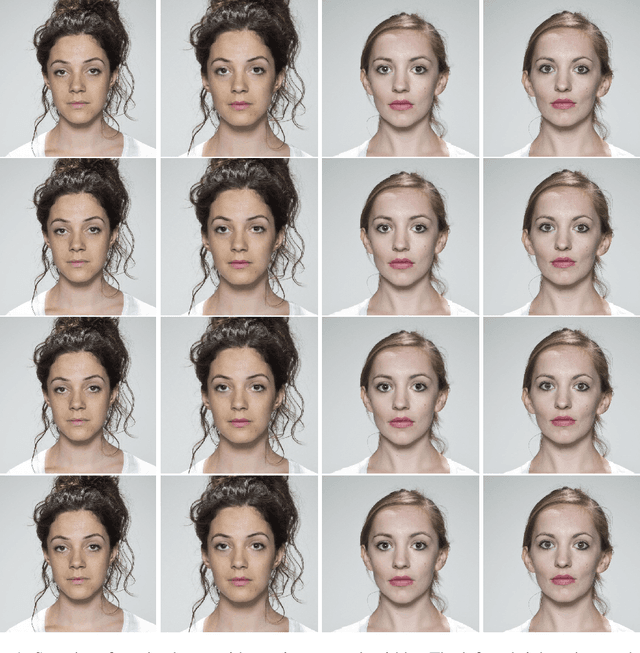
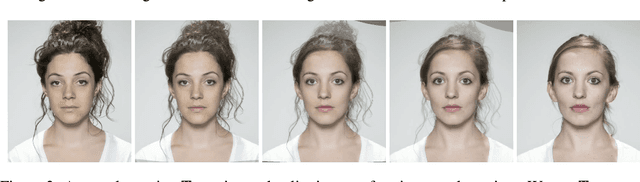
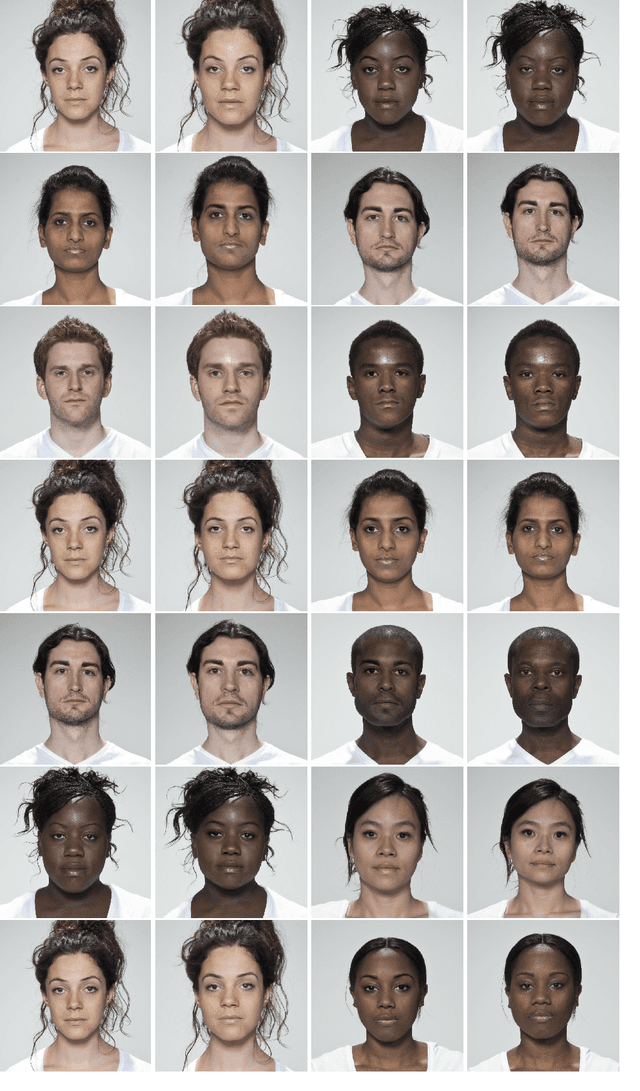
Face morphing is one of the seminal problems in computer graphics, with numerous artistic and forensic applications. It is notoriously challenging due to pose, lighting, gender, and ethnicity variations. Generally, this task consists of a warping for feature alignment and a blending for a seamless transition between the warped images. We propose to leverage coordinate-based neural networks to represent such warpings and blendings of face images. During training, we exploit the smoothness and flexibility of such networks, by combining energy functionals employed in classical approaches without discretizations. Additionally, our method is time-dependent, allowing a continuous warping, and blending of the target images. During warping inference, we need both direct and inverse transformations of the time-dependent warping. The first is responsible for morphing the target image into the source image, while the inverse is used for morphing in the opposite direction. Our neural warping stores those maps in a single network due to its inversible property, dismissing the hard task of inverting them. The results of our experiments indicate that our method is competitive with both classical and data-based neural techniques under the lens of face-morphing detection approaches. Aesthetically, the resulting images present a seamless blending of diverse faces not yet usual in the literature.