 Add to Chrome
 Add to Firefox
 Add to Edge
Dream-VL & Dream-VLA: Open Vision-Language and Vision-Language-Action Models with Diffusion Language Model Backbone
Dec 27, 2025
While autoregressive Large Vision-Language Models (VLMs) have achieved remarkable success, their sequential generation often limits their efficacy in complex visual planning and dynamic robotic control. In this work, we investigate the potential of constructing Vision-Language Models upon diffusion-based large language models (dLLMs) to overcome these limitations. We introduce Dream-VL, an open diffusion-based VLM (dVLM) that achieves state-of-the-art performance among previous dVLMs. Dream-VL is comparable to top-tier AR-based VLMs trained on open data on various benchmarks but exhibits superior potential when applied to visual planning tasks. Building upon Dream-VL, we introduce Dream-VLA, a dLLM-based Vision-Language-Action model (dVLA) developed through continuous pre-training on open robotic datasets. We demonstrate that the natively bidirectional nature of this diffusion backbone serves as a superior foundation for VLA tasks, inherently suited for action chunking and parallel generation, leading to significantly faster convergence in downstream fine-tuning. Dream-VLA achieves top-tier performance of 97.2% average success rate on LIBERO, 71.4% overall average on SimplerEnv-Bridge, and 60.5% overall average on SimplerEnv-Fractal, surpassing leading models such as $π_0$ and GR00T-N1. We also validate that dVLMs surpass AR baselines on downstream tasks across different training objectives. We release both Dream-VL and Dream-VLA to facilitate further research in the community.

HMS-Net: Hierarchical Multi-scale Sparsity-invariant Network for Sparse Depth Completion
Aug 27, 2018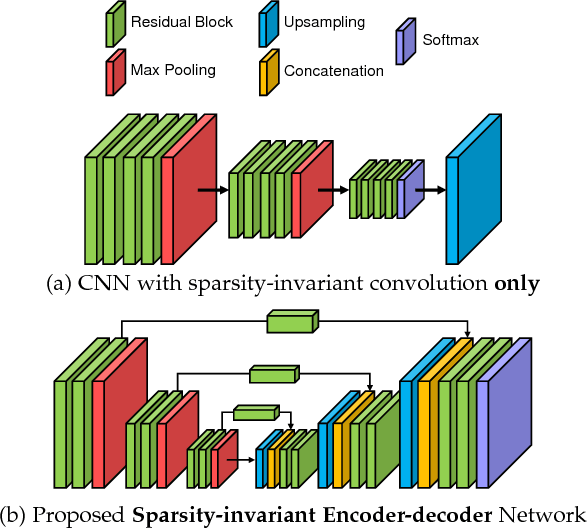
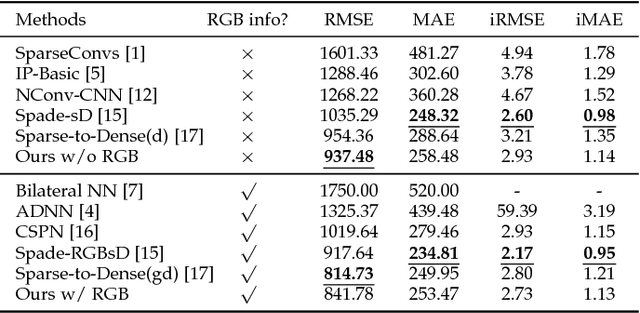
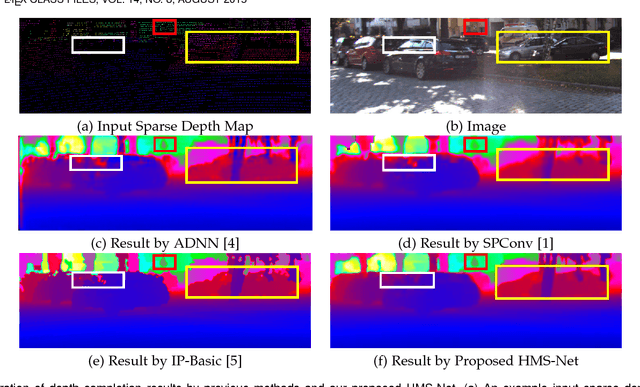
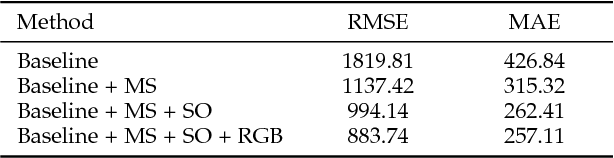
Dense depth cues are important and have wide applications in various computer vision tasks. In autonomous driving, LIDAR sensors are adopted to acquire depth measurements around the vehicle to perceive the surrounding environments. However, depth maps obtained by LIDAR are generally sparse because of its hardware limitation. The task of depth completion attracts increasing attention, which aims at generating a dense depth map from an input sparse depth map. To effectively utilize multi-scale features, we propose three novel sparsity-invariant operations, based on which, a sparsity-invariant multi-scale encoder-decoder network (HMS-Net) for handling sparse inputs and sparse feature maps is also proposed. Additional RGB features could be incorporated to further improve the depth completion performance. Our extensive experiments and component analysis on two public benchmarks, KITTI depth completion benchmark and NYU-depth-v2 dataset, demonstrate the effectiveness of the proposed approach. As of Aug. 12th, 2018, on KITTI depth completion leaderboard, our proposed model without RGB guidance ranks first among all peer-reviewed methods without using RGB information, and our model with RGB guidance ranks second among all RGB-guided methods.