 Add to Chrome
 Add to Firefox
 Add to Edge
FCUS-rPPG: A Fast-Converging Unsupervised Framework for Remote Photoplethysmography via Gradient Oscillation Suppression
Jun 02, 2026
Remote photoplethysmography (rPPG) enables non-contact extraction of blood volume pulse (BVP) signals using consumer-grade cameras. Recent unsupervised rPPG methods learn BVP representations without requiring ground-truth physiological annotations, yet their optimization is often hindered by noisy and unstable gradients, resulting in slow convergence and limited cross-domain generalization. In this paper, we propose FCUS-rPPG, a fast-converging unsupervised rPPG framework with strong generalization capability. Motivated by the observation that BVP representations exhibit both multi-spectral covariation and low-dimensional manifold structure, we design a spectrally shared backbone that facilitates BVP feature disentanglement while improving optimization efficiency. To jointly enhance convergence stability and generalization performance, we further develop a unified optimization framework operating at the gradient, loss-landscape, and feature-representation levels. Specifically, a post-verification masking mechanism filters out misleading gradients according to the weak-amplitude physiological prior of BVP signals; a perturbation-based loss landscape smoothing strategy steers optimization toward more generalizable flat minima; and a noise-aware null-space regularization constrains feature updates to the orthogonal complement of the noise subspace, thereby mitigating noise-induced representation drift. Extensive experiments on five datasets demonstrate that FCUS-rPPG requires only one training epoch, whereas existing methods typically require tens to hundreds of epochs. Notably, FCUS-rPPG consistently achieves state-of-the-art (SOTA) performance in cross-dataset evaluations. This study provides an efficient and robust solution to the real-world deployment of unsupervised rPPG. The source code will be publicly available at https://github.com/JiaJieLee/FCUS-rPPG.

Adaptive Physical-Facial Representation Fusion via Subject-Invariant Cross-Modal Prompt Tuning for Video-Based Emotion Recognition
May 07, 2026Emotion recognition from facial videos enables non-contact inference of human emotional states. Although facial expressions are widely used cues, they cannot fully reflect intrinsic affective states. Remote photoplethysmography (rPPG) provides complementary physiological information, but it is highly susceptible to noise and inter-subject variability, limiting generalization to unseen individuals. Existing multimodal methods combine facial and rPPG features, yet their fusion strategies often disrupt pretrained facial representations and lack explicit mechanisms to suppress subject-specific variations. To address these issues, we propose a subject-invariant cross-modal prompt-tuning framework for video-based emotion recognition. Specifically, rPPG waveforms are transformed into noise-robust time-frequency representations (TFRs), from which modality-complementary prompts are generated to modulate facial tokens within a frozen Vision Transformer (ViT). This design enables effective cross-modal interaction while preserving the generalizable facial representations learned by the pretrained backbone. In addition, we introduce a decoupled shared-specific adapter (DSSA) into each ViT layer to explicitly separate subject-shared and subject-specific components, thereby improving cross-subject generalization. Experiments on the MAHNOB-HCI and DEAP benchmarks demonstrate that the proposed method consistently outperforms strong baselines in both recognition accuracy and generalization ability, highlighting its effectiveness for video-based emotion recognition.
Customized Fusion: A Closed-Loop Dynamic Network for Adaptive Multi-Task-Aware Infrared-Visible Image Fusion
Apr 10, 2026Infrared-visible image fusion aims to integrate complementary information for robust visual understanding, but existing fusion methods struggle with simultaneously adapting to multiple downstream tasks. To address this issue, we propose a Closed-Loop Dynamic Network (CLDyN) that can adaptively respond to the semantic requirements of diverse downstream tasks for task-customized image fusion. Specifically, CLDyN introduces a closed-loop optimization mechanism that establishes a semantic transmission chain to achieve explicit feedback from downstream tasks to the fusion network through a Requirement-driven Semantic Compensation (RSC) module. The RSC module leverages a Basis Vector Bank (BVB) and an Architecture-Adaptive Semantic Injection (A2SI) block to customize the network architecture according to task requirements, thereby enabling task-specific semantic compensation and allowing the fusion network to actively adapt to diverse tasks without retraining. To promote semantic compensation, a reward-penalty strategy is introduced to reward or penalize the RSC module based on task performance variations. Experiments on the M3FD, FMB, and VT5000 datasets demonstrate that CLDyN not only maintains high fusion quality but also exhibits strong multi-task adaptability. The code is available at https://github.com/YR0211/CLDyN.
Degradation-Robust Fusion: An Efficient Degradation-Aware Diffusion Framework for Multimodal Image Fusion in Arbitrary Degradation Scenarios
Apr 10, 2026Complex degradations like noise, blur, and low resolution are typical challenges in real world image fusion tasks, limiting the performance and practicality of existing methods. End to end neural network based approaches are generally simple to design and highly efficient in inference, but their black-box nature leads to limited interpretability. Diffusion based methods alleviate this to some extent by providing powerful generative priors and a more structured inference process. However, they are trained to learn a single domain target distribution, whereas fusion lacks natural fused data and relies on modeling complementary information from multiple sources, making diffusion hard to apply directly in practice. To address these challenges, this paper proposes an efficient degradation aware diffusion framework for image fusion under arbitrary degradation scenarios. Specifically, instead of explicitly predicting noise as in conventional diffusion models, our method performs implicit denoising by directly regressing the fused image, enabling flexible adaptation to diverse fusion tasks under complex degradations with limited steps. Moreover, we design a joint observation model correction mechanism that simultaneously imposes degradation and fusion constraints during sampling to ensure high reconstruction accuracy. Experiments on diverse fusion tasks and degradation configurations demonstrate the superiority of the proposed method under complex degradation scenarios.
FaFCNN: A General Disease Classification Framework Based on Feature Fusion Neural Networks
Jul 24, 2023
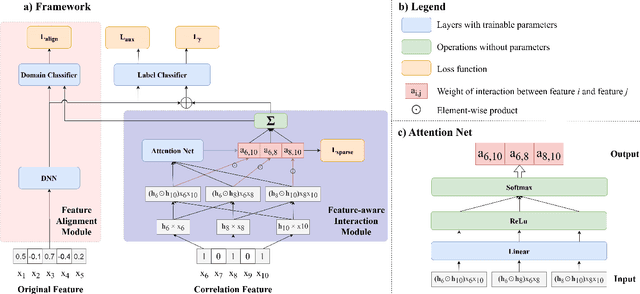
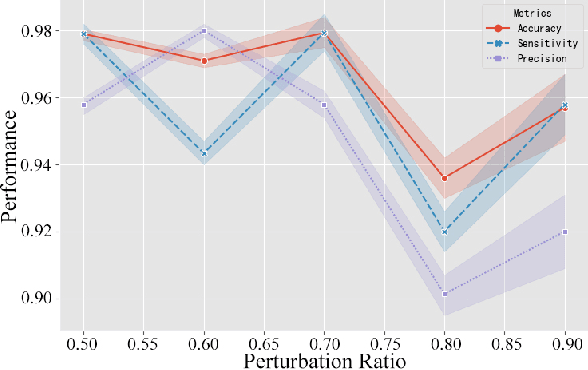
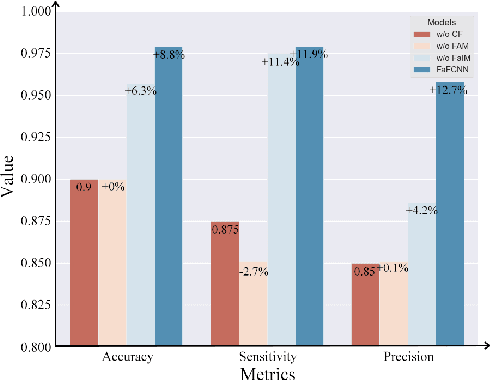
There are two fundamental problems in applying deep learning/machine learning methods to disease classification tasks, one is the insufficient number and poor quality of training samples; another one is how to effectively fuse multiple source features and thus train robust classification models. To address these problems, inspired by the process of human learning knowledge, we propose the Feature-aware Fusion Correlation Neural Network (FaFCNN), which introduces a feature-aware interaction module and a feature alignment module based on domain adversarial learning. This is a general framework for disease classification, and FaFCNN improves the way existing methods obtain sample correlation features. The experimental results show that training using augmented features obtained by pre-training gradient boosting decision tree yields more performance gains than random-forest based methods. On the low-quality dataset with a large amount of missing data in our setup, FaFCNN obtains a consistently optimal performance compared to competitive baselines. In addition, extensive experiments demonstrate the robustness of the proposed method and the effectiveness of each component of the model\footnote{Accepted in IEEE SMC2023}.
Landslide Surface Displacement Prediction Based on VSXC-LSTM Algorithm
Jul 24, 2023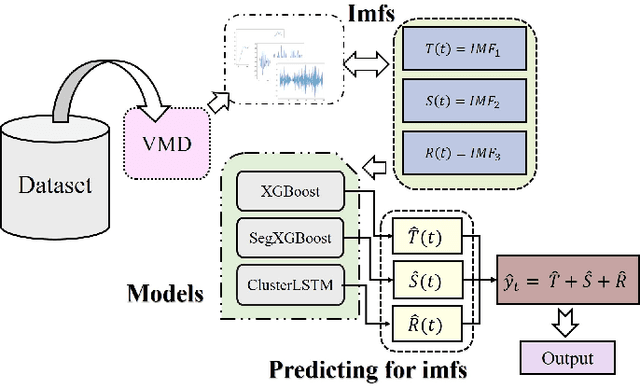
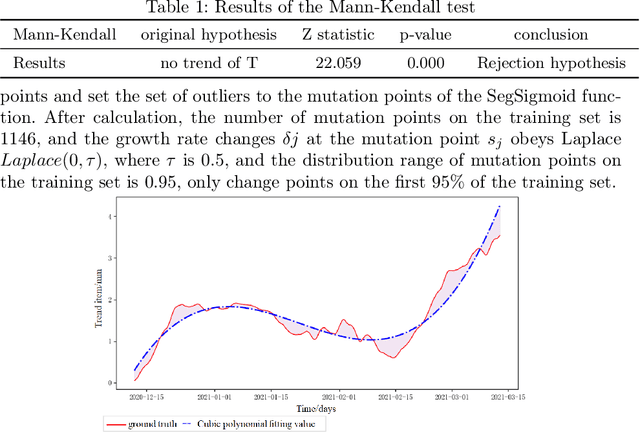
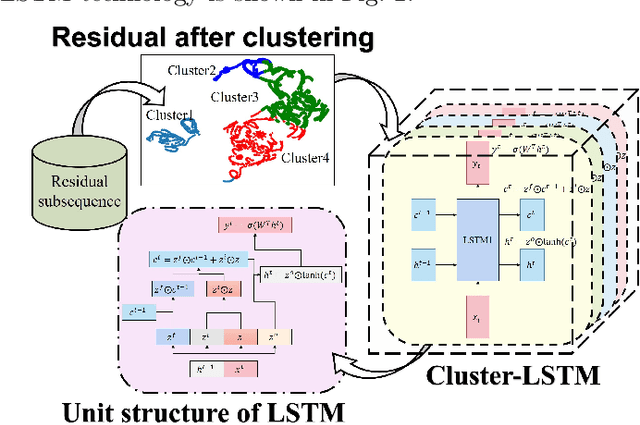
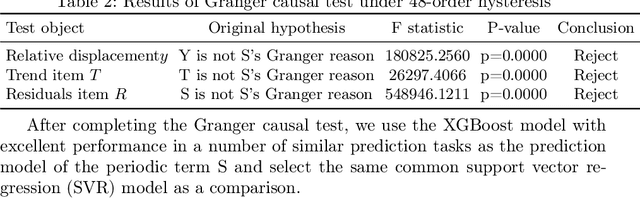
Landslide is a natural disaster that can easily threaten local ecology, people's lives and property. In this paper, we conduct modelling research on real unidirectional surface displacement data of recent landslides in the research area and propose a time series prediction framework named VMD-SegSigmoid-XGBoost-ClusterLSTM (VSXC-LSTM) based on variational mode decomposition, which can predict the landslide surface displacement more accurately. The model performs well on the test set. Except for the random item subsequence that is hard to fit, the root mean square error (RMSE) and the mean absolute percentage error (MAPE) of the trend item subsequence and the periodic item subsequence are both less than 0.1, and the RMSE is as low as 0.006 for the periodic item prediction module based on XGBoost\footnote{Accepted in ICANN2023}.