 Add to Chrome
 Add to Firefox
 Add to Edge
Anchor PCA
Jun 04, 2026
Principal component analysis (PCA) is one of the most widely used unsupervised dimension reduction techniques. We study PCA for data from multiple related domains. Since principal components generally differ across domains, one way to obtain a shared low-rank embedding is to perform PCA on the pooled data. However, this approach can focus on spurious directions that exhibit high variation in only a few domains. To find a robust embedding that still explains most variance in unseen but similar domains, we propose instead to focus on shared directions of variation. To this end, we introduce Anchor PCA which trades off overall explained variance with agreement between the shared and domain-specific low-rank embeddings. Anchor PCA amounts to PCA on a modified target matrix and thus can be solved efficiently. Moreover, we show that Anchor PCA recovers a maximal invariant subspace and admits a minimax reconstruction interpretation under bounded domain-specific covariance inflations. On simulated and real-world gas sensor data with temporal drift, we demonstrate, respectively, that Anchor PCA recovers the maximally invariant subspace and yields embeddings that explain more variance on unseen domains than the pooling baseline and a worst-case alternative. Taken together, these findings establish Anchor PCA as a promising approach to robust unsupervised dimension reduction from multi-domain data.

FLUXtrapolation: A benchmark on extrapolating ecosystem fluxes
May 19, 2026We introduce FLUXtrapolation, a benchmark for extrapolating ecosystem fluxes under progressively harder distribution shifts. Ecosystem fluxes are central to understanding the carbon, water, and energy cycles, yet they can only be measured directly at sparsely located measurement towers. Producing global flux estimates therefore requires training models on observed sites using globally available covariates and predicting in unobserved regions, that is, upscaling. Flux upscaling is a challenging domain generalization problem that is affected by a shift in covariate distribution across climates, ecosystem types, and environmental conditions, as well as by conditional shift: important drivers remain unobserved at global scale. We provide a quantitative analysis of both these shifts in $P_X$ and $P_{Y\mid X}$. FLUXtrapolation is designed based on domain expertise on flux upscaling: it defines temporal, spatial, and temperature-based extrapolation scenarios and evaluates performance across held-out domains, temporal aggregations, and tail errors. In a pilot study, we find that baselines perform similarly under median hourly RMSE, but separate under the proposed tail-focused and multi-scale evaluation. FLUXtrapolation therefore poses a realistic and thus relevant challenge for machine learning methods under distribution shift; at the same time, progress on this benchmark would directly support the scientific goal of improving flux upscaling.
Worst-case low-rank approximations
Mar 11, 2026Real-world data in health, economics, and environmental sciences are often collected across heterogeneous domains (such as hospitals, regions, or time periods). In such settings, distributional shifts can make standard PCA unreliable, in that, for example, the leading principal components may explain substantially less variance in unseen domains than in the training domains. Existing approaches (such as FairPCA) have proposed to consider worst-case (rather than average) performance across multiple domains. This work develops a unified framework, called wcPCA, applies it to other objectives (resulting in the novel estimators such as norm-minPCA and norm-maxregret, which are better suited for applications with heterogeneous total variance) and analyzes their relationship. We prove that for all objectives, the estimators are worst-case optimal not only over the observed source domains but also over all target domains whose covariance lies in the convex hull of the (possibly normalized) source covariances. We establish consistency and asymptotic worst-case guarantees of empirical estimators. We extend our methodology to matrix completion, another problem that makes use of low-rank approximations, and prove approximate worst-case optimality for inductive matrix completion. Simulations and two real-world applications on ecosystem-atmosphere fluxes demonstrate marked improvements in worst-case performance, with only minor losses in average performance.
Invariance-Based Dynamic Regret Minimization
Mar 04, 2026We consider stochastic non-stationary linear bandits where the linear parameter connecting contexts to the reward changes over time. Existing algorithms in this setting localize the policy by gradually discarding or down-weighting past data, effectively shrinking the time horizon over which learning can occur. However, in many settings historical data may still carry partial information about the reward model. We propose to leverage such data while adapting to changes, by assuming the reward model decomposes into stationary and non-stationary components. Based on this assumption, we introduce ISD-linUCB, an algorithm that uses past data to learn invariances in the reward model and subsequently exploits them to improve online performance. We show both theoretically and empirically that leveraging invariance reduces the problem dimensionality, yielding significant regret improvements in fast-changing environments when sufficient historical data is available.
Anti-causal domain generalization: Leveraging unlabeled data
Feb 19, 2026The problem of domain generalization concerns learning predictive models that are robust to distribution shifts when deployed in new, previously unseen environments. Existing methods typically require labeled data from multiple training environments, limiting their applicability when labeled data are scarce. In this work, we study domain generalization in an anti-causal setting, where the outcome causes the observed covariates. Under this structure, environment perturbations that affect the covariates do not propagate to the outcome, which motivates regularizing the model's sensitivity to these perturbations. Crucially, estimating these perturbation directions does not require labels, enabling us to leverage unlabeled data from multiple environments. We propose two methods that penalize the model's sensitivity to variations in the mean and covariance of the covariates across environments, respectively, and prove that these methods have worst-case optimality guarantees under certain classes of environments. Finally, we demonstrate the empirical performance of our approach on a controlled physical system and a physiological signal dataset.
Many Experiments, Few Repetitions, Unpaired Data, and Sparse Effects: Is Causal Inference Possible?
Jan 21, 2026We study the problem of estimating causal effects under hidden confounding in the following unpaired data setting: we observe some covariates $X$ and an outcome $Y$ under different experimental conditions (environments) but do not observe them jointly; we either observe $X$ or $Y$. Under appropriate regularity conditions, the problem can be cast as an instrumental variable (IV) regression with the environment acting as a (possibly high-dimensional) instrument. When there are many environments but only a few observations per environment, standard two-sample IV estimators fail to be consistent. We propose a GMM-type estimator based on cross-fold sample splitting of the instrument-covariate sample and prove that it is consistent as the number of environments grows but the sample size per environment remains constant. We further extend the method to sparse causal effects via $\ell_1$-regularized estimation and post-selection refitting.
Maximum Risk Minimization with Random Forests
Dec 11, 2025We consider a regression setting where observations are collected in different environments modeled by different data distributions. The field of out-of-distribution (OOD) generalization aims to design methods that generalize better to test environments whose distributions differ from those observed during training. One line of such works has proposed to minimize the maximum risk across environments, a principle that we refer to as MaxRM (Maximum Risk Minimization). In this work, we introduce variants of random forests based on the principle of MaxRM. We provide computationally efficient algorithms and prove statistical consistency for our primary method. Our proposed method can be used with each of the following three risks: the mean squared error, the negative reward (which relates to the explained variance), and the regret (which quantifies the excess risk relative to the best predictor). For MaxRM with regret as the risk, we prove a novel out-of-sample guarantee over unseen test distributions. Finally, we evaluate the proposed methods on both simulated and real-world data.
Transferring Causal Effects using Proxies
Oct 29, 2025We consider the problem of estimating a causal effect in a multi-domain setting. The causal effect of interest is confounded by an unobserved confounder and can change between the different domains. We assume that we have access to a proxy of the hidden confounder and that all variables are discrete or categorical. We propose methodology to estimate the causal effect in the target domain, where we assume to observe only the proxy variable. Under these conditions, we prove identifiability (even when treatment and response variables are continuous). We introduce two estimation techniques, prove consistency, and derive confidence intervals. The theoretical results are supported by simulation studies and a real-world example studying the causal effect of website rankings on consumer choices.
Representation Learning for Distributional Perturbation Extrapolation
Apr 25, 2025We consider the problem of modelling the effects of unseen perturbations such as gene knockdowns or drug combinations on low-level measurements such as RNA sequencing data. Specifically, given data collected under some perturbations, we aim to predict the distribution of measurements for new perturbations. To address this challenging extrapolation task, we posit that perturbations act additively in a suitable, unknown embedding space. More precisely, we formulate the generative process underlying the observed data as a latent variable model, in which perturbations amount to mean shifts in latent space and can be combined additively. Unlike previous work, we prove that, given sufficiently diverse training perturbations, the representation and perturbation effects are identifiable up to affine transformation, and use this to characterize the class of unseen perturbations for which we obtain extrapolation guarantees. To estimate the model from data, we propose a new method, the perturbation distribution autoencoder (PDAE), which is trained by maximising the distributional similarity between true and predicted perturbation distributions. The trained model can then be used to predict previously unseen perturbation distributions. Empirical evidence suggests that PDAE compares favourably to existing methods and baselines at predicting the effects of unseen perturbations.
DecoR: Deconfounding Time Series with Robust Regression
Jun 11, 2024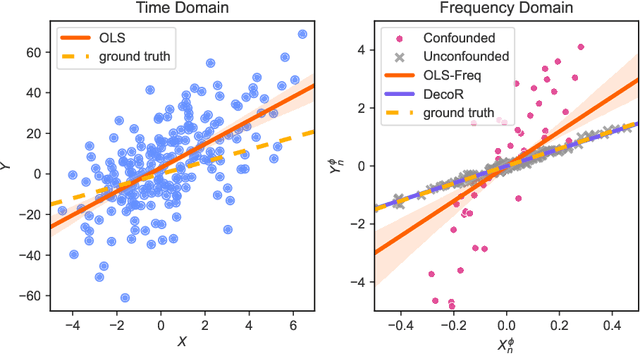
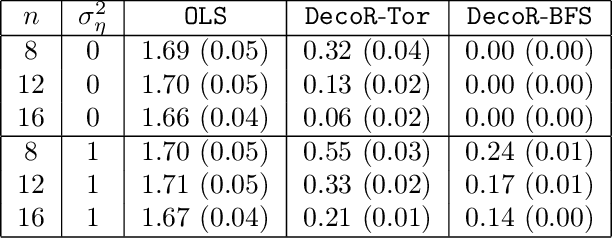


Causal inference on time series data is a challenging problem, especially in the presence of unobserved confounders. This work focuses on estimating the causal effect between two time series, which are confounded by a third, unobserved time series. Assuming spectral sparsity of the confounder, we show how in the frequency domain this problem can be framed as an adversarial outlier problem. We introduce Deconfounding by Robust regression (DecoR), a novel approach that estimates the causal effect using robust linear regression in the frequency domain. Considering two different robust regression techniques, we first improve existing bounds on the estimation error for such techniques. Crucially, our results do not require distributional assumptions on the covariates. We can therefore use them in time series settings. Applying these results to DecoR, we prove, under suitable assumptions, upper bounds for the estimation error of DecoR that imply consistency. We show DecoR's effectiveness through experiments on synthetic data. Our experiments furthermore suggest that our method is robust with respect to model misspecification.