 Add to Chrome
 Add to Firefox
 Add to Edge
Invariance-Based Dynamic Regret Minimization
Mar 04, 2026
We consider stochastic non-stationary linear bandits where the linear parameter connecting contexts to the reward changes over time. Existing algorithms in this setting localize the policy by gradually discarding or down-weighting past data, effectively shrinking the time horizon over which learning can occur. However, in many settings historical data may still carry partial information about the reward model. We propose to leverage such data while adapting to changes, by assuming the reward model decomposes into stationary and non-stationary components. Based on this assumption, we introduce ISD-linUCB, an algorithm that uses past data to learn invariances in the reward model and subsequently exploits them to improve online performance. We show both theoretically and empirically that leveraging invariance reduces the problem dimensionality, yielding significant regret improvements in fast-changing environments when sufficient historical data is available.

Invariant Subspace Decomposition
Apr 15, 2024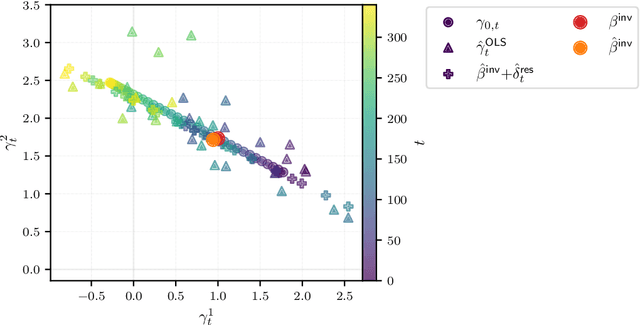
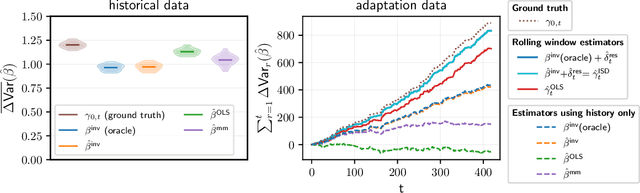
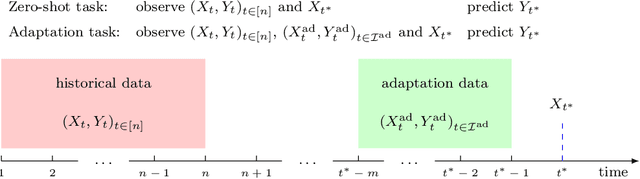
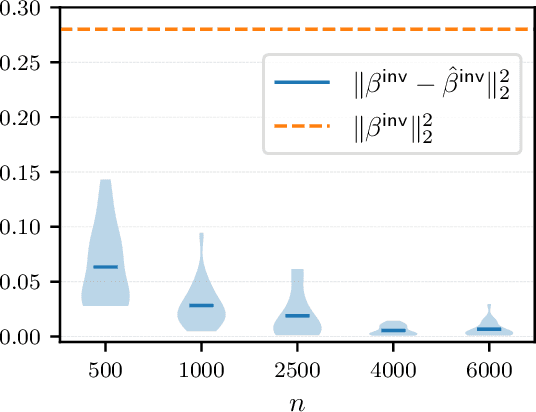
We consider the task of predicting a response Y from a set of covariates X in settings where the conditional distribution of Y given X changes over time. For this to be feasible, assumptions on how the conditional distribution changes over time are required. Existing approaches assume, for example, that changes occur smoothly over time so that short-term prediction using only the recent past becomes feasible. In this work, we propose a novel invariance-based framework for linear conditionals, called Invariant Subspace Decomposition (ISD), that splits the conditional distribution into a time-invariant and a residual time-dependent component. As we show, this decomposition can be utilized both for zero-shot and time-adaptation prediction tasks, that is, settings where either no or a small amount of training data is available at the time points we want to predict Y at, respectively. We propose a practical estimation procedure, which automatically infers the decomposition using tools from approximate joint matrix diagonalization. Furthermore, we provide finite sample guarantees for the proposed estimator and demonstrate empirically that it indeed improves on approaches that do not use the additional invariant structure.