 Add to Chrome
 Add to Firefox
 Add to Edge
Robust and Efficient Transfer Learning via Supernet Transfer in Warm-started Neural Architecture Search
Jul 26, 2024
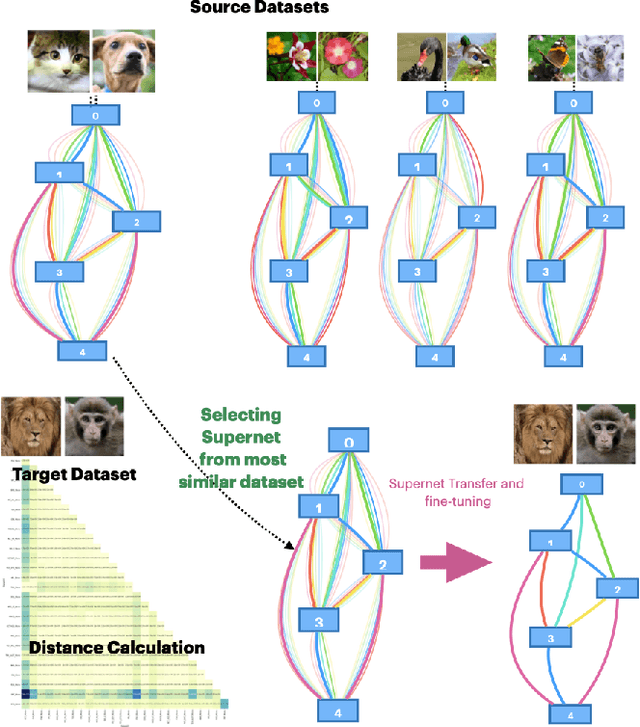

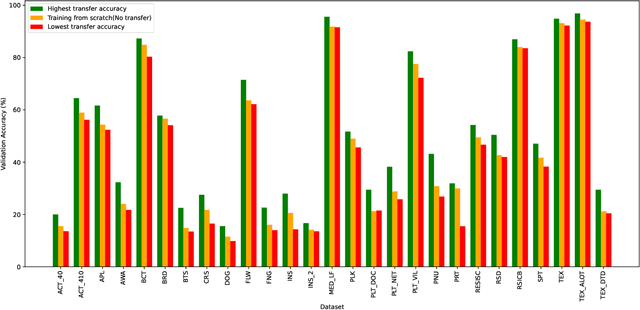
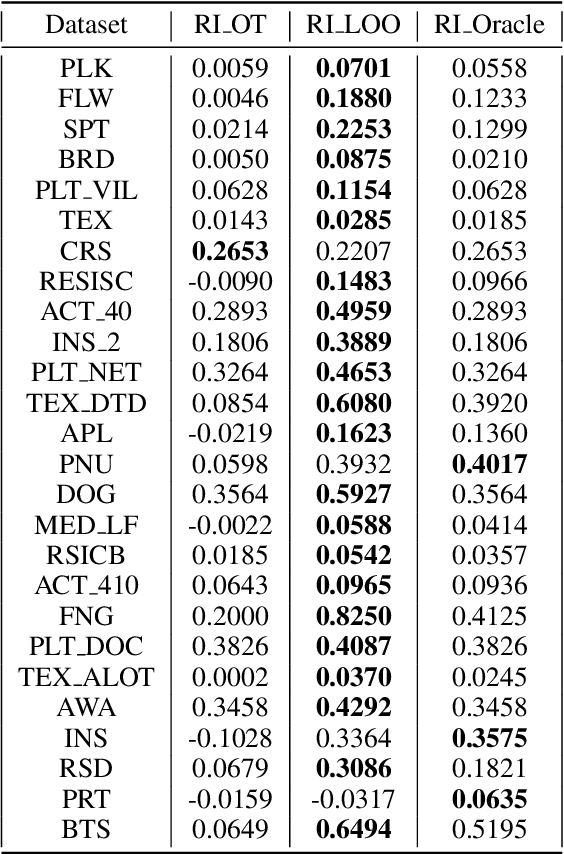
Hand-designing Neural Networks is a tedious process that requires significant expertise. Neural Architecture Search (NAS) frameworks offer a very useful and popular solution that helps to democratize AI. However, these NAS frameworks are often computationally expensive to run, which limits their applicability and accessibility. In this paper, we propose a novel transfer learning approach, capable of effectively transferring pretrained supernets based on Optimal Transport or multi-dataset pretaining. This method can be generally applied to NAS methods based on Differentiable Architecture Search (DARTS). Through extensive experiments across dozens of image classification tasks, we demonstrate that transferring pretrained supernets in this way can not only drastically speed up the supernet training which then finds optimal models (3 to 5 times faster on average), but even yield that outperform those found when running DARTS methods from scratch. We also observe positive transfer to almost all target datasets, making it very robust. Besides drastically improving the applicability of NAS methods, this also opens up new applications for continual learning and related fields.

Can time series forecasting be automated? A benchmark and analysis
Jul 25, 2024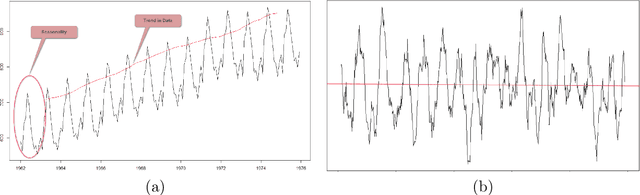
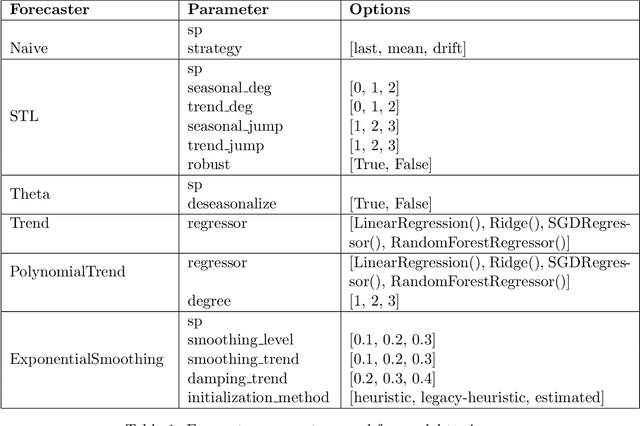
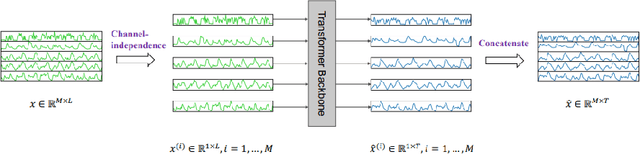
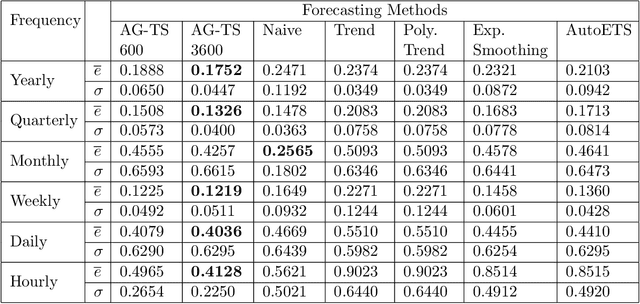
In the field of machine learning and artificial intelligence, time series forecasting plays a pivotal role across various domains such as finance, healthcare, and weather. However, the task of selecting the most suitable forecasting method for a given dataset is a complex task due to the diversity of data patterns and characteristics. This research aims to address this challenge by proposing a comprehensive benchmark for evaluating and ranking time series forecasting methods across a wide range of datasets. This study investigates the comparative performance of many methods from two prominent time series forecasting frameworks, AutoGluon-Timeseries, and sktime to shed light on their applicability in different real-world scenarios. This research contributes to the field of time series forecasting by providing a robust benchmarking methodology and facilitating informed decision-making when choosing forecasting methods for achieving optimal prediction.
HyTAS: A Hyperspectral Image Transformer Architecture Search Benchmark and Analysis
Jul 23, 2024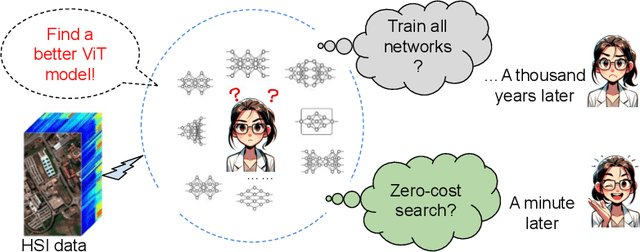



Hyperspectral Imaging (HSI) plays an increasingly critical role in precise vision tasks within remote sensing, capturing a wide spectrum of visual data. Transformer architectures have significantly enhanced HSI task performance, while advancements in Transformer Architecture Search (TAS) have improved model discovery. To harness these advancements for HSI classification, we make the following contributions: i) We propose HyTAS, the first benchmark on transformer architecture search for Hyperspectral imaging, ii) We comprehensively evaluate 12 different methods to identify the optimal transformer over 5 different datasets, iii) We perform an extensive factor analysis on the Hyperspectral transformer search performance, greatly motivating future research in this direction. All benchmark materials are available at HyTAS.
CLAMS: A System for Zero-Shot Model Selection for Clustering
Jul 15, 2024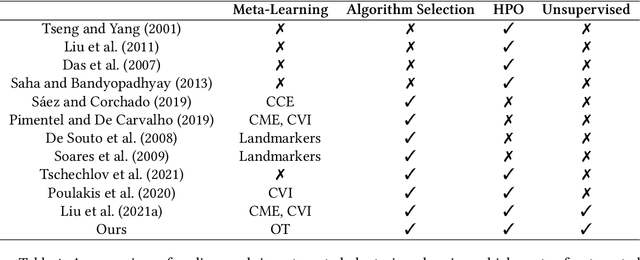


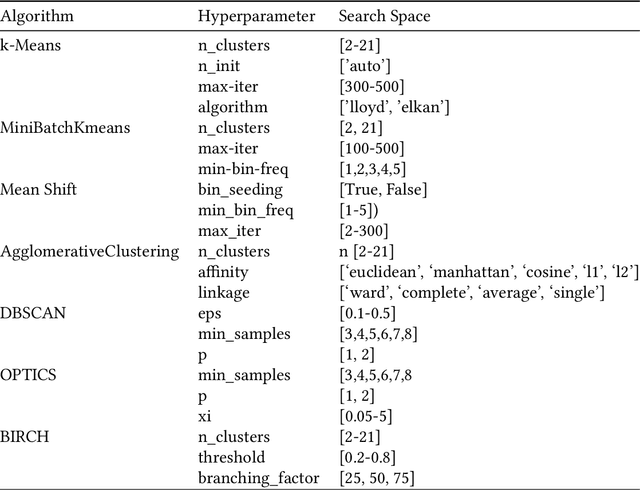
We propose an AutoML system that enables model selection on clustering problems by leveraging optimal transport-based dataset similarity. Our objective is to establish a comprehensive AutoML pipeline for clustering problems and provide recommendations for selecting the most suitable algorithms, thus opening up a new area of AutoML beyond the traditional supervised learning settings. We compare our results against multiple clustering baselines and find that it outperforms all of them, hence demonstrating the utility of similarity-based automated model selection for solving clustering applications.
Unsupervised Meta-Learning via In-Context Learning
May 25, 2024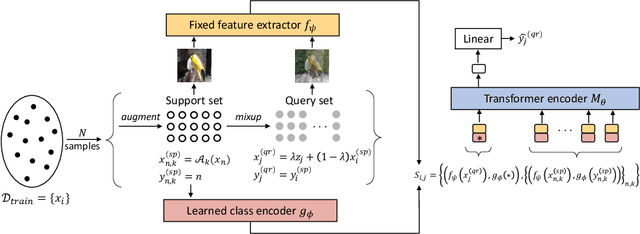
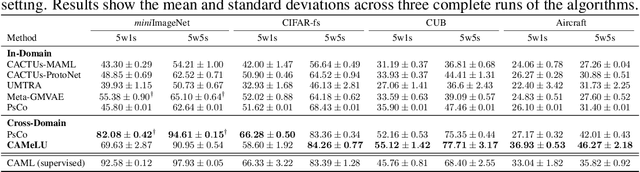

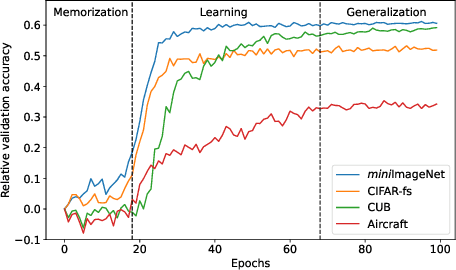
Unsupervised meta-learning aims to learn feature representations from unsupervised datasets that can transfer to downstream tasks with limited labeled data. In this paper, we propose a novel approach to unsupervised meta-learning that leverages the generalization abilities of in-context learning observed in transformer architectures. Our method reframes meta-learning as a sequence modeling problem, enabling the transformer encoder to learn task context from support images and utilize it to predict query images. At the core of our approach lies the creation of diverse tasks generated using a combination of data augmentations and a mixing strategy that challenges the model during training while fostering generalization to unseen tasks at test time. Experimental results on benchmark datasets, including miniImageNet, CIFAR-fs, CUB, and Aircraft, showcase the superiority of our approach over existing unsupervised meta-learning baselines, establishing it as the new state-of-the-art in the field. Remarkably, our method achieves competitive results with supervised and self-supervised approaches, underscoring the efficacy of the model in leveraging generalization over memorization.
Introducing v0.5 of the AI Safety Benchmark from MLCommons
Apr 18, 2024


This paper introduces v0.5 of the AI Safety Benchmark, which has been created by the MLCommons AI Safety Working Group. The AI Safety Benchmark has been designed to assess the safety risks of AI systems that use chat-tuned language models. We introduce a principled approach to specifying and constructing the benchmark, which for v0.5 covers only a single use case (an adult chatting to a general-purpose assistant in English), and a limited set of personas (i.e., typical users, malicious users, and vulnerable users). We created a new taxonomy of 13 hazard categories, of which 7 have tests in the v0.5 benchmark. We plan to release version 1.0 of the AI Safety Benchmark by the end of 2024. The v1.0 benchmark will provide meaningful insights into the safety of AI systems. However, the v0.5 benchmark should not be used to assess the safety of AI systems. We have sought to fully document the limitations, flaws, and challenges of v0.5. This release of v0.5 of the AI Safety Benchmark includes (1) a principled approach to specifying and constructing the benchmark, which comprises use cases, types of systems under test (SUTs), language and context, personas, tests, and test items; (2) a taxonomy of 13 hazard categories with definitions and subcategories; (3) tests for seven of the hazard categories, each comprising a unique set of test items, i.e., prompts. There are 43,090 test items in total, which we created with templates; (4) a grading system for AI systems against the benchmark; (5) an openly available platform, and downloadable tool, called ModelBench that can be used to evaluate the safety of AI systems on the benchmark; (6) an example evaluation report which benchmarks the performance of over a dozen openly available chat-tuned language models; (7) a test specification for the benchmark.
Croissant: A Metadata Format for ML-Ready Datasets
Mar 28, 2024Data is a critical resource for Machine Learning (ML), yet working with data remains a key friction point. This paper introduces Croissant, a metadata format for datasets that simplifies how data is used by ML tools and frameworks. Croissant makes datasets more discoverable, portable and interoperable, thereby addressing significant challenges in ML data management and responsible AI. Croissant is already supported by several popular dataset repositories, spanning hundreds of thousands of datasets, ready to be loaded into the most popular ML frameworks.
Automatic Combination of Sample Selection Strategies for Few-Shot Learning
Feb 05, 2024In few-shot learning, such as meta-learning, few-shot fine-tuning or in-context learning, the limited number of samples used to train a model have a significant impact on the overall success. Although a large number of sample selection strategies exist, their impact on the performance of few-shot learning is not extensively known, as most of them have been so far evaluated in typical supervised settings only. In this paper, we thoroughly investigate the impact of 20 sample selection strategies on the performance of 5 few-shot learning approaches over 8 image and 6 text datasets. In addition, we propose a new method for automatic combination of sample selection strategies (ACSESS) that leverages the strengths and complementary information of the individual strategies. The experimental results show that our method consistently outperforms the individual selection strategies, as well as the recently proposed method for selecting support examples for in-context learning. We also show a strong modality, dataset and approach dependence for the majority of strategies as well as their dependence on the number of shots - demonstrating that the sample selection strategies play a significant role for lower number of shots, but regresses to random selection at higher number of shots.
DMLR: Data-centric Machine Learning Research -- Past, Present and Future
Nov 21, 2023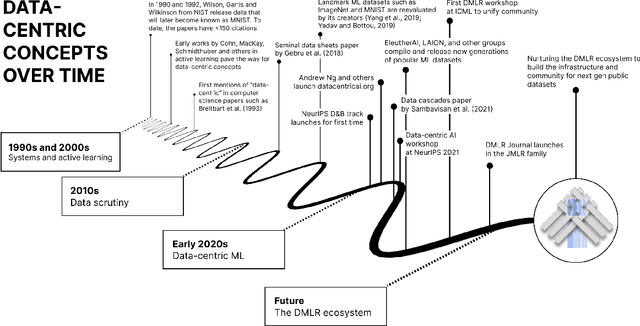
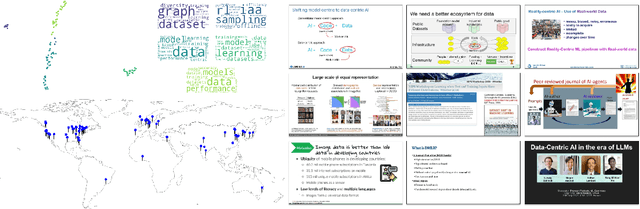

Drawing from discussions at the inaugural DMLR workshop at ICML 2023 and meetings prior, in this report we outline the relevance of community engagement and infrastructure development for the creation of next-generation public datasets that will advance machine learning science. We chart a path forward as a collective effort to sustain the creation and maintenance of these datasets and methods towards positive scientific, societal and business impact.
What Can AutoML Do For Continual Learning?
Nov 20, 2023This position paper outlines the potential of AutoML for incremental (continual) learning to encourage more research in this direction. Incremental learning involves incorporating new data from a stream of tasks and distributions to learn enhanced deep representations and adapt better to new tasks. However, a significant limitation of incremental learners is that most current techniques freeze the backbone architecture, hyperparameters, and the order & structure of the learning tasks throughout the learning and adaptation process. We strongly believe that AutoML offers promising solutions to address these limitations, enabling incremental learning to adapt to more diverse real-world tasks. Therefore, instead of directly proposing a new method, this paper takes a step back by posing the question: "What can AutoML do for incremental learning?" We outline three key areas of research that can contribute to making incremental learners more dynamic, highlighting concrete opportunities to apply AutoML methods in novel ways as well as entirely new challenges for AutoML research.