 Add to Chrome
 Add to Firefox
 Add to Edge
The Course of News Events: A Comparison of Bottom-Up and Top-Down Approaches for Collecting Text-Based Data about Disasters
Jul 01, 2026
News articles are an important source of information on disaster impacts and adaptation. A key methodological challenge in socio-environmental studies is how to select a representative data sample. Two approaches are common: querying news databases top-down with the aid of an existing disaster inventory or using NLP methods to cluster news texts bottom-up based on temporal and spatial features. Using a dataset of German news about landslides worldwide, we compare these approaches and discuss variations in event coverage. Such research design decision can influence the resulting news sample, affecting its use in studies of inequality in media coverage, disaster monitoring and inventory enrichment.

Assessing socio-economic climate impacts from text data
May 20, 2026Recent advances in natural language processing (NLP) and large language models (LLMs) have enabled the systematic use of large-scale textual data from news, social media, and reports to create datasets with socio-economic impacts of climate hazards such as floods, droughts, storms, and multi-hazard events. As the field of text-as-data for impact assessment expands, so does its methodological complexity. Yet research remains fragmented, with no clear guidelines for defining what constitutes an impact, handling temporal and spatial biases, and selecting appropriate modeling and post-processing strategies. This lack of coherence limits transparency and comparability across studies. Here, we address this gap by synthesising common practices, describing key challenges specific to the use of text-as-data methods for analyzing socio-economic impact data, and proposing recommendations to address them. By providing guidance on best practices, we aim to support the construction of robust text-derived socio-economic impact datasets that can more accurately inform disaster risk management and attribution studies.
The Newsworthiness of Brazilian Distress: A Peak Analysis on Time Series of International Media Attention to Disasters in Brazil
May 06, 2026Media coverage influences disaster response, yet the drivers of international media attention to local events remain unevenly understood. Brazil offers a compelling case: some of its natural and technological disasters occasionally hit the international headlines. However, systematic analyses of what makes these events be discussed abroad are still missing. Addressing this gap requires representative, validated and country-specific news datasets. This paper presents a peak analysis of 2k news about Brazilian fires and landslides in German newspapers from 2000 to 2024. Using time series segmentation to detect news event peaks, we examine the extent to which they can be temporally aligned with observations in national and global disaster databases.
Geolocating News about Extreme Climate Events: A Comparative Analysis of Off-the-Shelf Tools for Toponym Identification in German
May 05, 2026Determining the geolocation of extreme climate events and disasters in texts is a common problem in climate impact and adaptation research. Named-entity recognition (NER) tools are typically used to identify a pool of toponyms that serve as candidate event locations. In this study, we conduct a comparative analysis of three off-the-shelf NER tools, namely Flair, Spacy and Stanza. We describe and quantify differences between their outputs for German news articles and evaluate them extrinsically based on three methods to determine the country where events took place. We show how their contrasts are propagated into downstream tasks and can yield distinct decisions about a document's geographical focus, which, in turn, can impact conclusions about countries' prominence in German media.
Retrieving Floods without Floodlights: Topic Models as Binary Classifiers for Extreme Climate Events in German News
May 05, 2026In studies of media coverage of extreme climate events, NLP methods have become indispensable for identifying relevant texts in large news databases. Still, enough annotated data to train accurate deep learning-based classifiers from scratch is often not available. Topic Models have the advantage of being both unsupervised and interpretable, but are typically used only for exploratory analysis or data characterisation. In this study, we investigate how to employ Topic Models as binary classifiers for refining the retrieval of relevant news about seven types of extreme climate events in the German media. Our method relies on the posterior distributions estimated by Topic Models to select relevant documents, without modifying their training procedure. Using an annotated sample to guide the evaluation, we show that the probabilities assigned to keywords used to query news databases can also be informative for selecting relevant topics and improve sample precision. We compare our results to a fine-tuned text embedding classifier and an open-weight LLM, discussing observed trade-offs, e.g. the LLM's lowest precision. Moreover, we show that results are hazard-dependent, which speaks against considering climate events as a single category in NLP tasks.
clembench-2024: A Challenging, Dynamic, Complementary, Multilingual Benchmark and Underlying Flexible Framework for LLMs as Multi-Action Agents
May 31, 2024

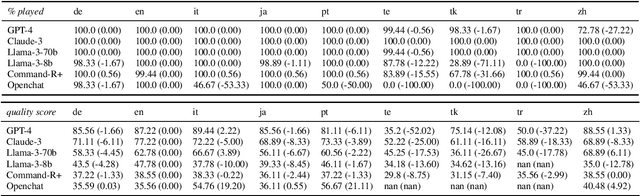

It has been established in recent work that Large Language Models (LLMs) can be prompted to "self-play" conversational games that probe certain capabilities (general instruction following, strategic goal orientation, language understanding abilities), where the resulting interactive game play can be automatically scored. In this paper, we take one of the proposed frameworks for setting up such game-play environments, and further test its usefulness as an evaluation instrument, along a number of dimensions: We show that it can easily keep up with new developments while avoiding data contamination, we show that the tests implemented within it are not yet saturated (human performance is substantially higher than that of even the best models), and we show that it lends itself to investigating additional questions, such as the impact of the prompting language on performance. We believe that the approach forms a good basis for making decisions on model choice for building applied interactive systems, and perhaps ultimately setting up a closed-loop development environment of system and simulated evaluator.
It Couldn't Help But Overhear: On the Limits of Modelling Meta-Communicative Grounding Acts with Supervised Learning
May 02, 2024

Active participation in a conversation is key to building common ground, since understanding is jointly tailored by producers and recipients. Overhearers are deprived of the privilege of performing grounding acts and can only conjecture about intended meanings. Still, data generation and annotation, modelling, training and evaluation of NLP dialogue models place reliance on the overhearing paradigm. How much of the underlying grounding processes are thereby forfeited? As we show, there is evidence pointing to the impossibility of properly modelling human meta-communicative acts with data-driven learning models. In this paper, we discuss this issue and provide a preliminary analysis on the variability of human decisions for requesting clarification. Most importantly, we wish to bring this topic back to the community's table, encouraging discussion on the consequences of having models designed to only "listen in".
When Only Time Will Tell: Interpreting How Transformers Process Local Ambiguities Through the Lens of Restart-Incrementality
Feb 20, 2024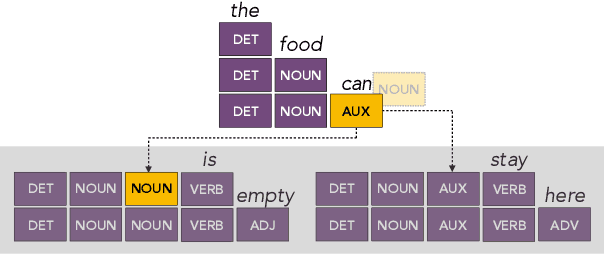
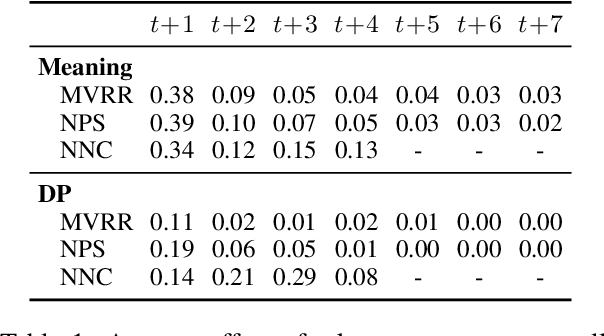
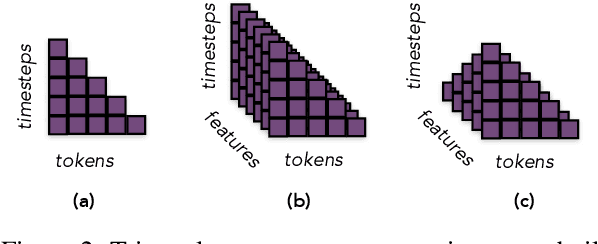
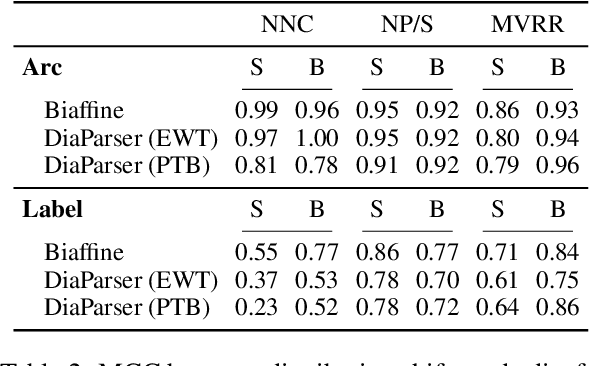
Incremental models that process sentences one token at a time will sometimes encounter points where more than one interpretation is possible. Causal models are forced to output one interpretation and continue, whereas models that can revise may edit their previous output as the ambiguity is resolved. In this work, we look at how restart-incremental Transformers build and update internal states, in an effort to shed light on what processes cause revisions not viable in autoregressive models. We propose an interpretable way to analyse the incremental states, showing that their sequential structure encodes information on the garden path effect and its resolution. Our method brings insights on various bidirectional encoders for contextualised meaning representation and dependency parsing, contributing to show their advantage over causal models when it comes to revisions.
Taking Action Towards Graceful Interaction: The Effects of Performing Actions on Modelling Policies for Instruction Clarification Requests
Jan 30, 2024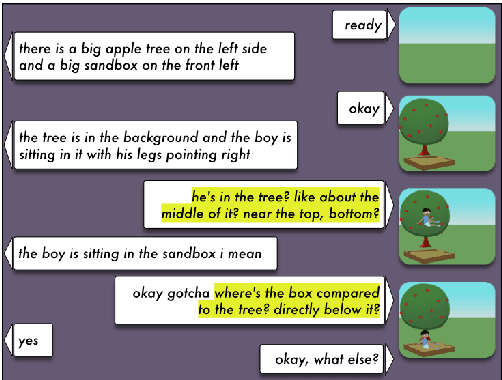
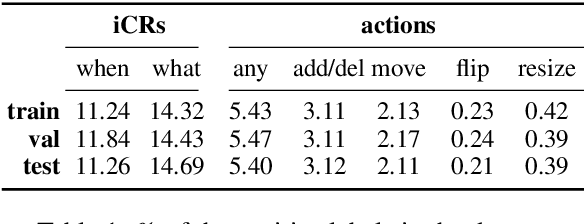
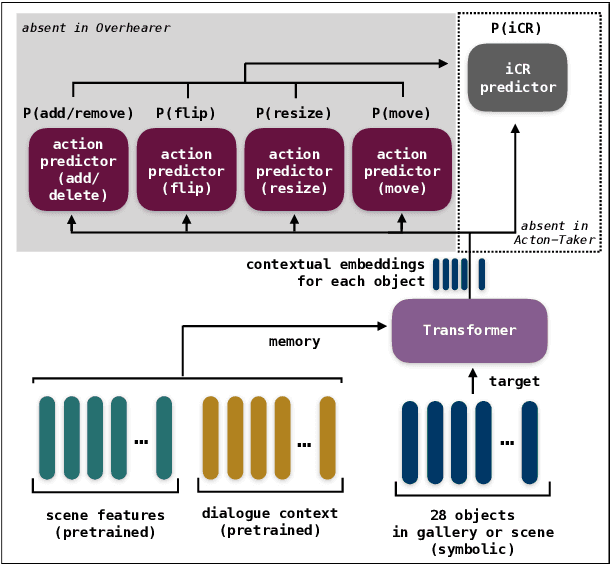
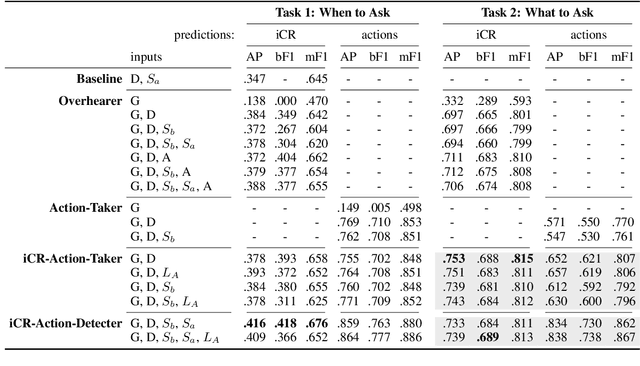
Clarification requests are a mechanism to help solve communication problems, e.g. due to ambiguity or underspecification, in instruction-following interactions. Despite their importance, even skilful models struggle with producing or interpreting such repair acts. In this work, we test three hypotheses concerning the effects of action taking as an auxiliary task in modelling iCR policies. Contrary to initial expectations, we conclude that its contribution to learning an iCR policy is limited, but some information can still be extracted from prediction uncertainty. We present further evidence that even well-motivated, Transformer-based models fail to learn good policies for when to ask Instruction CRs (iCRs), while the task of determining what to ask about can be more successfully modelled. Considering the implications of these findings, we further discuss the shortcomings of the data-driven paradigm for learning meta-communication acts.
Revising with a Backward Glance: Regressions and Skips during Reading as Cognitive Signals for Revision Policies in Incremental Processing
Oct 27, 2023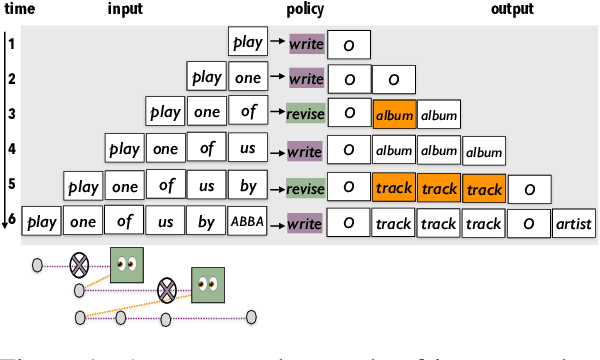
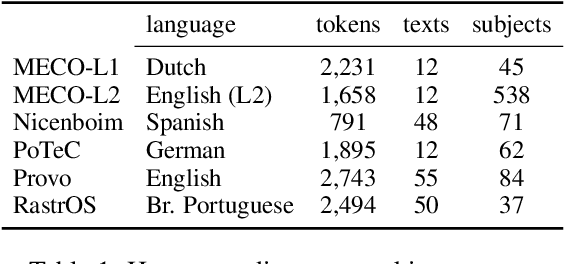
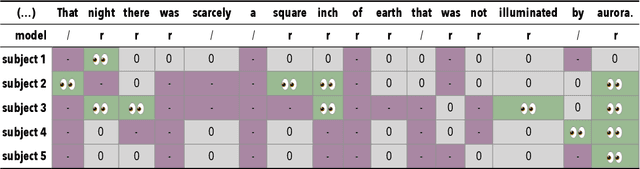
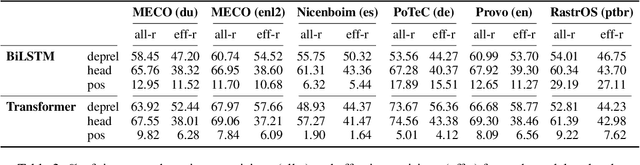
In NLP, incremental processors produce output in instalments, based on incoming prefixes of the linguistic input. Some tokens trigger revisions, causing edits to the output hypothesis, but little is known about why models revise when they revise. A policy that detects the time steps where revisions should happen can improve efficiency. Still, retrieving a suitable signal to train a revision policy is an open problem, since it is not naturally available in datasets. In this work, we investigate the appropriateness of regressions and skips in human reading eye-tracking data as signals to inform revision policies in incremental sequence labelling. Using generalised mixed-effects models, we find that the probability of regressions and skips by humans can potentially serve as useful predictors for revisions in BiLSTMs and Transformer models, with consistent results for various languages.