 Add to Chrome
 Add to Firefox
 Add to Edge
ARAPDiffusion: ARAP Regularization for Diffusion-Based Deformable Shape Space Learning
Jun 05, 2026
This paper introduces ARAPDiffusion, a latent diffusion model to learn the underlying continuous shape space of a deformation shape collection. The key innovation is in injecting the as-rigid-as-possible (ARAP) deformation model as regularization losses into latent diffusion (LD), releasing the requirement of having abundant 3D training data for learning generative models. In contrast to the standard LD, we show how the ARAP model can be used to improve both the encoder/decoder and the LD model. The training procedure alternates between using the synthetic distribution defined by the LD model to develop a regularization loss that enhances the shape encoder/decoder and using the shape decoder to develop a regularization loss to improve the LD model. We also show the benefit of the LD paradigm in combining a representation-free LD process and an implicit shape decoder that is applicable to unorganized point clouds. The experimental results of unconditional and conditional shape generation demonstrate the advantages of ARAPDiffusion over baseline approaches.

T2S-Bench & Structure-of-Thought: Benchmarking and Prompting Comprehensive Text-to-Structure Reasoning
Mar 04, 2026Think about how human handles complex reading tasks: marking key points, inferring their relationships, and structuring information to guide understanding and responses. Likewise, can a large language model benefit from text structure to enhance text-processing performance? To explore it, in this work, we first introduce Structure of Thought (SoT), a prompting technique that explicitly guides models to construct intermediate text structures, consistently boosting performance across eight tasks and three model families. Building upon this insight, we present T2S-Bench, the first benchmark designed to evaluate and improve text-to-structure capabilities of models. T2S-Bench includes 1.8K samples across 6 scientific domains and 32 structural types, rigorously constructed to ensure accuracy, fairness, and quality. Evaluation on 45 mainstream models reveals substantial improvement potential: the average accuracy on the multi-hop reasoning task is only 52.1%, and even the most advanced model achieves 58.1% node accuracy in end-to-end extraction. Furthermore, on Qwen2.5-7B-Instruct, SoT alone yields an average +5.7% improvement across eight diverse text-processing tasks, and fine-tuning on T2S-Bench further increases this gain to +8.6%. These results highlight the value of explicit text structuring and the complementary contributions of SoT and T2S-Bench. Dataset and eval code have been released at https://t2s-bench.github.io/T2S-Bench-Page/.
Dobi-SVD: Differentiable SVD for LLM Compression and Some New Perspectives
Feb 04, 2025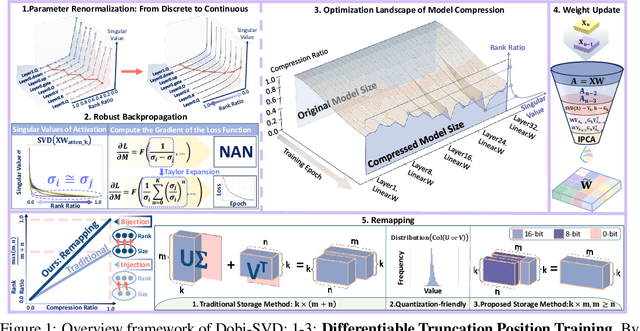
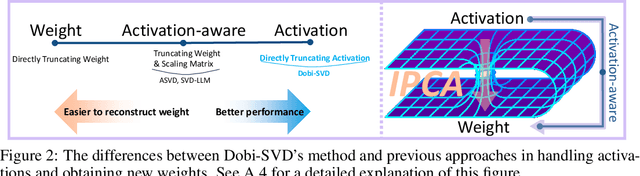
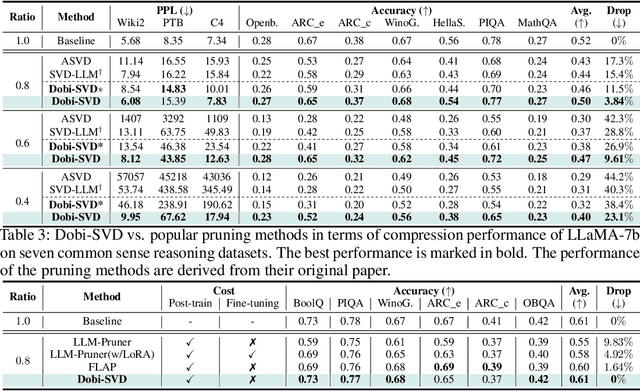

We provide a new LLM-compression solution via SVD, unlocking new possibilities for LLM compression beyond quantization and pruning. We point out that the optimal use of SVD lies in truncating activations, rather than merely using activations as an optimization distance. Building on this principle, we address three critical challenges in SVD-based LLM compression: including (1) How can we determine the optimal activation truncation position for each weight matrix in LLMs? (2) How can we efficiently reconstruct the weight matrices based on truncated activations? (3) How can we address the inherent "injection" nature that results in the information loss of the SVD? We propose Dobi-SVD, which establishes a new, principled approach to SVD-based LLM compression.
Key-Grid: Unsupervised 3D Keypoints Detection using Grid Heatmap Features
Oct 03, 2024
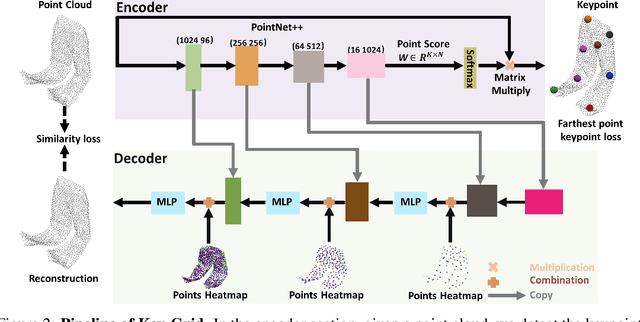
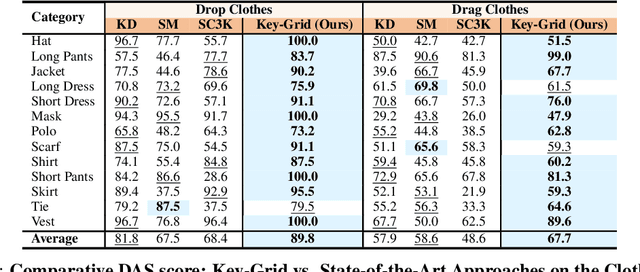
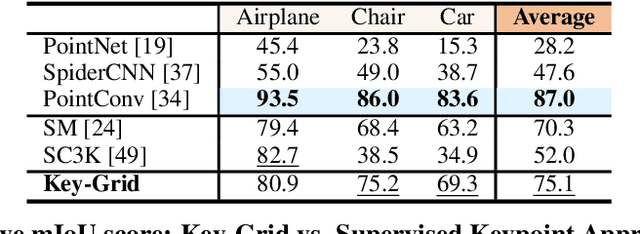
Detecting 3D keypoints with semantic consistency is widely used in many scenarios such as pose estimation, shape registration and robotics. Currently, most unsupervised 3D keypoint detection methods focus on the rigid-body objects. However, when faced with deformable objects, the keypoints they identify do not preserve semantic consistency well. In this paper, we introduce an innovative unsupervised keypoint detector Key-Grid for both the rigid-body and deformable objects, which is an autoencoder framework. The encoder predicts keypoints and the decoder utilizes the generated keypoints to reconstruct the objects. Unlike previous work, we leverage the identified keypoint in formation to form a 3D grid feature heatmap called grid heatmap, which is used in the decoder section. Grid heatmap is a novel concept that represents the latent variables for grid points sampled uniformly in the 3D cubic space, where these variables are the shortest distance between the grid points and the skeleton connected by keypoint pairs. Meanwhile, we incorporate the information from each layer of the encoder into the decoder section. We conduct an extensive evaluation of Key-Grid on a list of benchmark datasets. Key-Grid achieves the state-of-the-art performance on the semantic consistency and position accuracy of keypoints. Moreover, we demonstrate the robustness of Key-Grid to noise and downsampling. In addition, we achieve SE-(3) invariance of keypoints though generalizing Key-Grid to a SE(3)-invariant backbone.