 Add to Chrome
 Add to Firefox
 Add to Edge
Stabilizing Reinforcement Learning for Honesty Alignment in Language Models on Deductive Reasoning
Nov 12, 2025
Reinforcement learning with verifiable rewards (RLVR) has recently emerged as a promising framework for aligning language models with complex reasoning objectives. However, most existing methods optimize only for final task outcomes, leaving models vulnerable to collapse when negative rewards dominate early training. This challenge is especially pronounced in honesty alignment, where models must not only solve answerable queries but also identify when conclusions cannot be drawn from the given premises. Deductive reasoning provides an ideal testbed because it isolates reasoning capability from reliance on external factual knowledge. To investigate honesty alignment, we curate two multi-step deductive reasoning datasets from graph structures, one for linear algebra and one for logical inference, and introduce unanswerable cases by randomly perturbing an edge in half of the instances. We find that GRPO, with or without supervised fine tuning initialization, struggles on these tasks. Through extensive experiments across three models, we evaluate stabilization strategies and show that curriculum learning provides some benefit but requires carefully designed in distribution datasets with controllable difficulty. To address these limitations, we propose Anchor, a reinforcement learning method that injects ground truth trajectories into rollouts, preventing early training collapse. Our results demonstrate that this method stabilizes learning and significantly improves the overall reasoning performance, underscoring the importance of training dynamics for enabling reliable deductive reasoning in aligned language models.

PersonaAgent: When Large Language Model Agents Meet Personalization at Test Time
Jun 06, 2025Large Language Model (LLM) empowered agents have recently emerged as advanced paradigms that exhibit impressive capabilities in a wide range of domains and tasks. Despite their potential, current LLM agents often adopt a one-size-fits-all approach, lacking the flexibility to respond to users' varying needs and preferences. This limitation motivates us to develop PersonaAgent, the first personalized LLM agent framework designed to address versatile personalization tasks. Specifically, PersonaAgent integrates two complementary components - a personalized memory module that includes episodic and semantic memory mechanisms; a personalized action module that enables the agent to perform tool actions tailored to the user. At the core, the persona (defined as unique system prompt for each user) functions as an intermediary: it leverages insights from personalized memory to control agent actions, while the outcomes of these actions in turn refine the memory. Based on the framework, we propose a test-time user-preference alignment strategy that simulate the latest n interactions to optimize the persona prompt, ensuring real-time user preference alignment through textual loss feedback between simulated and ground-truth responses. Experimental evaluations demonstrate that PersonaAgent significantly outperforms other baseline methods by not only personalizing the action space effectively but also scaling during test-time real-world applications. These results underscore the feasibility and potential of our approach in delivering tailored, dynamic user experiences.
Estimating Depth of Monocular Panoramic Image with Teacher-Student Model Fusing Equirectangular and Spherical Representations
May 27, 2024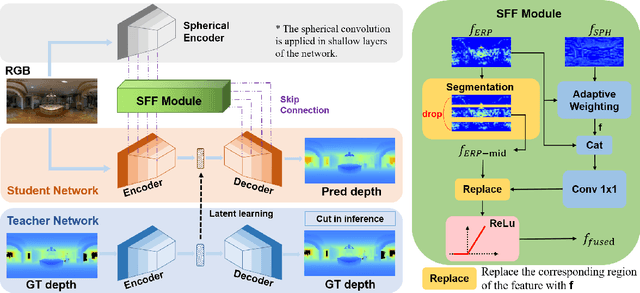
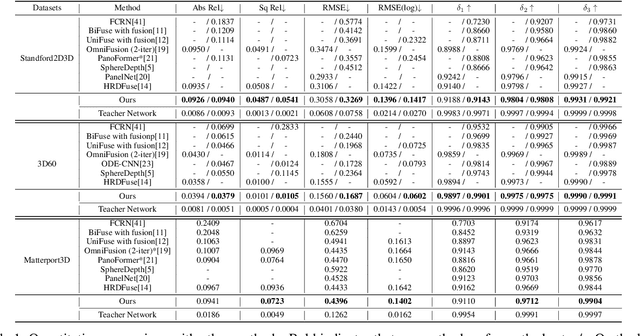
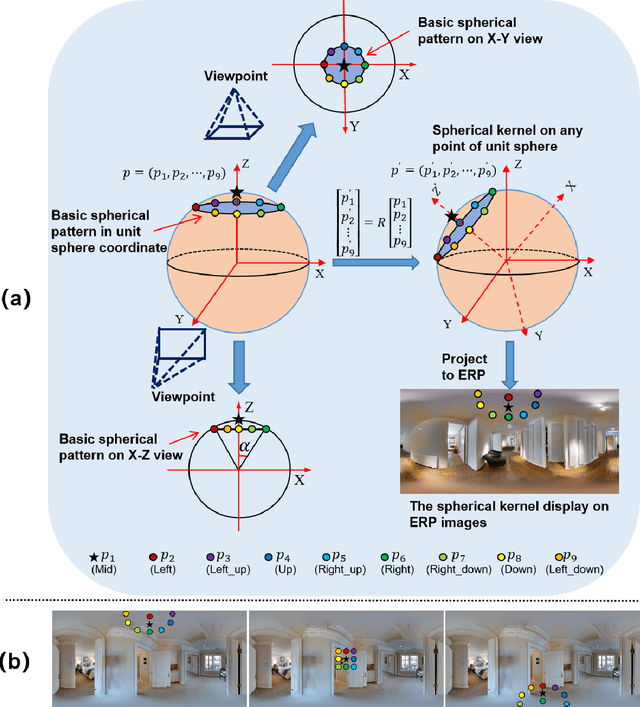
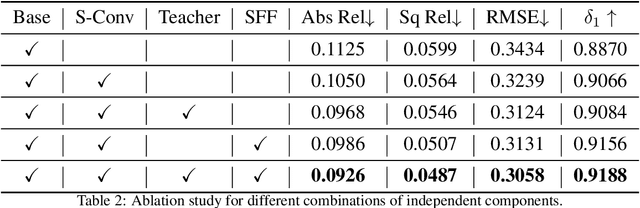
Disconnectivity and distortion are the two problems which must be coped with when processing 360 degrees equirectangular images. In this paper, we propose a method of estimating the depth of monocular panoramic image with a teacher-student model fusing equirectangular and spherical representations. In contrast with the existing methods fusing an equirectangular representation with a cube map representation or tangent representation, a spherical representation is a better choice because a sampling on a sphere is more uniform and can also cope with distortion more effectively. In this processing, a novel spherical convolution kernel computing with sampling points on a sphere is developed to extract features from the spherical representation, and then, a Segmentation Feature Fusion(SFF) methodology is utilized to combine the features with ones extracted from the equirectangular representation. In contrast with the existing methods using a teacher-student model to obtain a lighter model of depth estimation, we use a teacher-student model to learn the latent features of depth images. This results in a trained model which estimates the depth map of an equirectangular image using not only the feature maps extracted from an input equirectangular image but also the distilled knowledge learnt from the ground truth of depth map of a training set. In experiments, the proposed method is tested on several well-known 360 monocular depth estimation benchmark datasets, and outperforms the existing methods for the most evaluation indexes.