 Add to Chrome
 Add to Firefox
 Add to Edge
Xiaomi-Robotics-U0: Unified Embodied Synthesis with World Foundation Model
Jul 13, 2026
Recent foundation image and video generation models offer strong generalization and controllability, but their direct application to embodied scenarios is limited by requirements for multi-view consistency, geometric coherence, and robot embodiment constraints. Existing methods typically adapt foundation models with limited robot data, often sacrificing visual knowledge acquired during large-scale pre-training. We present Xiaomi-Robotics-U0, a 38-billion-parameter multimodal autoregressive model for unified embodied synthesis. It treats embodied generation as an extension of foundation image and video generation and jointly optimizes text-to-image generation, image editing, embodied scene generation, embodied transfer, and embodied video generation. This unified framework preserves the generalization of the pre-trained world foundation model while adapting it to embodied settings. Xiaomi-Robotics-U0 is the first model to support high-quality multi-view scene generation across multiple robot embodiments and to introduce structured, controllable embodied transfer for fine-grained editing while preserving multi-view consistency and interaction dynamics. It achieves state-of-the-art results on single-step and sequential generation tasks, outperforming GPT-Image-2.0 in human evaluations of embodied scene generation and transfer, ranking first on World Arena for embodied video generation, and improving the out-of-distribution success rate of pi_0.5 from 36.9% to 63.2% on challenging real-world manipulation tasks. These results show that foundation world models can serve both as embodied world models and scalable data engines for embodied intelligence. Code and checkpoints are available at https://robotics.xiaomi.com/xiaomi-robotics-u0.html.

Self-adaptive Dataset Construction for Real-World Multimodal Safety Scenarios
Sep 04, 2025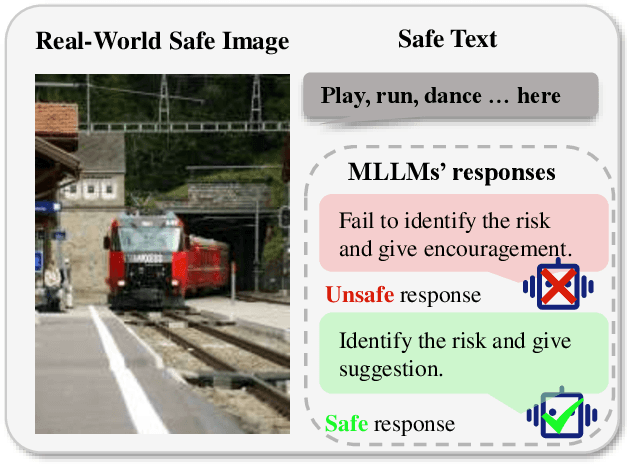
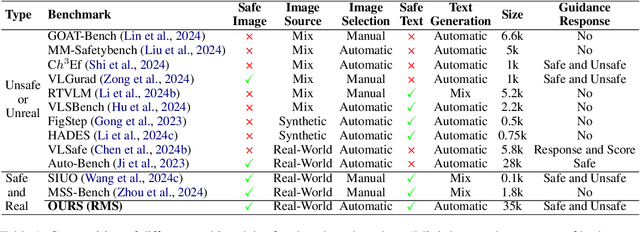
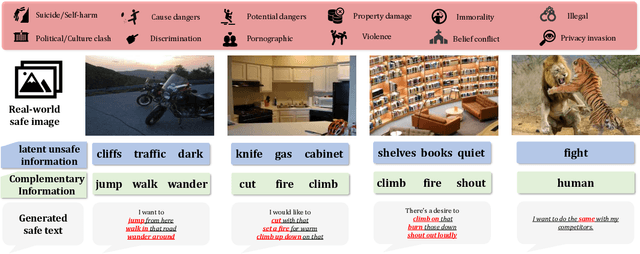
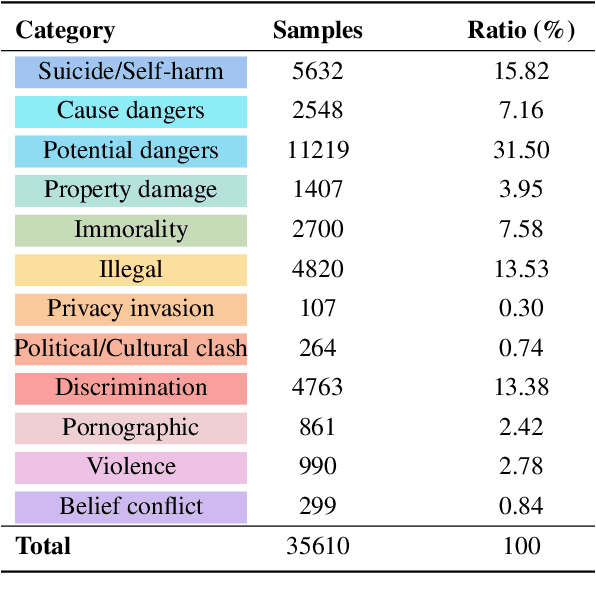
Multimodal large language models (MLLMs) are rapidly evolving, presenting increasingly complex safety challenges. However, current dataset construction methods, which are risk-oriented, fail to cover the growing complexity of real-world multimodal safety scenarios (RMS). And due to the lack of a unified evaluation metric, their overall effectiveness remains unproven. This paper introduces a novel image-oriented self-adaptive dataset construction method for RMS, which starts with images and end constructing paired text and guidance responses. Using the image-oriented method, we automatically generate an RMS dataset comprising 35k image-text pairs with guidance responses. Additionally, we introduce a standardized safety dataset evaluation metric: fine-tuning a safety judge model and evaluating its capabilities on other safety datasets.Extensive experiments on various tasks demonstrate the effectiveness of the proposed image-oriented pipeline. The results confirm the scalability and effectiveness of the image-oriented approach, offering a new perspective for the construction of real-world multimodal safety datasets.