 Add to Chrome
 Add to Firefox
 Add to Edge
S$^3$AM: A Single-Stream SAM with Reliability-Calibrated Frequency Adapter for Multi-modal Salient Object Detection
Aug 18, 2026
Vision foundation models have recently advanced multi-modal salient object detection (MSOD) through parameter-efficient tuning and prompt learning. However, existing Segment Anything Model (SAM)-adapted MSOD methods often rely on dual-stream encoders or auxiliary prompt generators, leading to redundant computation. Although a single-stream alternative can reduce this cost, early fusion may also propagate noisy or misaligned auxiliary high-frequency cues through the backbone. In this paper, we propose a novel single-stream framework that integrates reliability-calibrated frequency adaptation into the adopted SAM backbone for MSOD. It avoids duplicated foundation backbones while explicitly controlling auxiliary frequency injection. Specifically, we design a mixture of frequency experts module, which uses the stationary wavelet transform to decompose each modality and aggregate cross-modal frequency information. We further introduce a reliability-calibrated frequency adapter with a dual-gate calibration mechanism, which selectively propagates the calibrated residual across transformer stages while jointly controlling its injection strength and cross-modal reliability. A hypernetwork-guided semantic-structural decoder then combines semantic mask features from the adopted backbone with Mamba-based structural detail recovery. Comprehensive experiments on RGB-D, RGB-T, and RGB-NIR salient object detection benchmarks validate that the proposed framework achieves competitive performance with only 12.20M trainable parameters, accounting for 5.4\% of the total parameters. The code will be available at https://github.com/xuboyue1999/SSSAM.

DSFNet: Learning Dual-Domain Spectral Operators for Multi-Modality Spatio-Temporal Forecasting in Urban Transportation Systems
Jun 05, 2026Multi-Modality Spatio-Temporal Forecasting (MoSTF) extends traditional spatio-temporal forecasting by incorporating diverse traffic modalities. Despite significant recent strides in spatio-temporal modeling, existing approaches often fail to explicitly model the coupling relationships between different modality variables. Accurate MoSTF is challenging, as it requires modeling (1) temporal dynamic heterogeneity under exogenous influences and (2) heterogeneous spatial dependencies alongside complex cross-variable couplings. To address these challenges, we propose the Dual-Domain Spectral Filtering Network (DSFNet). Our framework employs dual-domain spectral filtering to capture heterogeneous spatial patterns and explicitly model the relationships between variables. Unlike graph-based message passing or dense attention over node-modality pairs, DSFNet factorizes space-modality interactions into feature-domain and spatial-domain spectral operators, enabling scalable modeling of nonlocal dependencies and cross-modality couplings. Furthermore, we introduce an external gating mechanism to adaptively regulate temporal dynamics under external influences. We validate our method through extensive experiments on five representative real-world traffic datasets. Compared with the second-best baselines, DSFNet reduces MAE by 3.21%-10.16% across these datasets. The results demonstrate that DSFNet significantly outperforms existing state-of-the-art baselines in accuracy while exhibiting efficiency and robustness.
Alternating Gradient Flow Utility: A Unified Metric for Structural Pruning and Dynamic Routing in Deep Networks
Mar 17, 2026Efficient deep learning traditionally relies on static heuristics like weight magnitude or activation awareness (e.g., Wanda, RIA). While successful in unstructured settings, we observe a critical limitation when applying these metrics to the structural pruning of deep vision networks. These contemporary metrics suffer from a magnitude bias, failing to preserve critical functional pathways. To overcome this, we propose a decoupled kinetic paradigm inspired by Alternating Gradient Flow (AGF), utilizing an absolute feature-space Taylor expansion to accurately capture the network's structural "kinetic utility". First, we uncover a topological phase transition at extreme sparsity, where AGF successfully preserves baseline functionality and exhibits topological implicit regularization, avoiding the collapse seen in models trained from scratch. Second, transitioning to architectures without strict structural priors, we reveal a phenomenon of Sparsity Bottleneck in Vision Transformers (ViTs). Through a gradient-magnitude decoupling analysis, we discover that dynamic signals suffer from signal compression in converged models, rendering them suboptimal for real-time routing. Finally, driven by these empirical constraints, we design a hybrid routing framework that decouples AGF-guided offline structural search from online execution via zero-cost physical priors. We validate our paradigm on large-scale benchmarks: under a 75% compression stress test on ImageNet-1K, AGF effectively avoids the structural collapse where traditional metrics aggressively fall below random sampling. Furthermore, when systematically deployed for dynamic inference on ImageNet-100, our hybrid approach achieves Pareto-optimal efficiency. It reduces the usage of the heavy expert by approximately 50% (achieving an estimated overall cost of 0.92$\times$) without sacrificing the full-model accuracy.
Resource-constrained Amazons chess decision framework integrating large language models and graph attention
Mar 11, 2026Artificial intelligence has advanced significantly through the development of intelligent game-playing systems, providing rigorous testbeds for decision-making, strategic planning, and adaptive learning. However, resource-constrained environments pose critical challenges, as conventional deep learning methods heavily rely on extensive datasets and computational resources. In this paper, we propose a lightweight hybrid framework for the Game of the Amazons, which explores the paradigm of weak-to-strong generalization by integrating the structural reasoning of graph-based learning with the generative capabilities of large language models. Specifically, we leverage a Graph Attention Autoencoder to inform a multi-step Monte Carlo Tree Search, utilize a Stochastic Graph Genetic Algorithm to optimize evaluation signals, and harness GPT-4o-mini to generate synthetic training data. Unlike traditional approaches that rely on expert demonstrations, our framework learns from noisy and imperfect supervision. We demonstrate that the Graph Attention mechanism effectively functions as a structural filter, denoising the LLM's outputs. Experiments on a 10$\times$10 Amazons board show that our hybrid approach not only achieves a 15\%--56\% improvement in decision accuracy over baselines but also significantly outperforms its teacher model (GPT-4o-mini), achieving a competitive win rate of 45.0\% at N=30 nodes and a decisive 66.5\% at only N=50 nodes. These results verify the feasibility of evolving specialized, high-performance game AI from general-purpose foundation models under stringent computational constraints.
Local adapt-then-combine algorithms for distributed nonsmooth optimization: Achieving provable communication acceleration
Feb 18, 2026This paper is concerned with the distributed composite optimization problem over networks, where agents aim to minimize a sum of local smooth components and a common nonsmooth term. Leveraging the probabilistic local updates mechanism, we propose a communication-efficient Adapt-Then-Combine (ATC) framework, FlexATC, unifying numerous ATC-based distributed algorithms. Under stepsizes independent of the network topology and the number of local updates, we establish sublinear and linear convergence rates for FlexATC in convex and strongly convex settings, respectively. Remarkably, in the strong convex setting, the linear rate is decoupled from the objective functions and network topology, and FlexATC permits communication to be skipped in most iterations without any deterioration of the linear rate. In addition, the proposed unified theory demonstrates for the first time that local updates provably lead to communication acceleration for ATC-based distributed algorithms. Numerical experiments further validate the efficacy of the proposed framework and corroborate the theoretical results.
User Hesitation and Negative Transfer in Multi-Behavior Recommendation
Nov 08, 2025Multi-behavior recommendation aims to integrate users' interactions across various behavior types (e.g., view, favorite, add-to-cart, purchase) to more comprehensively characterize user preferences. However, existing methods lack in-depth modeling when dealing with interactions that generate only auxiliary behaviors without triggering the target behavior. In fact, these weak signals contain rich latent information and can be categorized into two types: (1) positive weak signals-items that have not triggered the target behavior but exhibit frequent auxiliary interactions, reflecting users' hesitation tendencies toward these items; and (2) negative weak signals-auxiliary behaviors that result from misoperations or interaction noise, which deviate from true preferences and may cause negative transfer effects. To more effectively identify and utilize these weak signals, we propose a recommendation framework focused on weak signal learning, termed HNT. Specifically, HNT models weak signal features from two dimensions: positive and negative effects. By learning the characteristics of auxiliary behaviors that lead to target behaviors, HNT identifies similar auxiliary behaviors that did not trigger the target behavior and constructs a hesitation set of related items as weak positive samples to enhance preference modeling, thereby capturing users' latent hesitation intentions. Meanwhile, during auxiliary feature fusion, HNT incorporates latent negative transfer effect modeling to distinguish and suppress interference caused by negative representations through item similarity learning. Experiments on three real-world datasets demonstrate that HNT improves HR@10 and NDCG@10 by 12.57% and 14.37%, respectively, compared to the best baseline methods.
Decentralized Nonconvex Composite Federated Learning with Gradient Tracking and Momentum
Apr 17, 2025Decentralized Federated Learning (DFL) eliminates the reliance on the server-client architecture inherent in traditional federated learning, attracting significant research interest in recent years. Simultaneously, the objective functions in machine learning tasks are often nonconvex and frequently incorporate additional, potentially nonsmooth regularization terms to satisfy practical requirements, thereby forming nonconvex composite optimization problems. Employing DFL methods to solve such general optimization problems leads to the formulation of Decentralized Nonconvex Composite Federated Learning (DNCFL), a topic that remains largely underexplored. In this paper, we propose a novel DNCFL algorithm, termed \bf{DEPOSITUM}. Built upon proximal stochastic gradient tracking, DEPOSITUM mitigates the impact of data heterogeneity by enabling clients to approximate the global gradient. The introduction of momentums in the proximal gradient descent step, replacing tracking variables, reduces the variance introduced by stochastic gradients. Additionally, DEPOSITUM supports local updates of client variables, significantly reducing communication costs. Theoretical analysis demonstrates that DEPOSITUM achieves an expected $\epsilon$-stationary point with an iteration complexity of $\mathcal{O}(1/\epsilon^2)$. The proximal gradient, consensus errors, and gradient estimation errors decrease at a sublinear rate of $\mathcal{O}(1/T)$. With appropriate parameter selection, the algorithm achieves network-independent linear speedup without requiring mega-batch sampling. Finally, we apply DEPOSITUM to the training of neural networks on real-world datasets, systematically examining the influence of various hyperparameters on its performance. Comparisons with other federated composite optimization algorithms validate the effectiveness of the proposed method.
X Modality Assisting RGBT Object Tracking
Dec 27, 2023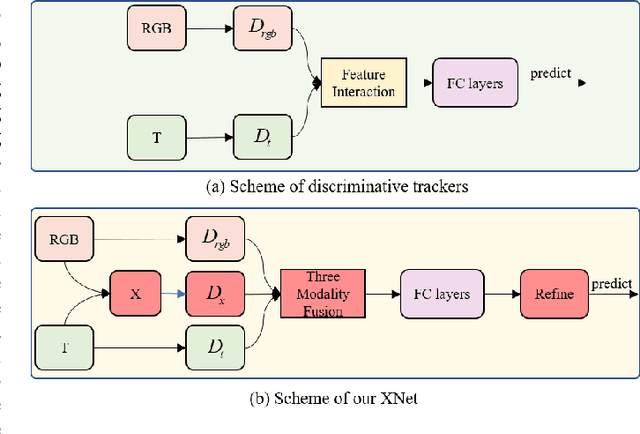
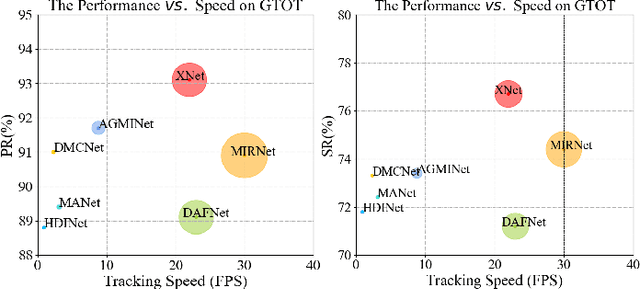
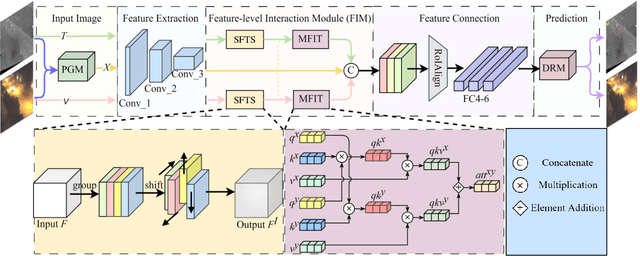
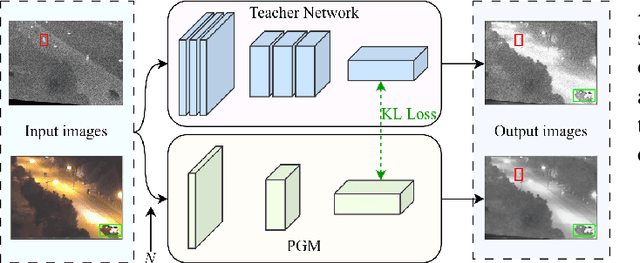
Learning robust multi-modal feature representations is critical for boosting tracking performance. To this end, we propose a novel X Modality Assisting Network (X-Net) to shed light on the impact of the fusion paradigm by decoupling the visual object tracking into three distinct levels, facilitating subsequent processing. Firstly, to tackle the feature learning hurdles stemming from significant differences between RGB and thermal modalities, a plug-and-play pixel-level generation module (PGM) is proposed based on self-knowledge distillation learning, which effectively generates X modality to bridge the gap between the dual patterns while reducing noise interference. Subsequently, to further achieve the optimal sample feature representation and facilitate cross-modal interactions, we propose a feature-level interaction module (FIM) that incorporates a mixed feature interaction transformer and a spatial-dimensional feature translation strategy. Ultimately, aiming at random drifting due to missing instance features, we propose a flexible online optimized strategy called the decision-level refinement module (DRM), which contains optical flow and refinement mechanisms. Experiments are conducted on three benchmarks to verify that the proposed X-Net outperforms state-of-the-art trackers.
MG-Skip: Random Multi-Gossip Skipping Method for Nonsmooth Distributed Optimization
Dec 19, 2023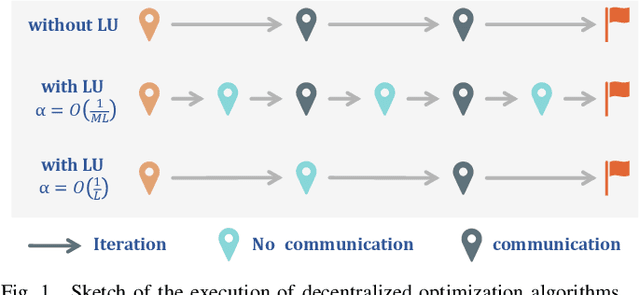
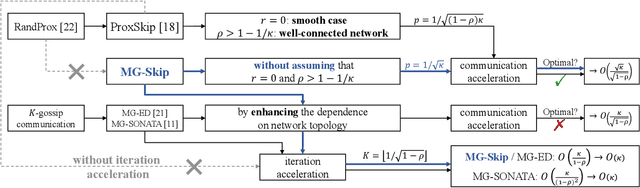
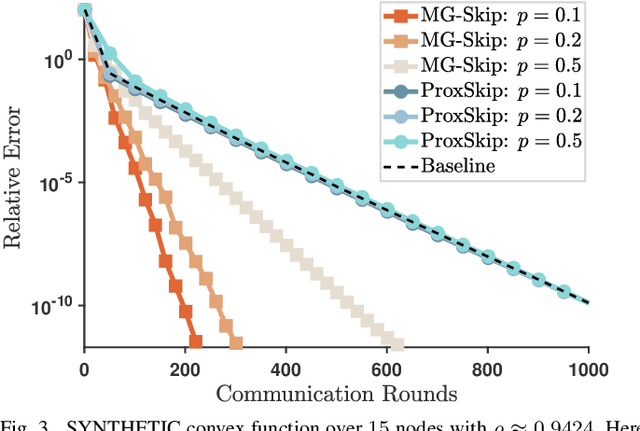
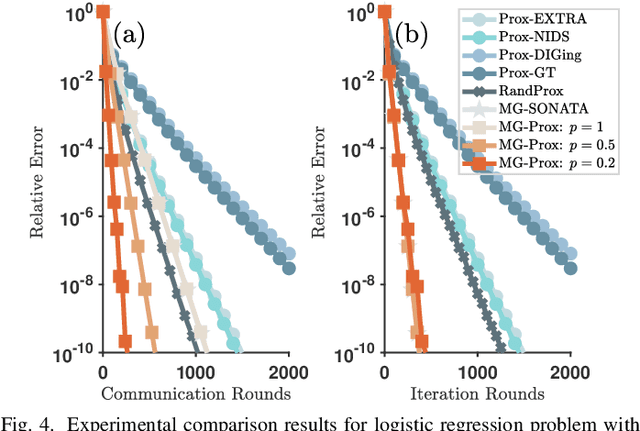
Distributed optimization methods with probabilistic local updates have recently gained attention for their provable ability to communication acceleration. Nevertheless, this capability is effective only when the loss function is smooth and the network is sufficiently well-connected. In this paper, we propose the first linear convergent method MG-Skip with probabilistic local updates for nonsmooth distributed optimization. Without any extra condition for the network connectivity, MG-Skip allows for the multiple-round gossip communication to be skipped in most iterations, while its iteration complexity is $\mathcal{O}\left(\kappa \log \frac{1}{\epsilon}\right)$ and communication complexity is only $\mathcal{O}\left(\sqrt{\frac{\kappa}{(1-\rho)}} \log \frac{1}{\epsilon}\right)$, where $\kappa$ is the condition number of the loss function and $\rho$ reflects the connectivity of the network topology. To the best of our knowledge, MG-Skip achieves the best communication complexity when the loss function has the smooth (strongly convex)+nonsmooth (convex) composite form.
RandCom: Random Communication Skipping Method for Decentralized Stochastic Optimization
Oct 12, 2023Distributed optimization methods with random communication skips are gaining increasing attention due to their proven benefits in accelerating communication complexity. Nevertheless, existing research mainly focuses on centralized communication protocols for strongly convex deterministic settings. In this work, we provide a decentralized optimization method called RandCom, which incorporates probabilistic local updates. We analyze the performance of RandCom in stochastic non-convex, convex, and strongly convex settings and demonstrate its ability to asymptotically reduce communication overhead by the probability of communication. Additionally, we prove that RandCom achieves linear speedup as the number of nodes increases. In stochastic strongly convex settings, we further prove that RandCom can achieve linear speedup with network-independent stepsizes. Moreover, we apply RandCom to federated learning and provide positive results concerning the potential for achieving linear speedup and the suitability of the probabilistic local update approach for non-convex settings.