 Add to Chrome
 Add to Firefox
 Add to Edge
PartMat: Material-Aware 3D Part Decomposition with a Single Global Latent
Aug 03, 2026
Part-level 3D generation has recently attracted increasing attention for producing structured and editable 3D assets. However, existing methods typically decompose objects according to functional semantics rather than the editable material boundaries (e.g., fabric, wood, metal) required in practical 3D applications such as interior design. Additionally, current methods often generate parts independently, causing computational costs to scale linearly with the part count. To address these limitations, we present PartMat, an efficient material-aware 3D part decomposition pipeline that represents multi-part geometry with a single global latent. Given a reference image and a single whole-object geometry, PartMat decomposes the object into parts that follow material boundaries. First, we propose PartVAE to learn such a unified representation and decode all material parts in a single forward pass, thereby decoupling inference cost from the number of parts. Second, with this representation, a diffusion model is trained for part generation and refined via reinforcement learning for accurate material assignment and overlap suppression. Finally, to recover fine-grained geometric details, we introduce a sparse-voxel flow-matching model with part attention for geometry post-processing. Extensive experiments demonstrate that PartMat significantly outperforms existing baselines in material-aware decomposition accuracy and achieves comparable geometric quality, while maintaining efficient inference.

Home3D 1.0: A High-Fidelity Image-to-3D Asset Generation System for Interior Design
Jun 29, 2026We present Home3D 1.0, a modular image-to-3D generation system that produces high-quality 3D assets from a single reference image, targeting interior design and e-commerce applications. Given a photograph of a furniture or decor item, the system outputs a mesh with physically-based rendering (PBR) materials, and the mesh can be decomposed into material-specific components. The pipeline is organized into four tightly coupled modules: Geometry reconstructs a watertight mesh through latent SDF modelling with a geometry VAE and a coarse-to-fine flow-matching DiT; Texture predicts multiview albedo observations, reprojects them onto the mesh, and completes unseen surface regions with a 3D texture field; Material uses MatWeaver to obtain component masks through video-based segmentation and UV-space voting, then retrieves and bakes PBR maps from a curated material library through hierarchical multi-modal matching; and Parts generates material-editable semantic part meshes with a PartVAE and PartDiT, decoding multi-head part-specific SDF fields in one pass. Each module is evaluated independently with dedicated metrics, highlighting both the current system capability and the remaining gaps toward broader deployment.
HomeDiffusion: Zero-Shot Object Customization with Multi-View Representation Learning for Indoor Scenes
Jun 29, 2026Recently, zero-shot object customization generation methods have rapidly developed and shown tremendous potential for applications. For instance, in the e-commerce domain, consumers can observe the visual effect of furniture placed within their personal living spaces or clothes worn on their own bodies. Many existing approaches perform object customization generation based on diffusion models and extracted reference object features. However, the generated object significantly diverges from the original reference object in details such as patterns and curves. Particularly for asymmetrical reference objects, the absence of comprehensive multi-viewpoint information prevents the generation of object poses that harmonize with the background scene. To address these shortcomings, we have constructed a novel dataset comprising multi-angle images of furniture and indoor scenes. Based on diffusion models, we introduce HomeDiffusion, which can leverage multi-viewpoint images of the same reference object to accurately generate visually harmonious object poses within specified areas of the background scene. During the diffusion process, we further extract high-fidelity details of the reference object and perform cross-attention with the noise latents in the latent space, thereby ensuring the preservation of details in the customized object generation. Extensive qualitative and quantitative experiments demonstrate that our method achieves superior performance over other existing zero-shot as well as few-shot object customization approaches.
Semi-Supervised Noise Adaptation: Transferring Knowledge from Noise Domain
May 30, 2026Transfer learning aims to facilitate the learning of a target domain by transferring knowledge from a source domain. The source domain typically contains semantically meaningful samples (*e.g.*, images) to facilitate effective knowledge transfer. However, a recent study observes that the noise domain constructed from simple distributions (*e.g.*, Gaussian distributions) can serve as a surrogate source domain in the semi-supervised setting, where only a small proportion of target samples are labeled while most remain unlabeled. Based on this surprising observation, we formulate a novel problem termed *Semi-Supervised Noise Adaptation* (SSNA), which aims to leverage a synthetic noise domain to improve the generalization of the target domain. To address this problem, we first establish a generalization bound characterizing the effect of the noise domain on generalization, based on which we propose a Noise Adaptation Framework (NAF). Extensive experiments demonstrate that NAF effectively leverages the noise domain to tighten the generalization bound of the target domain, leading to improved performance. The codes are available at https://github.com/AIResearch-Group/SSNA.
SkeleGuide: Explicit Skeleton Reasoning for Context-Aware Human-in-Place Image Synthesis
Mar 02, 2026Generating realistic and structurally plausible human images into existing scenes remains a significant challenge for current generative models, which often produce artifacts like distorted limbs and unnatural poses. We attribute this systemic failure to an inability to perform explicit reasoning over human skeletal structure. To address this, we introduce SkeleGuide, a novel framework built upon explicit skeletal reasoning. Through joint training of its reasoning and rendering stages, SkeleGuide learns to produce an internal pose that acts as a strong structural prior, guiding the synthesis towards high structural integrity. For fine-grained user control, we introduce PoseInverter, a module that decodes this internal latent pose into an explicit and editable format. Extensive experiments demonstrate that SkeleGuide significantly outperforms both specialized and general-purpose models in generating high-fidelity, contextually-aware human images. Our work provides compelling evidence that explicitly modeling skeletal structure is a fundamental step towards robust and plausible human image synthesis.
Data-driven 2D stationary quantum droplets and wave propagations in the amended GP equation with two potentials via deep neural networks learning
Sep 04, 2024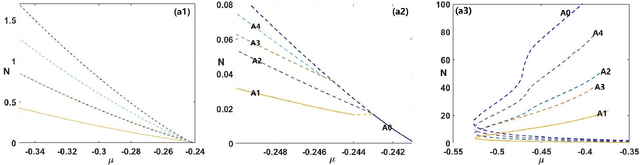
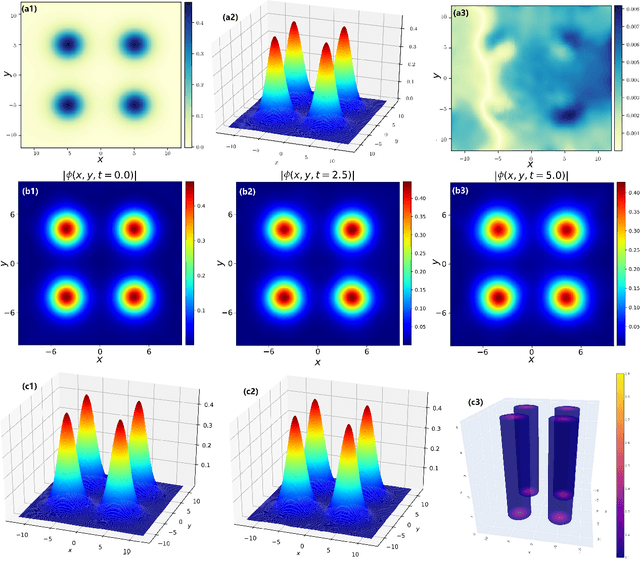

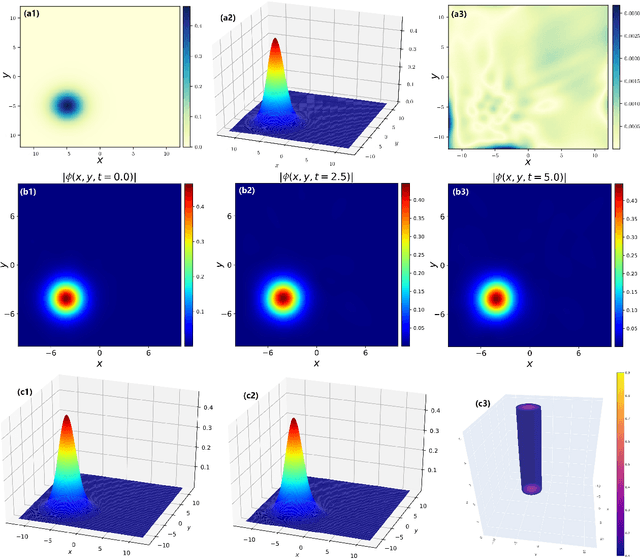
In this paper, we develop a systematic deep learning approach to solve two-dimensional (2D) stationary quantum droplets (QDs) and investigate their wave propagation in the 2D amended Gross-Pitaevskii equation with Lee-Huang-Yang correction and two kinds of potentials. Firstly, we use the initial-value iterative neural network (IINN) algorithm for 2D stationary quantum droplets of stationary equations. Then the learned stationary QDs are used as the initial value conditions for physics-informed neural networks (PINNs) to explore their evolutions in the some space-time region. Especially, we consider two types of potentials, one is the 2D quadruple-well Gaussian potential and the other is the PT-symmetric HO-Gaussian potential, which lead to spontaneous symmetry breaking and the generation of multi-component QDs. The used deep learning method can also be applied to study wave propagations of other nonlinear physical models.
Two-stage initial-value iterative physics-informed neural networks for simulating solitary waves of nonlinear wave equations
Sep 02, 2024We propose a new two-stage initial-value iterative neural network (IINN) algorithm for solitary wave computations of nonlinear wave equations based on traditional numerical iterative methods and physics-informed neural networks (PINNs). Specifically, the IINN framework consists of two subnetworks, one of which is used to fit a given initial value, and the other incorporates physical information and continues training on the basis of the first subnetwork. Importantly, the IINN method does not require any additional data information including boundary conditions, apart from the given initial value. Corresponding theoretical guarantees are provided to demonstrate the effectiveness of our IINN method. The proposed IINN method is efficiently applied to learn some types of solutions in different nonlinear wave equations, including the one-dimensional (1D) nonlinear Schr\"odinger equations (NLS) equation (with and without potentials), the 1D saturable NLS equation with PT -symmetric optical lattices, the 1D focusing-defocusing coupled NLS equations, the KdV equation, the two-dimensional (2D) NLS equation with potentials, the 2D amended GP equation with a potential, the (2+1)-dimensional KP equation, and the 3D NLS equation with a potential. These applications serve as evidence for the efficacy of our method. Finally, by comparing with the traditional methods, we demonstrate the advantages of the proposed IINN method.
* 25 pages, 17 figures
Deep learning soliton dynamics and complex potentials recognition for 1D and 2D PT-symmetric saturable nonlinear Schrödinger equations
Sep 29, 2023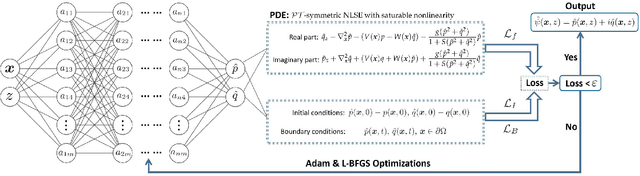
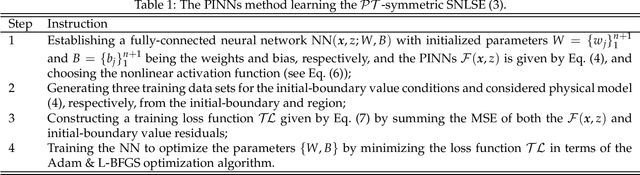
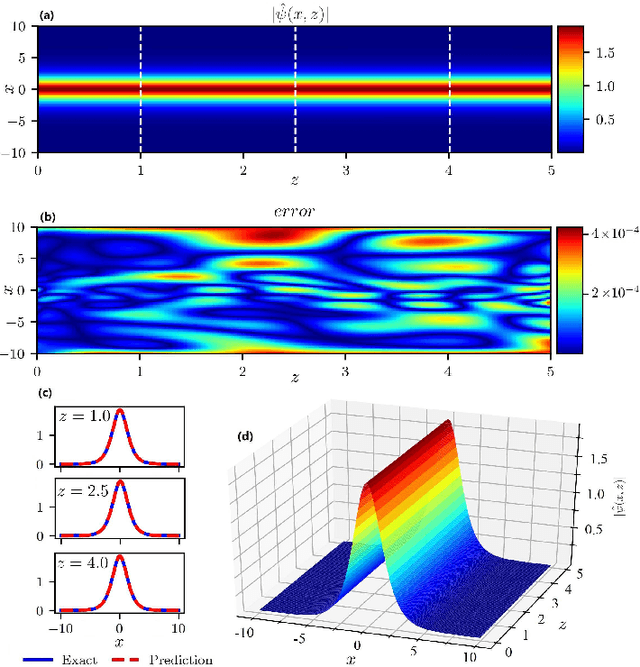
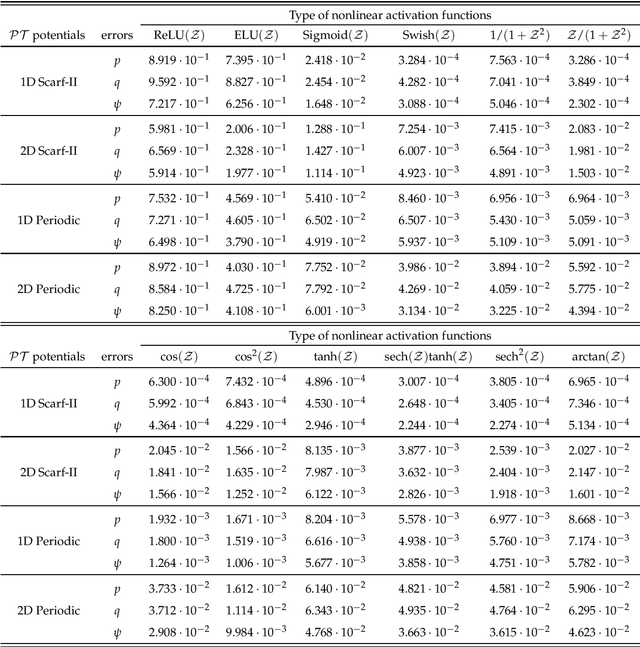
In this paper, we firstly extend the physics-informed neural networks (PINNs) to learn data-driven stationary and non-stationary solitons of 1D and 2D saturable nonlinear Schr\"odinger equations (SNLSEs) with two fundamental PT-symmetric Scarf-II and periodic potentials in optical fibers. Secondly, the data-driven inverse problems are studied for PT-symmetric potential functions discovery rather than just potential parameters in the 1D and 2D SNLSEs. Particularly, we propose a modified PINNs (mPINNs) scheme to identify directly the PT potential functions of the 1D and 2D SNLSEs by the solution data. And the inverse problems about 1D and 2D PT -symmetric potentials depending on propagation distance z are also investigated using mPINNs method. We also identify the potential functions by the PINNs applied to the stationary equation of the SNLSE. Furthermore, two network structures are compared under different parameter conditions such that the predicted PT potentials can achieve the similar high accuracy. These results illustrate that the established deep neural networks can be successfully used in 1D and 2D SNLSEs with high accuracies. Moreover, some main factors affecting neural networks performance are discussed in 1D and 2D PT Scarf-II and periodic potentials, including activation functions, structures of the networks, and sizes of the training data. In particular, twelve different nonlinear activation functions are in detail analyzed containing the periodic and non-periodic functions such that it is concluded that selecting activation functions according to the form of solution and equation usually can achieve better effect.
* 27 pages, 20 figures
Data-driven localized waves and parameter discovery in the massive Thirring model via extended physics-informed neural networks with interface zones
Sep 29, 2023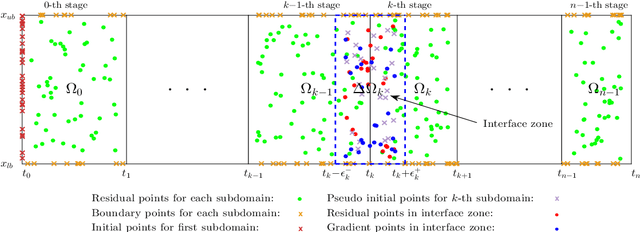

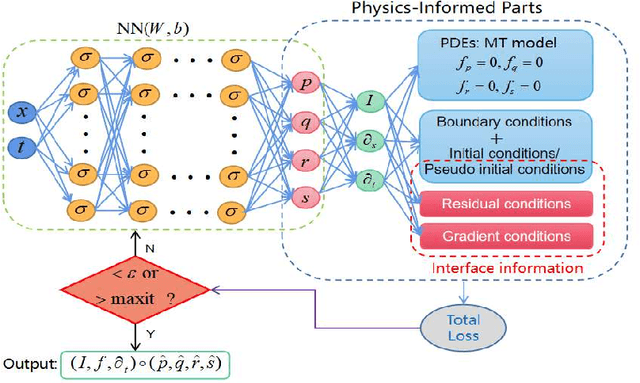

In this paper, we study data-driven localized wave solutions and parameter discovery in the massive Thirring (MT) model via the deep learning in the framework of physics-informed neural networks (PINNs) algorithm. Abundant data-driven solutions including soliton of bright/dark type, breather and rogue wave are simulated accurately and analyzed contrastively with relative and absolute errors. For higher-order localized wave solutions, we employ the extended PINNs (XPINNs) with domain decomposition to capture the complete pictures of dynamic behaviors such as soliton collisions, breather oscillations and rogue-wave superposition. In particular, we modify the interface line in domain decomposition of XPINNs into a small interface zone and introduce the pseudo initial, residual and gradient conditions as interface conditions linked adjacently with individual neural networks. Then this modified approach is applied successfully to various solutions ranging from bright-bright soliton, dark-dark soliton, dark-antidark soliton, general breather, Kuznetsov-Ma breather and second-order rogue wave. Experimental results show that this improved version of XPINNs reduce the complexity of computation with faster convergence rate and keep the quality of learned solutions with smoother stitching performance as well. For the inverse problems, the unknown coefficient parameters of linear and nonlinear terms in the MT model are identified accurately with and without noise by using the classical PINNs algorithm.