 Add to Chrome
 Add to Firefox
 Add to Edge
PartMat: Material-Aware 3D Part Decomposition with a Single Global Latent
Aug 03, 2026
Part-level 3D generation has recently attracted increasing attention for producing structured and editable 3D assets. However, existing methods typically decompose objects according to functional semantics rather than the editable material boundaries (e.g., fabric, wood, metal) required in practical 3D applications such as interior design. Additionally, current methods often generate parts independently, causing computational costs to scale linearly with the part count. To address these limitations, we present PartMat, an efficient material-aware 3D part decomposition pipeline that represents multi-part geometry with a single global latent. Given a reference image and a single whole-object geometry, PartMat decomposes the object into parts that follow material boundaries. First, we propose PartVAE to learn such a unified representation and decode all material parts in a single forward pass, thereby decoupling inference cost from the number of parts. Second, with this representation, a diffusion model is trained for part generation and refined via reinforcement learning for accurate material assignment and overlap suppression. Finally, to recover fine-grained geometric details, we introduce a sparse-voxel flow-matching model with part attention for geometry post-processing. Extensive experiments demonstrate that PartMat significantly outperforms existing baselines in material-aware decomposition accuracy and achieves comparable geometric quality, while maintaining efficient inference.

Home3D 1.0: A High-Fidelity Image-to-3D Asset Generation System for Interior Design
Jun 29, 2026We present Home3D 1.0, a modular image-to-3D generation system that produces high-quality 3D assets from a single reference image, targeting interior design and e-commerce applications. Given a photograph of a furniture or decor item, the system outputs a mesh with physically-based rendering (PBR) materials, and the mesh can be decomposed into material-specific components. The pipeline is organized into four tightly coupled modules: Geometry reconstructs a watertight mesh through latent SDF modelling with a geometry VAE and a coarse-to-fine flow-matching DiT; Texture predicts multiview albedo observations, reprojects them onto the mesh, and completes unseen surface regions with a 3D texture field; Material uses MatWeaver to obtain component masks through video-based segmentation and UV-space voting, then retrieves and bakes PBR maps from a curated material library through hierarchical multi-modal matching; and Parts generates material-editable semantic part meshes with a PartVAE and PartDiT, decoding multi-head part-specific SDF fields in one pass. Each module is evaluated independently with dedicated metrics, highlighting both the current system capability and the remaining gaps toward broader deployment.
HomeDiffusion: Zero-Shot Object Customization with Multi-View Representation Learning for Indoor Scenes
Jun 29, 2026Recently, zero-shot object customization generation methods have rapidly developed and shown tremendous potential for applications. For instance, in the e-commerce domain, consumers can observe the visual effect of furniture placed within their personal living spaces or clothes worn on their own bodies. Many existing approaches perform object customization generation based on diffusion models and extracted reference object features. However, the generated object significantly diverges from the original reference object in details such as patterns and curves. Particularly for asymmetrical reference objects, the absence of comprehensive multi-viewpoint information prevents the generation of object poses that harmonize with the background scene. To address these shortcomings, we have constructed a novel dataset comprising multi-angle images of furniture and indoor scenes. Based on diffusion models, we introduce HomeDiffusion, which can leverage multi-viewpoint images of the same reference object to accurately generate visually harmonious object poses within specified areas of the background scene. During the diffusion process, we further extract high-fidelity details of the reference object and perform cross-attention with the noise latents in the latent space, thereby ensuring the preservation of details in the customized object generation. Extensive qualitative and quantitative experiments demonstrate that our method achieves superior performance over other existing zero-shot as well as few-shot object customization approaches.
SkeleGuide: Explicit Skeleton Reasoning for Context-Aware Human-in-Place Image Synthesis
Mar 02, 2026Generating realistic and structurally plausible human images into existing scenes remains a significant challenge for current generative models, which often produce artifacts like distorted limbs and unnatural poses. We attribute this systemic failure to an inability to perform explicit reasoning over human skeletal structure. To address this, we introduce SkeleGuide, a novel framework built upon explicit skeletal reasoning. Through joint training of its reasoning and rendering stages, SkeleGuide learns to produce an internal pose that acts as a strong structural prior, guiding the synthesis towards high structural integrity. For fine-grained user control, we introduce PoseInverter, a module that decodes this internal latent pose into an explicit and editable format. Extensive experiments demonstrate that SkeleGuide significantly outperforms both specialized and general-purpose models in generating high-fidelity, contextually-aware human images. Our work provides compelling evidence that explicitly modeling skeletal structure is a fundamental step towards robust and plausible human image synthesis.
3D-FRONT: 3D Furnished Rooms with layOuts and semaNTics
Nov 18, 2020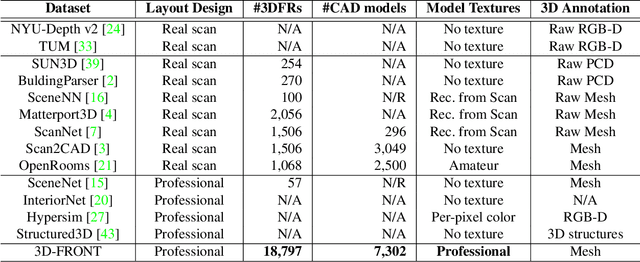
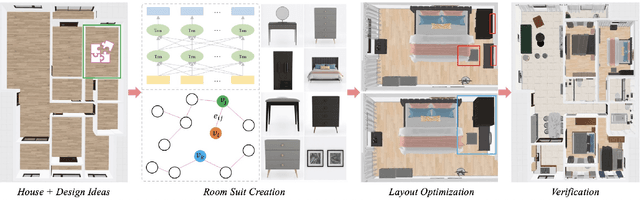
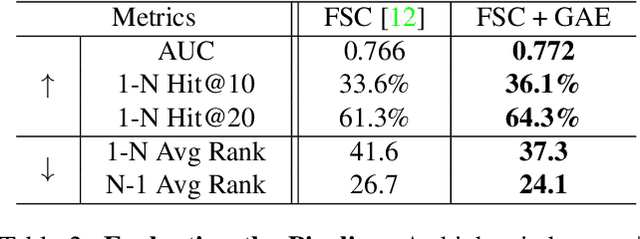
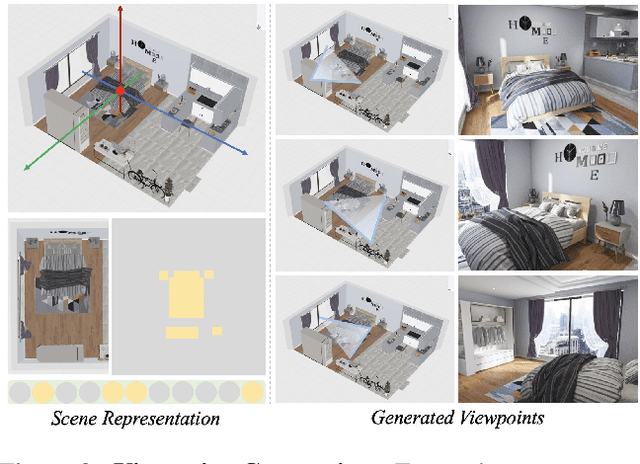
We introduce 3D-FRONT (3D Furnished Rooms with layOuts and semaNTics), a new, large-scale, and comprehensive repository of synthetic indoor scenes highlighted by professionally designed layouts and a large number of rooms populated by high-quality textured 3D models with style compatibility. From layout semantics down to texture details of individual objects, our dataset is freely available to the academic community and beyond. Currently, 3D-FRONT contains 18,797 rooms diversely furnished by 3D objects, far surpassing all publicly available scene datasets. In addition, the 7,302 furniture objects all come with high-quality textures. While the floorplans and layout designs are directly sourced from professional creations, the interior designs in terms of furniture styles, color, and textures have been carefully curated based on a recommender system we develop to attain consistent styles as expert designs. Furthermore, we release Trescope, a light-weight rendering tool, to support benchmark rendering of 2D images and annotations from 3D-FRONT. We demonstrate two applications, interior scene synthesis and texture synthesis, that are especially tailored to the strengths of our new dataset. The project page is at: https://tianchi.aliyun.com/specials/promotion/alibaba-3d-scene-dataset.