 Add to Chrome
 Add to Firefox
 Add to Edge
Home3D 1.0: A High-Fidelity Image-to-3D Asset Generation System for Interior Design
Jun 29, 2026
We present Home3D 1.0, a modular image-to-3D generation system that produces high-quality 3D assets from a single reference image, targeting interior design and e-commerce applications. Given a photograph of a furniture or decor item, the system outputs a mesh with physically-based rendering (PBR) materials, and the mesh can be decomposed into material-specific components. The pipeline is organized into four tightly coupled modules: Geometry reconstructs a watertight mesh through latent SDF modelling with a geometry VAE and a coarse-to-fine flow-matching DiT; Texture predicts multiview albedo observations, reprojects them onto the mesh, and completes unseen surface regions with a 3D texture field; Material uses MatWeaver to obtain component masks through video-based segmentation and UV-space voting, then retrieves and bakes PBR maps from a curated material library through hierarchical multi-modal matching; and Parts generates material-editable semantic part meshes with a PartVAE and PartDiT, decoding multi-head part-specific SDF fields in one pass. Each module is evaluated independently with dedicated metrics, highlighting both the current system capability and the remaining gaps toward broader deployment.

Double Actor-Critic with TD Error-Driven Regularization in Reinforcement Learning
Sep 28, 2024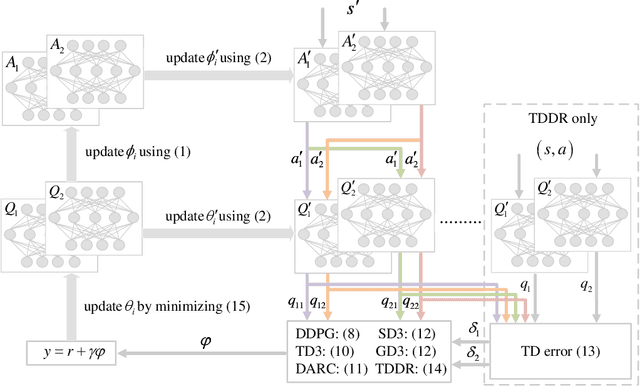
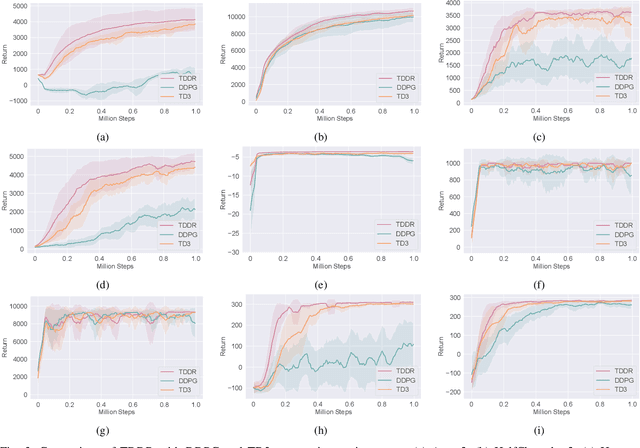

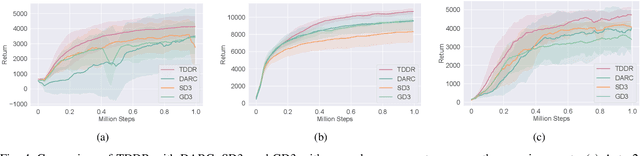
To obtain better value estimation in reinforcement learning, we propose a novel algorithm based on the double actor-critic framework with temporal difference error-driven regularization, abbreviated as TDDR. TDDR employs double actors, with each actor paired with a critic, thereby fully leveraging the advantages of double critics. Additionally, TDDR introduces an innovative critic regularization architecture. Compared to classical deterministic policy gradient-based algorithms that lack a double actor-critic structure, TDDR provides superior estimation. Moreover, unlike existing algorithms with double actor-critic frameworks, TDDR does not introduce any additional hyperparameters, significantly simplifying the design and implementation process. Experiments demonstrate that TDDR exhibits strong competitiveness compared to benchmark algorithms in challenging continuous control tasks.
A Histogram Thresholding Improvement to Mask R-CNN for Scalable Segmentation of New and Old Rural Buildings
Feb 08, 2021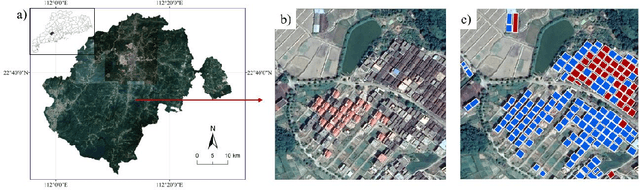
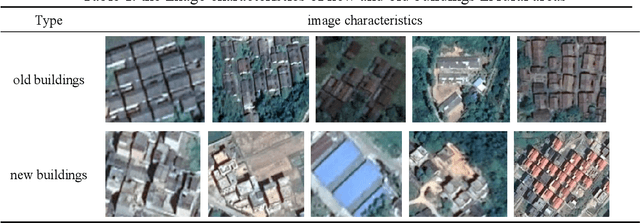
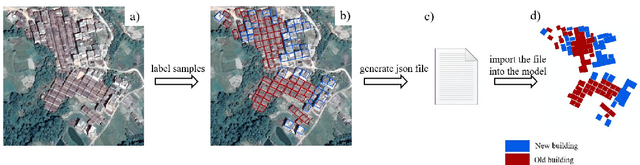

Mapping new and old buildings are of great significance for understanding socio-economic development in rural areas. In recent years, deep neural networks have achieved remarkable building segmentation results in high-resolution remote sensing images. However, the scarce training data and the varying geographical environments have posed challenges for scalable building segmentation. This study proposes a novel framework based on Mask R-CNN, named HTMask R-CNN, to extract new and old rural buildings even when the label is scarce. The framework adopts the result of single-object instance segmentation from the orthodox Mask R-CNN. Further, it classifies the rural buildings into new and old ones based on a dynamic grayscale threshold inferred from the result of a two-object instance segmentation task where training data is scarce. We found that the framework can extract more buildings and achieve a much higher mean Average Precision (mAP) than the orthodox Mask R-CNN model. We tested the novel framework's performance with increasing training data and found that it converged even when the training samples were limited. This framework's main contribution is to allow scalable segmentation by using significantly fewer training samples than traditional machine learning practices. That makes mapping China's new and old rural buildings viable.