 Add to Chrome
 Add to Firefox
 Add to Edge
Privacy-Preserving EHR Data Transformation via Geometric Operators: A Human-AI Co-Design Technical Report
Mar 24, 2026
Electronic health records (EHRs) and other real-world clinical data are essential for clinical research, medical artificial intelligence, and life science, but their sharing is severely limited by privacy, governance, and interoperability constraints. These barriers create persistent data silos that hinder multi-center studies, large-scale model development, and broader biomedical discovery. Existing privacy-preserving approaches, including multi-party computation and related cryptographic techniques, provide strong protection but often introduce substantial computational overhead, reducing the efficiency of large-scale machine learning and foundation-model training. In addition, many such methods make data usable for restricted computation while leaving them effectively invisible to clinicians and researchers, limiting their value in workflows that still require direct inspection, exploratory analysis, and human interpretation. We propose a real-world-data transformation framework for privacy-preserving sharing of structured clinical records. Instead of converting data into opaque representations, our approach constructs transformed numeric views that preserve medical semantics and major statistical properties while, under a clearly specified threat model, provably breaking direct linkage between those views and protected patient-level attributes. Through collaboration between computer scientists and the AI agent \textbf{SciencePal}, acting as a constrained tool inventor under human guidance, we design three transformation operators that are non-reversible within this threat model, together with an additional mixing strategy for high-risk scenarios, supported by theoretical analysis and empirical evaluation under reconstruction, record linkage, membership inference, and attribute inference attacks.

Improving Learning of New Diseases through Knowledge-Enhanced Initialization for Federated Adapter Tuning
Aug 14, 2025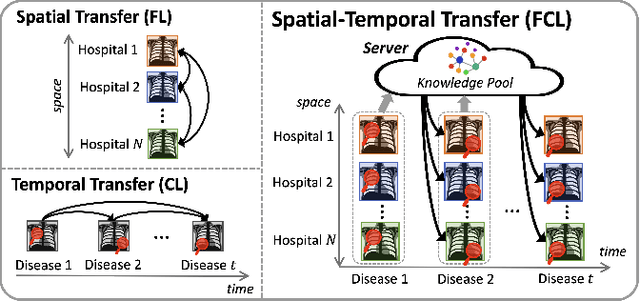
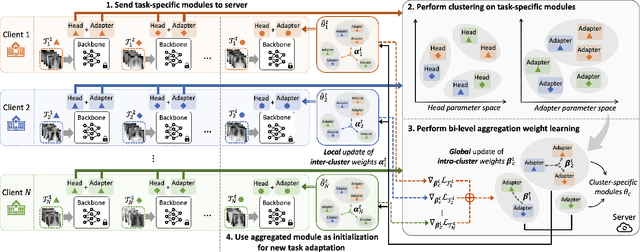
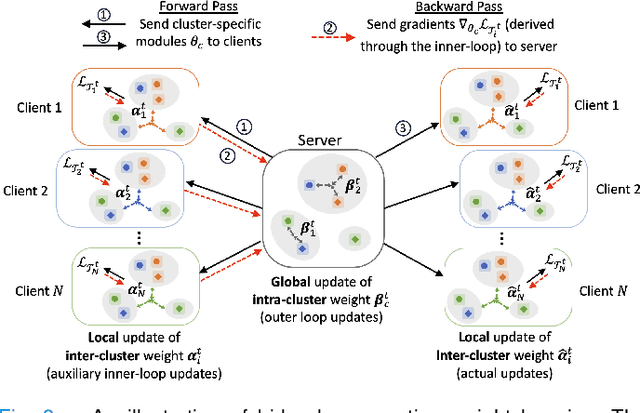
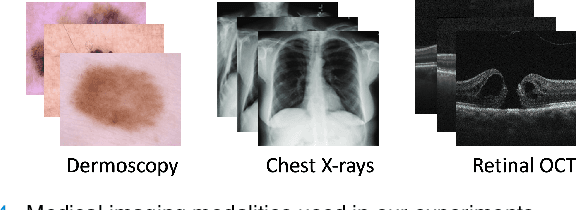
In healthcare, federated learning (FL) is a widely adopted framework that enables privacy-preserving collaboration among medical institutions. With large foundation models (FMs) demonstrating impressive capabilities, using FMs in FL through cost-efficient adapter tuning has become a popular approach. Given the rapidly evolving healthcare environment, it is crucial for individual clients to quickly adapt to new tasks or diseases by tuning adapters while drawing upon past experiences. In this work, we introduce Federated Knowledge-Enhanced Initialization (FedKEI), a novel framework that leverages cross-client and cross-task transfer from past knowledge to generate informed initializations for learning new tasks with adapters. FedKEI begins with a global clustering process at the server to generalize knowledge across tasks, followed by the optimization of aggregation weights across clusters (inter-cluster weights) and within each cluster (intra-cluster weights) to personalize knowledge transfer for each new task. To facilitate more effective learning of the inter- and intra-cluster weights, we adopt a bi-level optimization scheme that collaboratively learns the global intra-cluster weights across clients and optimizes the local inter-cluster weights toward each client's task objective. Extensive experiments on three benchmark datasets of different modalities, including dermatology, chest X-rays, and retinal OCT, demonstrate FedKEI's advantage in adapting to new diseases compared to state-of-the-art methods.