 Add to Chrome
 Add to Firefox
 Add to Edge
Privacy-Preserving EHR Data Transformation via Geometric Operators: A Human-AI Co-Design Technical Report
Mar 24, 2026
Electronic health records (EHRs) and other real-world clinical data are essential for clinical research, medical artificial intelligence, and life science, but their sharing is severely limited by privacy, governance, and interoperability constraints. These barriers create persistent data silos that hinder multi-center studies, large-scale model development, and broader biomedical discovery. Existing privacy-preserving approaches, including multi-party computation and related cryptographic techniques, provide strong protection but often introduce substantial computational overhead, reducing the efficiency of large-scale machine learning and foundation-model training. In addition, many such methods make data usable for restricted computation while leaving them effectively invisible to clinicians and researchers, limiting their value in workflows that still require direct inspection, exploratory analysis, and human interpretation. We propose a real-world-data transformation framework for privacy-preserving sharing of structured clinical records. Instead of converting data into opaque representations, our approach constructs transformed numeric views that preserve medical semantics and major statistical properties while, under a clearly specified threat model, provably breaking direct linkage between those views and protected patient-level attributes. Through collaboration between computer scientists and the AI agent \textbf{SciencePal}, acting as a constrained tool inventor under human guidance, we design three transformation operators that are non-reversible within this threat model, together with an additional mixing strategy for high-risk scenarios, supported by theoretical analysis and empirical evaluation under reconstruction, record linkage, membership inference, and attribute inference attacks.

Knowledge-Aware Prompt Tuning for Generalizable Vision-Language Models
Aug 22, 2023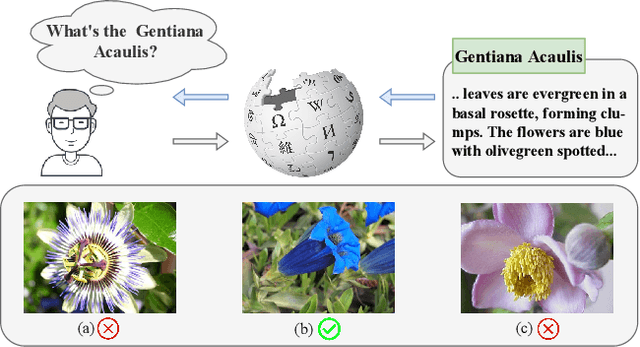
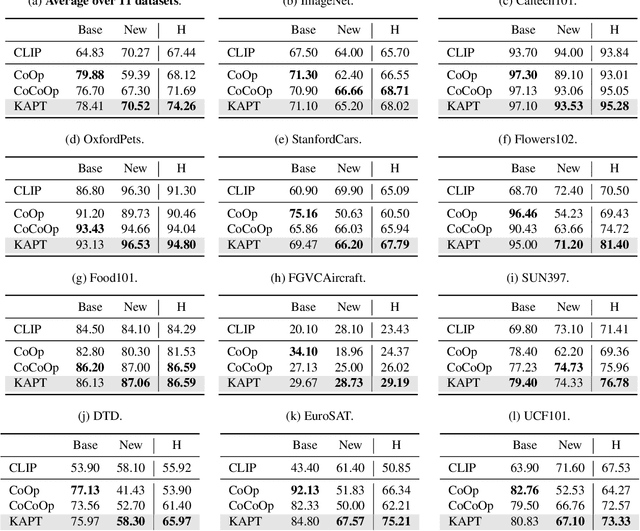
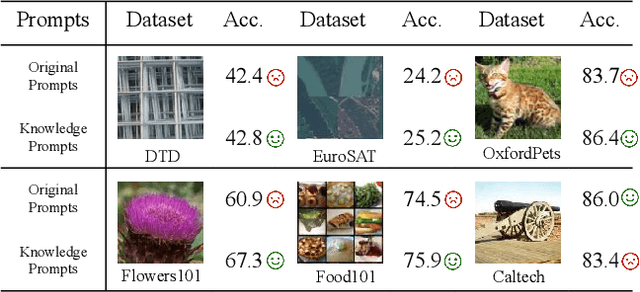

Pre-trained vision-language models, e.g., CLIP, working with manually designed prompts have demonstrated great capacity of transfer learning. Recently, learnable prompts achieve state-of-the-art performance, which however are prone to overfit to seen classes, failing to generalize to unseen classes. In this paper, we propose a Knowledge-Aware Prompt Tuning (KAPT) framework for vision-language models. Our approach takes inspiration from human intelligence in which external knowledge is usually incorporated into recognizing novel categories of objects. Specifically, we design two complementary types of knowledge-aware prompts for the text encoder to leverage the distinctive characteristics of category-related external knowledge. The discrete prompt extracts the key information from descriptions of an object category, and the learned continuous prompt captures overall contexts. We further design an adaptation head for the visual encoder to aggregate salient attentive visual cues, which establishes discriminative and task-aware visual representations. We conduct extensive experiments on 11 widely-used benchmark datasets and the results verify the effectiveness in few-shot image classification, especially in generalizing to unseen categories. Compared with the state-of-the-art CoCoOp method, KAPT exhibits favorable performance and achieves an absolute gain of 3.22% on new classes and 2.57% in terms of harmonic mean.