 Add to Chrome
 Add to Firefox
 Add to Edge
VLAff: Vision-Language-Affordance Model for Unified Actionable Affordances
Aug 05, 2026
Learning manipulation skills from human videos is promising for scalable robot learning. However, the embodiment mismatch between humans and robots makes this challenging. One promising solution is to learn object-centric actionable affordances that are embodiment-agnostic. In this work, we propose a framework that leverages egocentric human videos with state-of-the-art 3D Structure-from-Motion and hand mesh reconstruction to extract actionable affordances such as visual, grasp, and trajectory affordances that explicitly encode where to interact, how to grasp, and how to move. We construct EgoAffordance, a large-scale dataset comprising 204K episodes with 5.6M visual affordances and 11.6M grasp and trajectory affordances. Building on this, we introduce VLAff, a large vision-language model-based unified foundation model that learns cross-modal correlations across all actionable affordances. Given a visual observation and instruction, VLAff generates visual affordance heatmaps, grasp poses, and trajectories, which are then converted into directly executable actions by utilizing 3D scene information. Through extensive experiments, we demonstrate that VLAff not only achieves state-of-the-art performance on visual affordance prediction, but can also be effectively applied to real robot applications such as zero-shot manipulation and affordance-guided robot learning.

MEVION: Low-Cost Open-Source Data Collection System for Powerful and High-Speed Dual-Arm Manipulation
Jul 20, 2026The global competition for developing robotic foundation models is intensifying. Among the data collection systems used for dual-arm robots, ALOHA is representative of being low-cost and open-source, and is widely adopted by researchers as a de facto standard. However, due to its limited ability to generate high forces and speeds, it is difficult to handle heavy objects or perform fast manipulations. To address this, we developed MEVION, a low-cost and open-source dual-arm robot data collection system capable of generating greater force and speed. All parts of this robot can be sourced through e-commerce, and by extensively utilizing sheet metal welding, its large body structure is constructed with a small number of components at low cost, while also simplifying assembly. MEVION is equipped with four 6-DoF arms with parallel grippers. Each arm weighs 7.0 kg and has a maximum torque of 60 Nm, and the entire system can be constructed for about USD 14,000. The elbow joint adopts a closed-link mechanism similar to those used in quadruped robots, which reduces the distal mass and enables higher force and speed output at the end-effector. We demonstrate that MEVION enables data collection for object manipulation tasks not previously possible and supports imitation learning-based motion generation. All hardware and software of this work are included in the Supplementary Materials or https://github.com/haraduka/mevion.
Vision-Language-Action Models for Robotics: A Review Towards Real-World Applications
Oct 08, 2025Amid growing efforts to leverage advances in large language models (LLMs) and vision-language models (VLMs) for robotics, Vision-Language-Action (VLA) models have recently gained significant attention. By unifying vision, language, and action data at scale, which have traditionally been studied separately, VLA models aim to learn policies that generalise across diverse tasks, objects, embodiments, and environments. This generalisation capability is expected to enable robots to solve novel downstream tasks with minimal or no additional task-specific data, facilitating more flexible and scalable real-world deployment. Unlike previous surveys that focus narrowly on action representations or high-level model architectures, this work offers a comprehensive, full-stack review, integrating both software and hardware components of VLA systems. In particular, this paper provides a systematic review of VLAs, covering their strategy and architectural transition, architectures and building blocks, modality-specific processing techniques, and learning paradigms. In addition, to support the deployment of VLAs in real-world robotic applications, we also review commonly used robot platforms, data collection strategies, publicly available datasets, data augmentation methods, and evaluation benchmarks. Throughout this comprehensive survey, this paper aims to offer practical guidance for the robotics community in applying VLAs to real-world robotic systems. All references categorized by training approach, evaluation method, modality, and dataset are available in the table on our project website: https://vla-survey.github.io .
Open X-Embodiment: Robotic Learning Datasets and RT-X Models
Oct 17, 2023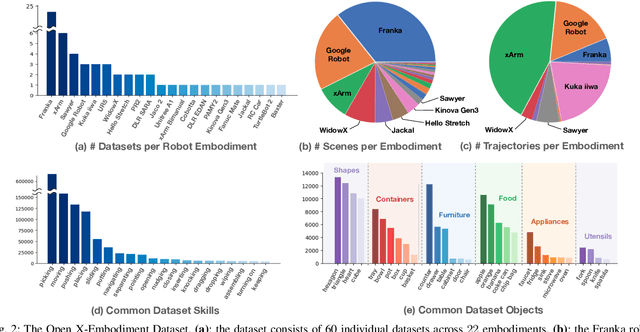
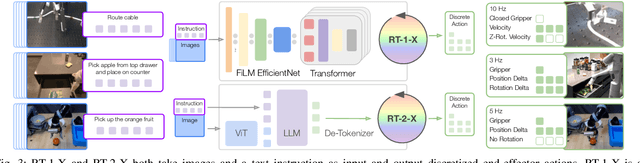


Large, high-capacity models trained on diverse datasets have shown remarkable successes on efficiently tackling downstream applications. In domains from NLP to Computer Vision, this has led to a consolidation of pretrained models, with general pretrained backbones serving as a starting point for many applications. Can such a consolidation happen in robotics? Conventionally, robotic learning methods train a separate model for every application, every robot, and even every environment. Can we instead train generalist X-robot policy that can be adapted efficiently to new robots, tasks, and environments? In this paper, we provide datasets in standardized data formats and models to make it possible to explore this possibility in the context of robotic manipulation, alongside experimental results that provide an example of effective X-robot policies. We assemble a dataset from 22 different robots collected through a collaboration between 21 institutions, demonstrating 527 skills (160266 tasks). We show that a high-capacity model trained on this data, which we call RT-X, exhibits positive transfer and improves the capabilities of multiple robots by leveraging experience from other platforms. More details can be found on the project website $\href{https://robotics-transformer-x.github.io}{\text{robotics-transformer-x.github.io}}$.