 Add to Chrome
 Add to Firefox
 Add to Edge
Trie-Aware Transformers for Generative Recommendation
Feb 25, 2026
Generative recommendation (GR) aligns with advances in generative AI by casting next-item prediction as token-level generation rather than score-based ranking. Most GR methods adopt a two-stage pipeline: (i) \textit{item tokenization}, which maps each item to a sequence of discrete, hierarchically organized tokens; and (ii) \textit{autoregressive generation}, which predicts the next item's tokens conditioned on the tokens of user's interaction history. Although hierarchical tokenization induces a prefix tree (trie) over items, standard autoregressive modeling with conventional Transformers often flattens item tokens into a linear stream and overlooks the underlying topology. To address this, we propose TrieRec, a trie-aware generative recommendation method that augments Transformers with structural inductive biases via two positional encodings. First, a \textit{trie-aware absolute positional encoding} aggregates a token's (node's) local structural context (\eg depth, ancestors, and descendants) into the token representation. Second, a \textit{topology-aware relative positional encoding} injects pairwise structural relations into self-attention to capture topology-induced semantic relatedness. TrieRec is also model-agnostic, efficient, and hyperparameter-free. In our experiments, we implement TrieRec within three representative GR backbones, achieving notably improvements of 8.83\% on average across four real-world datasets.

Few-Shot Graph Classification with Model Agnostic Meta-Learning
Mar 18, 2020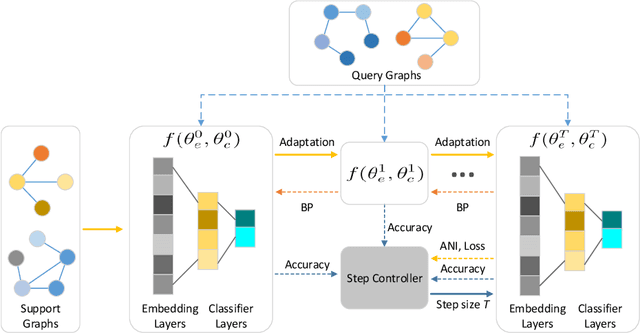
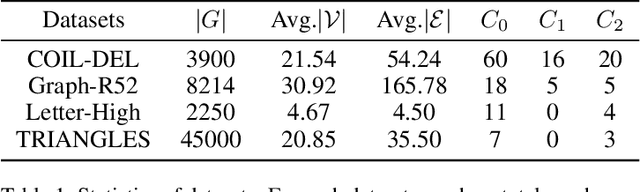
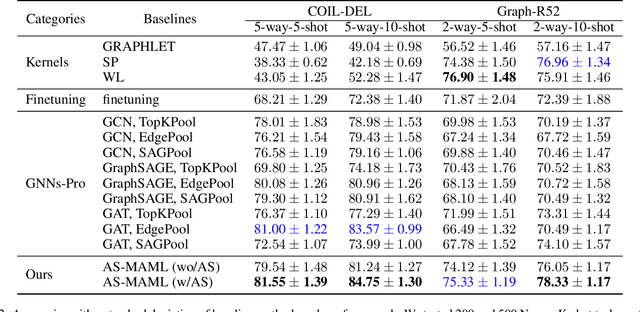
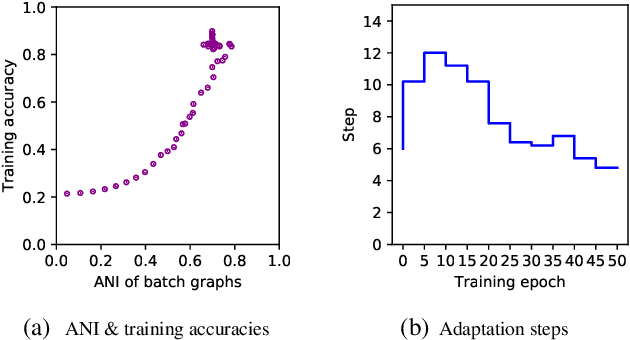
Graph classification aims to perform accurate information extraction and classification over graphstructured data. In the past few years, Graph Neural Networks (GNNs) have achieved satisfactory performance on graph classification tasks. However, most GNNs based methods focus on designing graph convolutional operations and graph pooling operations, overlooking that collecting or labeling graph-structured data is more difficult than grid-based data. We utilize meta-learning for fewshot graph classification to alleviate the scarce of labeled graph samples when training new tasks.More specifically, to boost the learning of graph classification tasks, we leverage GNNs as graph embedding backbone and meta-learning as training paradigm to capture task-specific knowledge rapidly in graph classification tasks and transfer them to new tasks. To enhance the robustness of meta-learner, we designed a novel step controller driven by Reinforcement Learning. The experiments demonstrate that our framework works well compared to baselines.