 Add to Chrome
 Add to Firefox
 Add to Edge
Non-invasive Blood Glucose Estimation from Wearable Physiological Signals
Jul 05, 2026
Non-invasive blood glucose estimation from wearable physiological signals remains difficult because longitudinal photoplethysmography (PPG) data are subject to distribution drift, whereas reference capillary blood glucose labels are sparse and costly to acquire. We propose a \rev{deep-learning-based} dynamic incremental learning (DIL) framework that combines a mutual entropy-optimized replay-based dynamic clustering module (MERDC) with an uncertainty-quantified proxy gradient bridging agent (PGBA) for label-efficient adaptation to unlabeled PPG streams. To support this setting, we further establish a longitudinal benchmark dataset comprising PPG, reference capillary blood glucose, and cuff blood pressure measurements from 183 participants collected over 285 days, and we make this resource available to the research community. Under 5-fold subject-independent validation, the proposed method achieves a mean absolute error (MAE) of $0.64 \pm 0.01$ millimoles per liter (mmol/L) and a root mean square error (RMSE) of $1.29 \pm 0.10$ mmol/L, with $97.69 \pm 1.63\%$ of estimates falling within Clarke zones A+B. Aggregation-level analyses further support the robustness of the observed error distribution beyond window-level evaluation. \rev{These results provide a proof-of-concept for adaptive non-invasive glucose estimation in wearable physiological sensing and establish a longitudinal benchmark for subsequent research.

A Question Answering Dataset for Temporal-Sensitive Retrieval-Augmented Generation
Aug 17, 2025We introduce ChronoQA, a large-scale benchmark dataset for Chinese question answering, specifically designed to evaluate temporal reasoning in Retrieval-Augmented Generation (RAG) systems. ChronoQA is constructed from over 300,000 news articles published between 2019 and 2024, and contains 5,176 high-quality questions covering absolute, aggregate, and relative temporal types with both explicit and implicit time expressions. The dataset supports both single- and multi-document scenarios, reflecting the real-world requirements for temporal alignment and logical consistency. ChronoQA features comprehensive structural annotations and has undergone multi-stage validation, including rule-based, LLM-based, and human evaluation, to ensure data quality. By providing a dynamic, reliable, and scalable resource, ChronoQA enables structured evaluation across a wide range of temporal tasks, and serves as a robust benchmark for advancing time-sensitive retrieval-augmented question answering systems.
Non-autoregressive Personalized Bundle Generation
Jun 11, 2024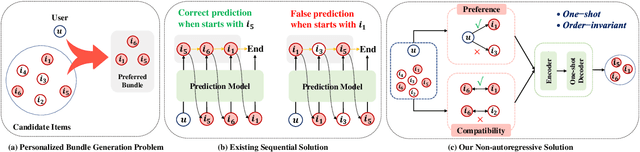
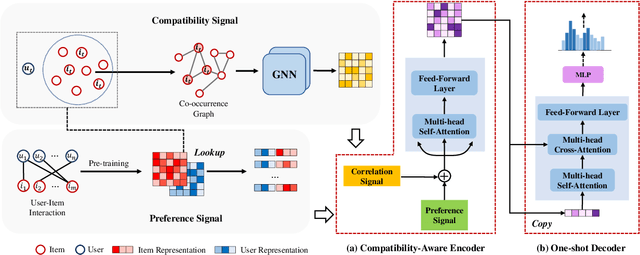

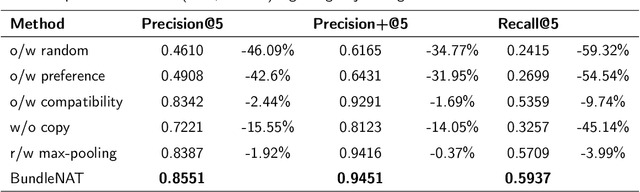
The personalized bundle generation problem, which aims to create a preferred bundle for user from numerous candidate items, receives increasing attention in recommendation. However, existing works ignore the order-invariant nature of the bundle and adopt sequential modeling methods as the solution, which might introduce inductive bias and cause a large latency in prediction. To address this problem, we propose to perform the bundle generation via non-autoregressive mechanism and design a novel encoder-decoder framework named BundleNAT, which can effectively output the targeted bundle in one-shot without relying on any inherent order. In detail, instead of learning sequential dependency, we propose to adopt pre-training techniques and graph neural network to fully embed user-based preference and item-based compatibility information, and use a self-attention based encoder to further extract global dependency pattern. We then design a permutation-equivariant decoding architecture that is able to directly output the desired bundle in a one-shot manner. Experiments on three real-world datasets from Youshu and Netease show the proposed BundleNAT significantly outperforms the current state-of-the-art methods in average by up to 35.92%, 10.97% and 23.67% absolute improvements in Precision, Precision+, and Recall, respectively.
Machine Learning in Aerodynamic Shape Optimization
Feb 15, 2022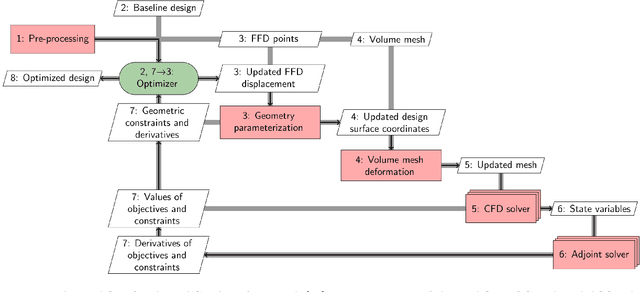
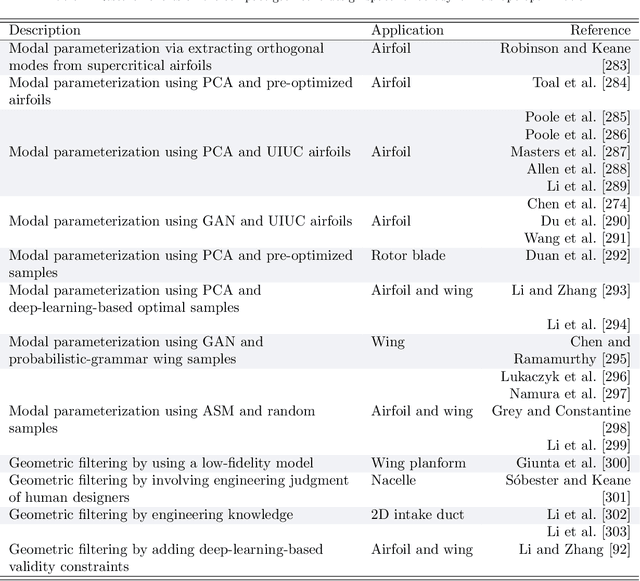
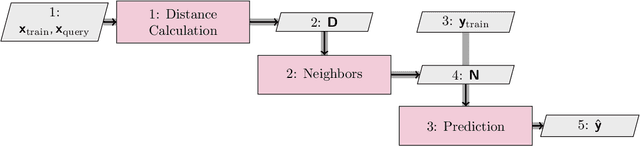
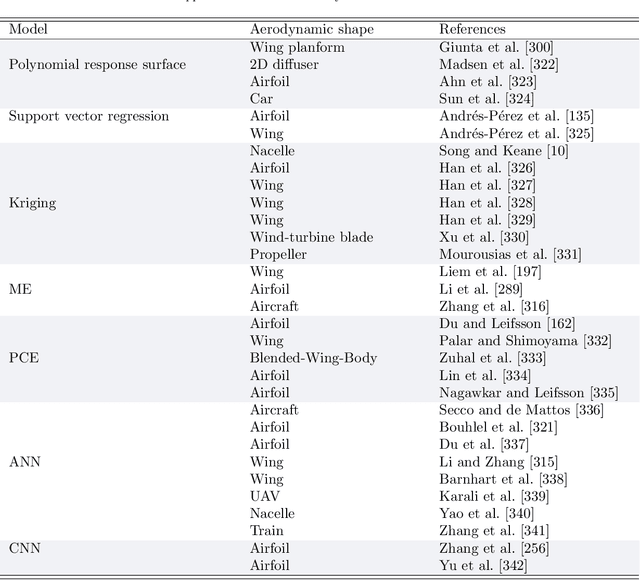
Large volumes of experimental and simulation aerodynamic data have been rapidly advancing aerodynamic shape optimization (ASO) via machine learning (ML), whose effectiveness has been growing thanks to continued developments in deep learning. In this review, we first introduce the state of the art and the unsolved challenges in ASO. Next, we present a description of ML fundamentals and detail the ML algorithms that have succeeded in ASO. Then we review ML applications contributing to ASO from three fundamental perspectives: compact geometric design space, fast aerodynamic analysis, and efficient optimization architecture. In addition to providing a comprehensive summary of the research, we comment on the practicality and effectiveness of the developed methods. We show how cutting-edge ML approaches can benefit ASO and address challenging demands like interactive design optimization. However, practical large-scale design optimizations remain a challenge due to the costly ML training expense. A deep coupling of ML model construction with ASO prior experience and knowledge, such as taking physics into account, is recommended to train ML models effectively.