 Add to Chrome
 Add to Firefox
 Add to Edge
MedMASLab: A Unified Orchestration Framework for Benchmarking Multimodal Medical Multi-Agent Systems
Mar 10, 2026
While Multi-Agent Systems (MAS) show potential for complex clinical decision support, the field remains hindered by architectural fragmentation and the lack of standardized multimodal integration. Current medical MAS research suffers from non-uniform data ingestion pipelines, inconsistent visual-reasoning evaluation, and a lack of cross-specialty benchmarking. To address these challenges, we present MedMASLab, a unified framework and benchmarking platform for multimodal medical multi-agent systems. MedMASLab introduces: (1) A standardized multimodal agent communication protocol that enables seamless integration of 11 heterogeneous MAS architectures across 24 medical modalities. (2) An automated clinical reasoning evaluator, a zero-shot semantic evaluation paradigm that overcomes the limitations of lexical string-matching by leveraging large vision-language models to verify diagnostic logic and visual grounding. (3) The most extensive benchmark to date, spanning 11 organ systems and 473 diseases, standardizing data from 11 clinical benchmarks. Our systematic evaluation reveals a critical domain-specific performance gap: while MAS improves reasoning depth, current architectures exhibit significant fragility when transitioning between specialized medical sub-domains. We provide a rigorous ablation of interaction mechanisms and cost-performance trade-offs, establishing a new technical baseline for future autonomous clinical systems. The source code and data is publicly available at: https://github.com/NUS-Project/MedMASLab/

Multi-Objective Mobile Damped Wave Algorithm (MOMDWA): A Novel Approach For Quantum System Control
Feb 06, 2025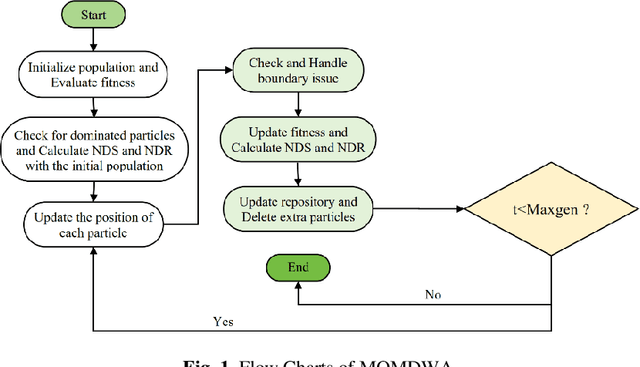
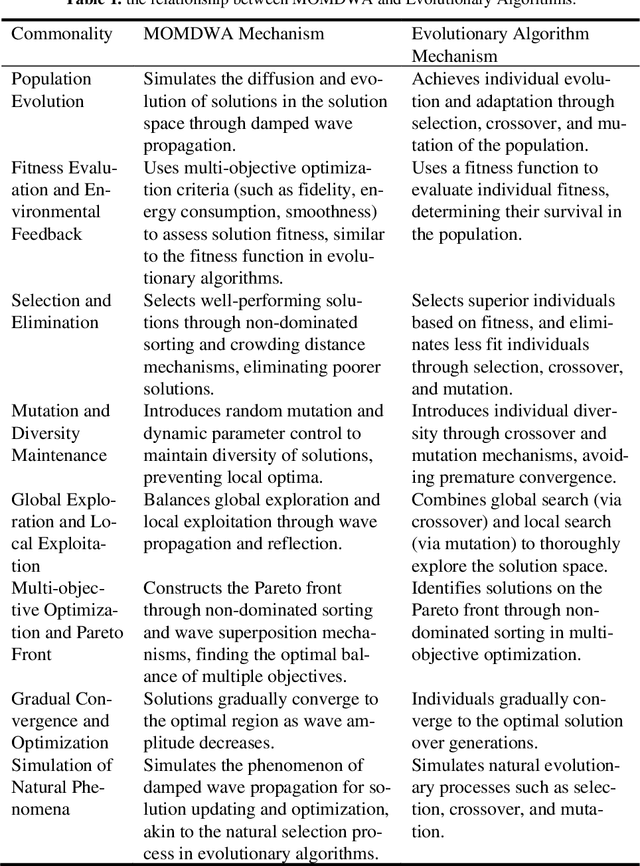
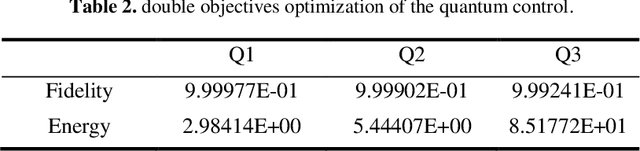
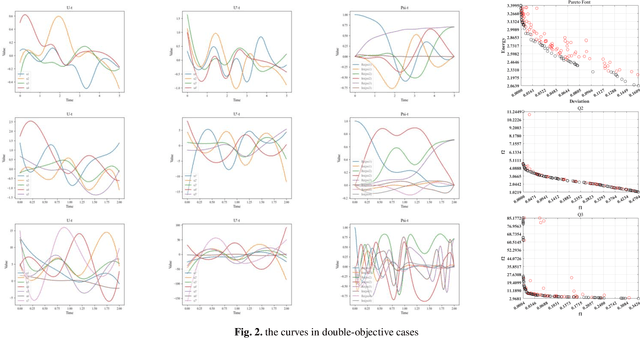
In this paper, we introduce a novel multi-objective optimization algorithm, the Multi-Objective Mobile Damped Wave Algorithm (MOMDWA), specifically designed to address complex quantum control problems. Our approach extends the capabilities of the original Mobile Damped Wave Algorithm (MDWA) by incorporating multiple objectives, enabling a more comprehensive optimization process. We applied MOMDWA to three quantum control scenarios, focusing on optimizing the balance between control fidelity, energy consumption, and control smoothness. The results demonstrate that MOMDWA significantly enhances quantum control efficiency and robustness, achieving high fidelity while minimizing energy use and ensuring smooth control pulses. This advancement offers a valuable tool for quantum computing and other domains requiring precise, multi-objective control.