 Add to Chrome
 Add to Firefox
 Add to Edge
TwistNet-2D: Learning Second-Order Channel Interactions via Spiral Twisting for Texture Recognition
Feb 06, 2026
Second-order feature statistics are central to texture recognition, yet current methods face a fundamental tension: bilinear pooling and Gram matrices capture global channel correlations but collapse spatial structure, while self-attention models spatial context through weighted aggregation rather than explicit pairwise feature interactions. We introduce TwistNet-2D, a lightweight module that computes \emph{local} pairwise channel products under directional spatial displacement, jointly encoding where features co-occur and how they interact. The core component, Spiral-Twisted Channel Interaction (STCI), shifts one feature map along a prescribed direction before element-wise channel multiplication, thereby capturing the cross-position co-occurrence patterns characteristic of structured and periodic textures. Aggregating four directional heads with learned channel reweighting and injecting the result through a sigmoid-gated residual path, \TwistNet incurs only 3.5% additional parameters and 2% additional FLOPs over ResNet-18, yet consistently surpasses both parameter-matched and substantially larger baselines -- including ConvNeXt, Swin Transformer, and hybrid CNN--Transformer architectures -- across four texture and fine-grained recognition benchmarks.

OPAL: Operator-Programmed Algorithms for Landscape-Aware Black-Box Optimization
Dec 14, 2025Black-box optimization often relies on evolutionary and swarm algorithms whose performance is highly problem dependent. We view an optimizer as a short program over a small vocabulary of search operators and learn this operator program separately for each problem instance. We instantiate this idea in Operator-Programmed Algorithms (OPAL), a landscape-aware framework for continuous black-box optimization that uses a small design budget with a standard differential evolution baseline to probe the landscape, builds a $k$-nearest neighbor graph over sampled points, and encodes this trajectory with a graph neural network. A meta-learner then maps the resulting representation to a phase-wise schedule of exploration, restart, and local search operators. On the CEC~2017 test suite, a single meta-trained OPAL policy is statistically competitive with state-of-the-art adaptive differential evolution variants and achieves significant improvements over simpler baselines under nonparametric tests. Ablation studies on CEC~2017 justify the choices for the design phase, the trajectory graph, and the operator-program representation, while the meta-components add only modest wall-clock overhead. Overall, the results indicate that operator-programmed, landscape-aware per-instance design is a practical way forward beyond ad hoc metaphor-based algorithms in black-box optimization.
Multi-Objective Mobile Damped Wave Algorithm (MOMDWA): A Novel Approach For Quantum System Control
Feb 06, 2025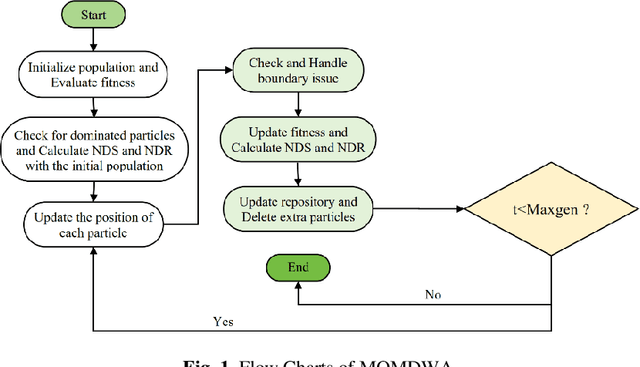
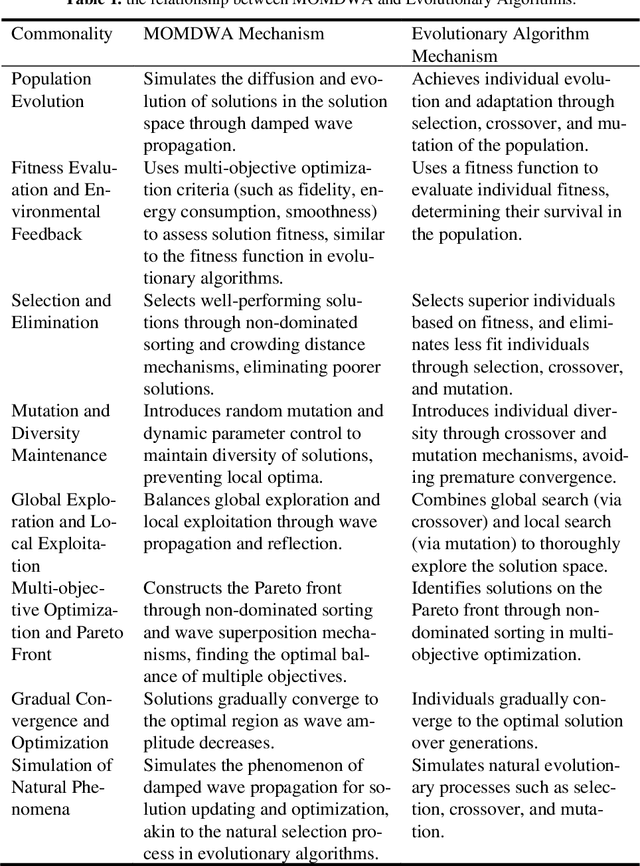
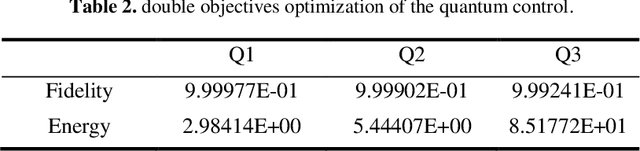
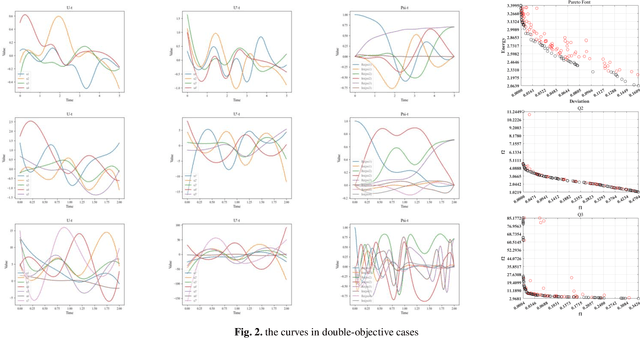
In this paper, we introduce a novel multi-objective optimization algorithm, the Multi-Objective Mobile Damped Wave Algorithm (MOMDWA), specifically designed to address complex quantum control problems. Our approach extends the capabilities of the original Mobile Damped Wave Algorithm (MDWA) by incorporating multiple objectives, enabling a more comprehensive optimization process. We applied MOMDWA to three quantum control scenarios, focusing on optimizing the balance between control fidelity, energy consumption, and control smoothness. The results demonstrate that MOMDWA significantly enhances quantum control efficiency and robustness, achieving high fidelity while minimizing energy use and ensuring smooth control pulses. This advancement offers a valuable tool for quantum computing and other domains requiring precise, multi-objective control.
Graph Neural Networks Are Evolutionary Algorithms
Dec 24, 2024In this paper, we reveal the intrinsic duality between graph neural networks (GNNs) and evolutionary algorithms (EAs), bridging two traditionally distinct fields. Building on this insight, we propose Graph Neural Evolution (GNE), a novel evolutionary algorithm that models individuals as nodes in a graph and leverages designed frequency-domain filters to balance global exploration and local exploitation. Through the use of these filters, GNE aggregates high-frequency (diversity-enhancing) and low-frequency (stability-promoting) information, transforming EAs into interpretable and tunable mechanisms in the frequency domain. Extensive experiments on benchmark functions demonstrate that GNE consistently outperforms state-of-the-art algorithms such as GA, DE, CMA-ES, SDAES, and RL-SHADE, excelling in complex landscapes, optimal solution shifts, and noisy environments. Its robustness, adaptability, and superior convergence highlight its practical and theoretical value. Beyond optimization, GNE establishes a conceptual and mathematical foundation linking EAs and GNNs, offering new perspectives for both fields. Its framework encourages the development of task-adaptive filters and hybrid approaches for EAs, while its insights can inspire advances in GNNs, such as improved global information propagation and mitigation of oversmoothing. GNE's versatility extends to solving challenges in machine learning, including hyperparameter tuning and neural architecture search, as well as real-world applications in engineering and operations research. By uniting the dynamics of EAs with the structural insights of GNNs, this work provides a foundation for interdisciplinary innovation, paving the way for scalable and interpretable solutions to complex optimization problems.