 Add to Chrome
 Add to Firefox
 Add to Edge
Structure-Internalized Rule Language Model for Faithful Knowledge Graph Reasoning
Aug 18, 2026
Knowledge Graph Reasoning (KGR) aims to discover latent facts by leveraging the structural evidence available in KGs, posing a challenge to the structural semantic understanding capability of KGR models. Recent studies have demonstrated that Large Language Models (LLMs) can achieve remarkable progress on KGR tasks via flexible in-context learning. However, the inherent representation inconsistency between KG structural context and LLM parametric knowledge remains inadequately addressed. This limitation prevents LLMs from effectively perceiving reasoning evidence that aligns with KG constraints, which undermines both the effectiveness and faithfulness of reasoning. We refer to this problem as reasoning evidence perception drift of LLMs over KGs. To address this problem, we propose a Structure-Internalized Rule Language Model (SIRLM), which centers on structural rule generation to couple the parametric learning of structural knowledge with the faithfulness evaluation of reasoning logic, enabling LLMs to anchor tightly to KG-grounded evidence. Specifically, we first design a Structure-Internalized Rule Generator (SIRG), which incorporates an in-context learning block augmented with a structural relation memory to coordinate structural and parametric knowledge. Furthermore, we equip SIRG with a KG tokenizer based on structural invariance learning and a neuro-symbolic reasoner based on rule-constrained message propagation. These components provide SIRG with learnable structural representations and faithful rule-execution feedback, respectively. Our SIRLM can be seamlessly integrated into standard LLM training paradigms, such as SFT and GRPO. Extensive experiments against 17 state-of-the-art KGR methods on 36 datasets demonstrate the significant superiority of SIRLM.

Knowledge Restoration-driven Prompt Optimization: Unlocking LLM Potential for Open-Domain Relational Triplet Extraction
Jan 21, 2026Open-domain Relational Triplet Extraction (ORTE) is the foundation for mining structured knowledge without predefined schemas. Despite the impressive in-context learning capabilities of Large Language Models (LLMs), existing methods are hindered by their reliance on static, heuristic-driven prompting strategies. Due to the lack of reflection mechanisms required to internalize erroneous signals, these methods exhibit vulnerability in semantic ambiguity, often making erroneous extraction patterns permanent. To address this bottleneck, we propose a Knowledge Reconstruction-driven Prompt Optimization (KRPO) framework to assist LLMs in continuously improving their extraction capabilities for complex ORTE task flows. Specifically, we design a self-evaluation mechanism based on knowledge restoration, which provides intrinsic feedback signals by projecting structured triplets into semantic consistency scores. Subsequently, we propose a prompt optimizer based on a textual gradient that can internalize historical experiences to iteratively optimize prompts, which can better guide LLMs to handle subsequent extraction tasks. Furthermore, to alleviate relation redundancy, we design a relation canonicalization memory that collects representative relations and provides semantically distinct schemas for the triplets. Extensive experiments across three datasets show that KRPO significantly outperforms strong baselines in the extraction F1 score.
Relink: Constructing Query-Driven Evidence Graph On-the-Fly for GraphRAG
Jan 12, 2026Graph-based Retrieval-Augmented Generation (GraphRAG) mitigates hallucinations in Large Language Models (LLMs) by grounding them in structured knowledge. However, current GraphRAG methods are constrained by a prevailing \textit{build-then-reason} paradigm, which relies on a static, pre-constructed Knowledge Graph (KG). This paradigm faces two critical challenges. First, the KG's inherent incompleteness often breaks reasoning paths. Second, the graph's low signal-to-noise ratio introduces distractor facts, presenting query-relevant but misleading knowledge that disrupts the reasoning process. To address these challenges, we argue for a \textit{reason-and-construct} paradigm and propose Relink, a framework that dynamically builds a query-specific evidence graph. To tackle incompleteness, \textbf{Relink} instantiates required facts from a latent relation pool derived from the original text corpus, repairing broken paths on the fly. To handle misleading or distractor facts, Relink employs a unified, query-aware evaluation strategy that jointly considers candidates from both the KG and latent relations, selecting those most useful for answering the query rather than relying on their pre-existence. This empowers Relink to actively discard distractor facts and construct the most faithful and precise evidence path for each query. Extensive experiments on five Open-Domain Question Answering benchmarks show that Relink achieves significant average improvements of 5.4\% in EM and 5.2\% in F1 over leading GraphRAG baselines, demonstrating the superiority of our proposed framework.
Effective Instruction Parsing Plugin for Complex Logical Query Answering on Knowledge Graphs
Oct 27, 2024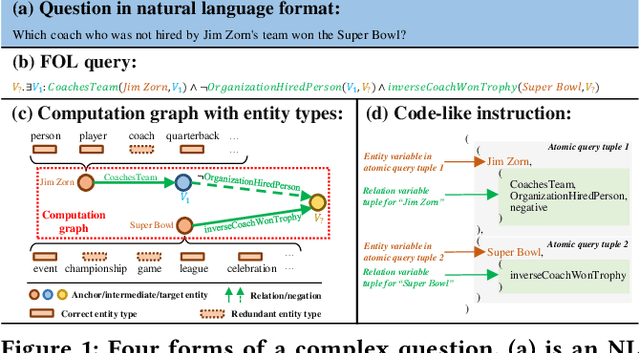
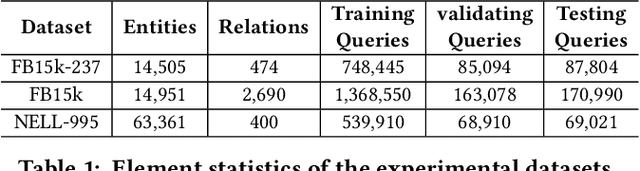
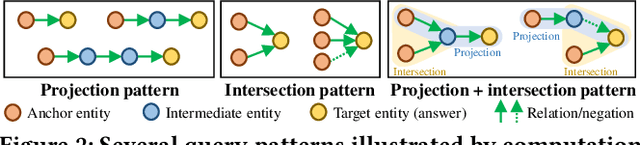
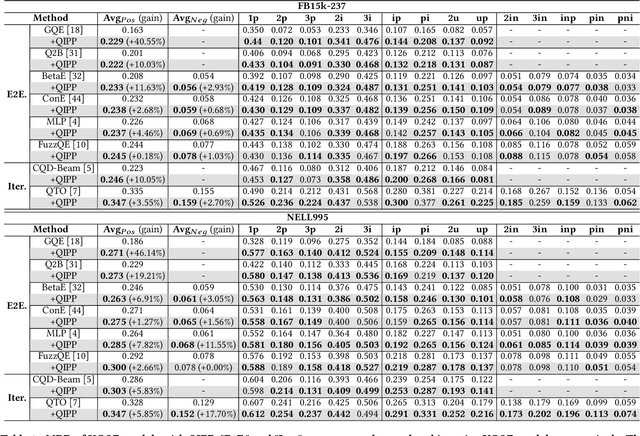
Knowledge Graph Query Embedding (KGQE) aims to embed First-Order Logic (FOL) queries in a low-dimensional KG space for complex reasoning over incomplete KGs. To enhance the generalization of KGQE models, recent studies integrate various external information (such as entity types and relation context) to better capture the logical semantics of FOL queries. The whole process is commonly referred to as Query Pattern Learning (QPL). However, current QPL methods typically suffer from the pattern-entity alignment bias problem, leading to the learned defective query patterns limiting KGQE models' performance. To address this problem, we propose an effective Query Instruction Parsing Plugin (QIPP) that leverages the context awareness of Pre-trained Language Models (PLMs) to capture latent query patterns from code-like query instructions. Unlike the external information introduced by previous QPL methods, we first propose code-like instructions to express FOL queries in an alternative format. This format utilizes textual variables and nested tuples to convey the logical semantics within FOL queries, serving as raw materials for a PLM-based instruction encoder to obtain complete query patterns. Building on this, we design a query-guided instruction decoder to adapt query patterns to KGQE models. To further enhance QIPP's effectiveness across various KGQE models, we propose a query pattern injection mechanism based on compressed optimization boundaries and an adaptive normalization component, allowing KGQE models to utilize query patterns more efficiently. Extensive experiments demonstrate that our plug-and-play method improves the performance of eight basic KGQE models and outperforms two state-of-the-art QPL methods.