 Add to Chrome
 Add to Firefox
 Add to Edge
Impedance Control of Ship-Borne Manipulators via Optimization-based Task-Space Inverse Dynamics
Jul 24, 2026
Ship-borne manipulators operating in maritime environments are subject to stochastic wave-induced base motions that introduce kinematic disturbances and dynamic coupling, degrading trajectory tracking accuracy and complicating safe, contact-rich manipulation. This paper proposes a torque-level optimization-based control framework that integrates high-precision trajectory tracking with task-space impedance for ship-borne manipulators. The controller is formulated using task-space inverse dynamics (TSID) and solved via quadratic programming to explicitly compensate for the dynamic coupling introduced by base motion. To enable accurate feedforward compensation, an error-state Kalman filter (ESKF) is developed to estimate the base state by fusing inertial measurements with end-effector pose feedback. The framework is validated in simulation and real-world experiments using a 7-DOF manipulator mounted on a 6-DOF Stewart platform. The proposed method reduces real-world end-effector position tracking error by over 25.7% compared with the best baseline. Furthermore, the controller enables dynamic peg-in-hole insertion with 1~mm clearance under base motion, increasing the success rate while reducing average contact forces by 45%, demonstrating precise and compliant manipulation in contact-rich environments.

SSI-Policy: Learning Structured Scene Interfaces for Vision-Language Robotic Manipulation
Jun 25, 2026Real-world robotic manipulation demands spatial grounding, task-aware reasoning, and precise control. Learning such capabilities becomes particularly challenging in the low-data regime. Prior methods often trade off scalable task-level reasoning and explicit physical structure: video-based approaches can drift geometrically over long horizons, 3D approaches often require depth sensing, and many flow/trajectory interfaces emphasize motion without an explicit RGB-only geometric representation. We introduce SSI-Policy, a modular framework built around a Structured Scene Interface (SSI) -- a unified, RGB-only intermediate representation that jointly encodes monocular depth features, language-grounded object layouts, and instruction-conditioned 2D motion trajectories. Critically, SSI is robot-agnostic and trainable from action-free video, decoupling perception from control so that the downstream policy can learn from few demonstrations. On the LIBERO benchmark with only 10 demonstrations per task, SSI-Policy improves over the strongest prior method by nearly 15\% and remains competitive with 50-demo methods that leverage large-scale external pretraining. Ablations show that geometric and motion cues provide complementary benefits within the shared interface. We further validate on 13 real-world tasks spanning spatial reasoning, cross-embodiment transfer, and contact-rich manipulation.
MinInter: Minimizing Trajectory Interpolation During Data Augmentation for Imitation Learning
Jun 23, 2026Imitation learning enables robots to acquire complex manipulation skills from demonstrations, but its effectiveness is limited by the cost of collecting high-quality data. Trajectory-level data augmentation methods alleviate this challenge by recombining expert demonstrations under varied initial states. However, such methods typically insert interpolations or other non-expert transition segments between disjoint parts, and such non-expert segments could reduce the quality of the generated data. This paper introduces Minimizing Interpolation (MinInter), an effective trajectory selection method that, for each sampled initial configuration, chooses the source demonstration requiring the least interpolation to form a complete trajectory. By explicitly minimizing interpolations during data generation, MinInter produces higher-quality synthetic demonstrations while remaining compatible with existing data generation frameworks. Experiments on 12 manipulation tasks with 26 variants from the MimicGen benchmark show that MinInter consistently improves both data generation success rates and policy success rates, with the largest gains on contact-rich, long-horizon and high-variance settings. Compared to the recent SkillGen framework, MinInter achieves higher policy success rates despite its conceptual simplicity, underscoring the value of interpolation minimization for data augmentation.
MARS2 2025 Challenge on Multimodal Reasoning: Datasets, Methods, Results, Discussion, and Outlook
Sep 17, 2025
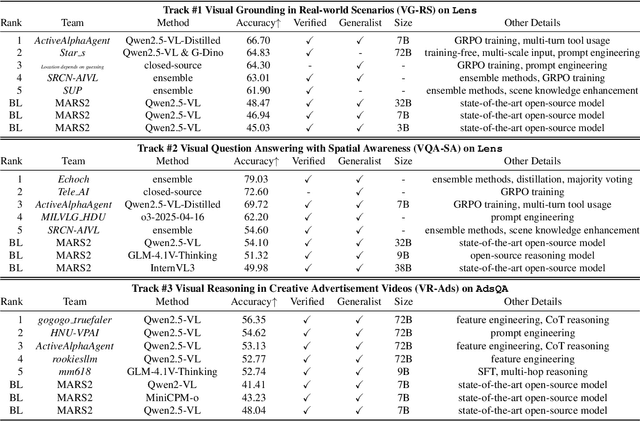

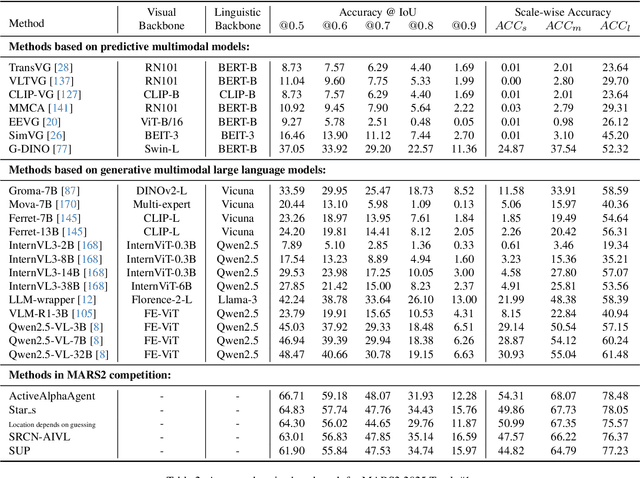
This paper reviews the MARS2 2025 Challenge on Multimodal Reasoning. We aim to bring together different approaches in multimodal machine learning and LLMs via a large benchmark. We hope it better allows researchers to follow the state-of-the-art in this very dynamic area. Meanwhile, a growing number of testbeds have boosted the evolution of general-purpose large language models. Thus, this year's MARS2 focuses on real-world and specialized scenarios to broaden the multimodal reasoning applications of MLLMs. Our organizing team released two tailored datasets Lens and AdsQA as test sets, which support general reasoning in 12 daily scenarios and domain-specific reasoning in advertisement videos, respectively. We evaluated 40+ baselines that include both generalist MLLMs and task-specific models, and opened up three competition tracks, i.e., Visual Grounding in Real-world Scenarios (VG-RS), Visual Question Answering with Spatial Awareness (VQA-SA), and Visual Reasoning in Creative Advertisement Videos (VR-Ads). Finally, 76 teams from the renowned academic and industrial institutions have registered and 40+ valid submissions (out of 1200+) have been included in our ranking lists. Our datasets, code sets (40+ baselines and 15+ participants' methods), and rankings are publicly available on the MARS2 workshop website and our GitHub organization page https://github.com/mars2workshop/, where our updates and announcements of upcoming events will be continuously provided.
Coordinated Defense Allocation in Reach-Avoid Scenarios with Efficient Online Optimization
Apr 01, 2023


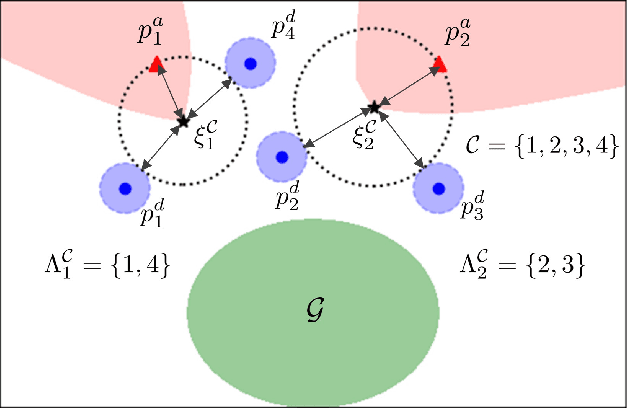
Deriving strategies for multiple agents under adversarial scenarios poses a significant challenge in attaining both optimality and efficiency. In this paper, we propose an efficient defense strategy for cooperative defense against a group of attackers in a convex environment. The defenders aim to minimize the total number of attackers that successfully enter the target set without prior knowledge of the attacker's strategy. Our approach involves a two-scale method that decomposes the problem into coordination against a single attacker and assigning defenders to attackers. We first develop a coordination strategy for multiple defenders against a single attacker, implementing online convex programming. This results in the maximum defense-winning region of initial joint states from which the defender can successfully defend against a single attacker. We then propose an allocation algorithm that significantly reduces computational effort required to solve the induced integer linear programming problem. The allocation guarantees defense performance enhancement as the game progresses. We perform various simulations to verify the efficiency of our algorithm compared to the state-of-the-art approaches, including the one using the Gazabo platform with Robot Operating System.