 Add to Chrome
 Add to Firefox
 Add to Edge
LOOPRAG: Enhancing Loop Transformation Optimization with Retrieval-Augmented Large Language Models
Dec 12, 2025
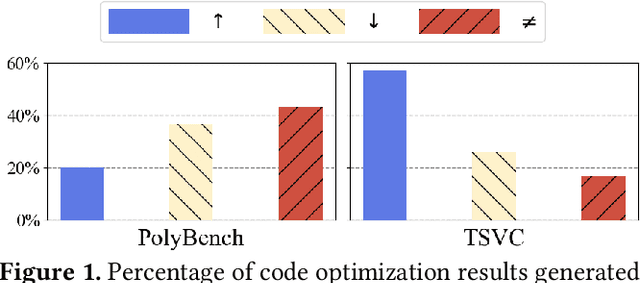
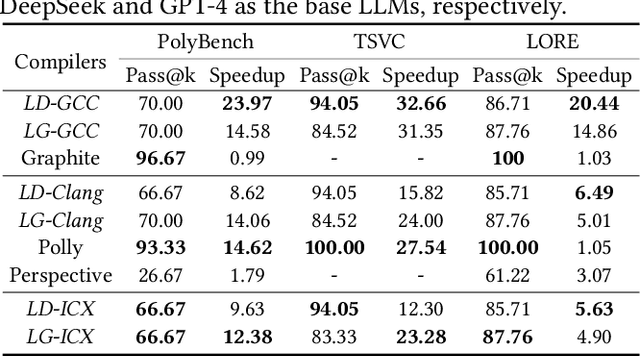
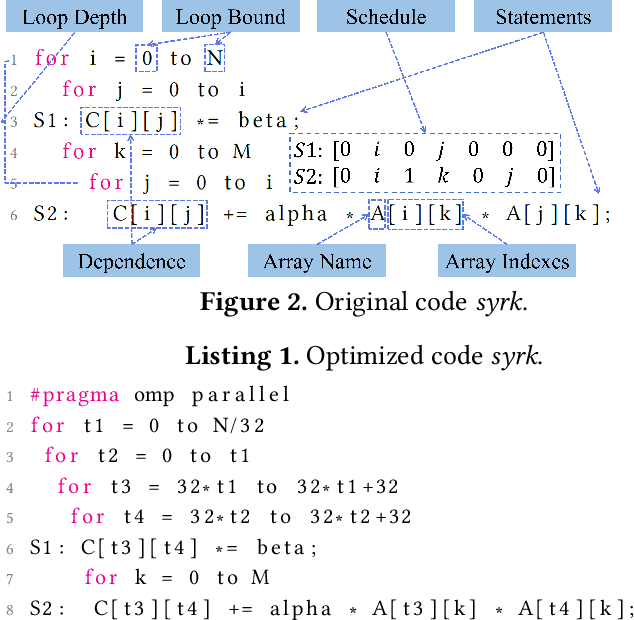
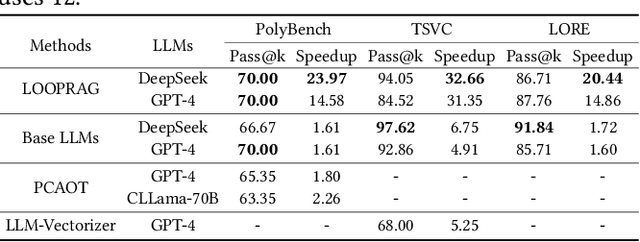
Loop transformations are semantics-preserving optimization techniques, widely used to maximize objectives such as parallelism. Despite decades of research, applying the optimal composition of loop transformations remains challenging due to inherent complexities, including cost modeling for optimization objectives. Recent studies have explored the potential of Large Language Models (LLMs) for code optimization. However, our key observation is that LLMs often struggle with effective loop transformation optimization, frequently leading to errors or suboptimal optimization, thereby missing opportunities for performance improvements. To bridge this gap, we propose LOOPRAG, a novel retrieval-augmented generation framework designed to guide LLMs in performing effective loop optimization on Static Control Part. We introduce a parameter-driven method to harness loop properties, which trigger various loop transformations, and generate diverse yet legal example codes serving as a demonstration source. To effectively obtain the most informative demonstrations, we propose a loop-aware algorithm based on loop features, which balances similarity and diversity for code retrieval. To enhance correct and efficient code generation, we introduce a feedback-based iterative mechanism that incorporates compilation, testing and performance results as feedback to guide LLMs. Each optimized code undergoes mutation, coverage and differential testing for equivalence checking. We evaluate LOOPRAG on PolyBench, TSVC and LORE benchmark suites, and compare it against compilers (GCC-Graphite, Clang-Polly, Perspective and ICX) and representative LLMs (DeepSeek and GPT-4). The results demonstrate average speedups over base compilers of up to 11.20$\times$, 14.34$\times$, and 9.29$\times$ for PolyBench, TSVC, and LORE, respectively, and speedups over base LLMs of up to 11.97$\times$, 5.61$\times$, and 11.59$\times$.

CasCast: Skillful High-resolution Precipitation Nowcasting via Cascaded Modelling
Feb 06, 2024

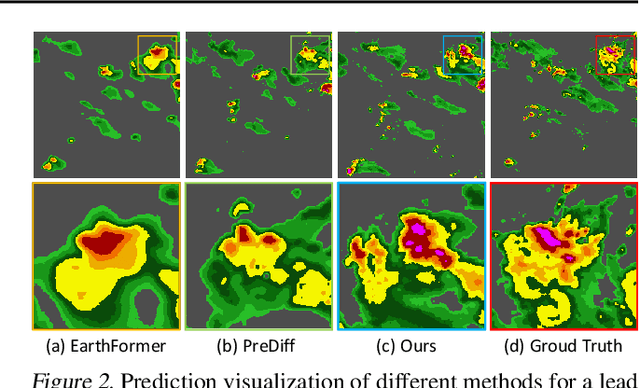

Precipitation nowcasting based on radar data plays a crucial role in extreme weather prediction and has broad implications for disaster management. Despite progresses have been made based on deep learning, two key challenges of precipitation nowcasting are not well-solved: (i) the modeling of complex precipitation system evolutions with different scales, and (ii) accurate forecasts for extreme precipitation. In this work, we propose CasCast, a cascaded framework composed of a deterministic and a probabilistic part to decouple the predictions for mesoscale precipitation distributions and small-scale patterns. Then, we explore training the cascaded framework at the high resolution and conducting the probabilistic modeling in a low dimensional latent space with a frame-wise-guided diffusion transformer for enhancing the optimization of extreme events while reducing computational costs. Extensive experiments on three benchmark radar precipitation datasets show that CasCast achieves competitive performance. Especially, CasCast significantly surpasses the baseline (up to +91.8%) for regional extreme-precipitation nowcasting.
Document-level Relation Extraction with Context Guided Mention Integration and Inter-pair Reasoning
Jan 13, 2022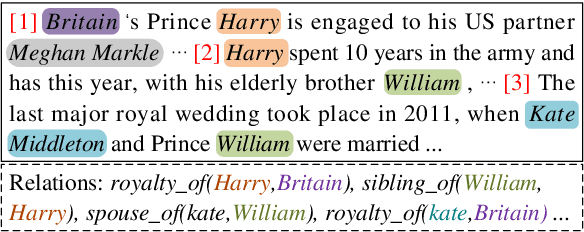
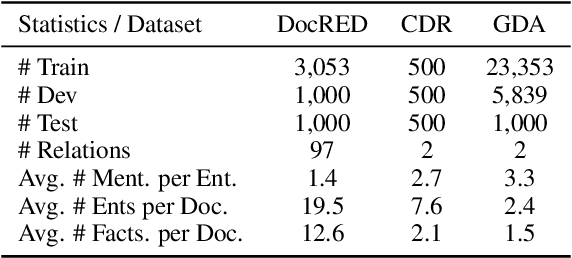
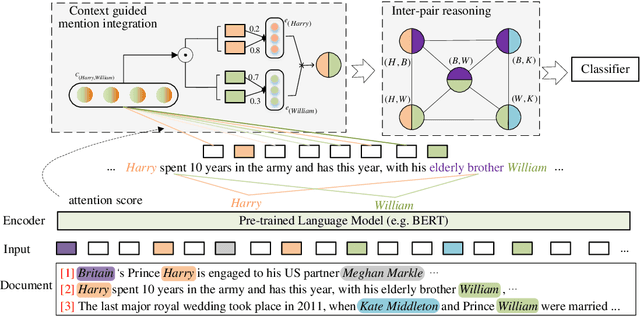
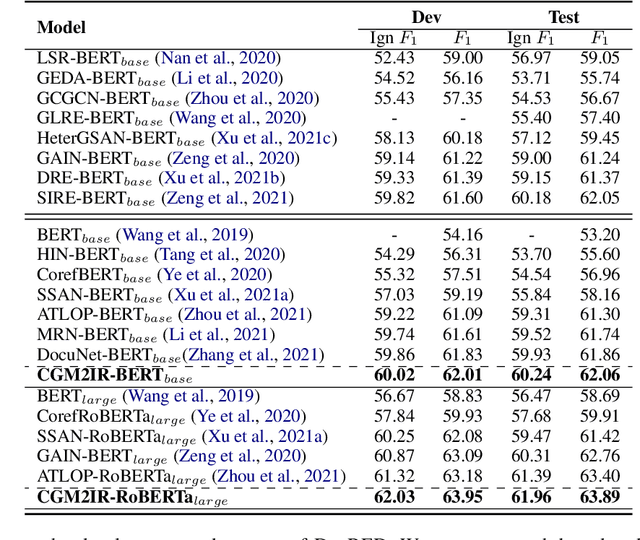
Document-level Relation Extraction (DRE) aims to recognize the relations between two entities. The entity may correspond to multiple mentions that span beyond sentence boundary. Few previous studies have investigated the mention integration, which may be problematic because coreferential mentions do not equally contribute to a specific relation. Moreover, prior efforts mainly focus on reasoning at entity-level rather than capturing the global interactions between entity pairs. In this paper, we propose two novel techniques, Context Guided Mention Integration and Inter-pair Reasoning (CGM2IR), to improve the DRE. Instead of simply applying average pooling, the contexts are utilized to guide the integration of coreferential mentions in a weighted sum manner. Additionally, inter-pair reasoning executes an iterative algorithm on the entity pair graph, so as to model the interdependency of relations. We evaluate our CGM2IR model on three widely used benchmark datasets, namely DocRED, CDR, and GDA. Experimental results show that our model outperforms previous state-of-the-art models.