 Add to Chrome
 Add to Firefox
 Add to Edge
SIGMA: A Semantic-Grounded Instruction-Driven Generative Multi-Task Recommender at AliExpress
Feb 26, 2026
With the rapid evolution of Large Language Models, generative recommendation is gradually reshaping the paradigm of recommender systems. However, most existing methods are still confined to the interaction-driven next-item prediction paradigm, failing to rapidly adapt to evolving trends or address diverse recommendation tasks along with business-specific requirements in real-world scenarios. To this end, we present SIGMA, a Semantic-Grounded Instruction-Driven Generative Multi-Task Recommender at AliExpress. Specifically, we first ground item entities in general semantics via a unified latent space capturing both semantic and collaborative relations. Building upon this, we develop a hybrid item tokenization method for precise modeling and efficient generation. Moreover, we construct a large-scale multi-task SFT dataset to empower SIGMA to fulfill various recommendation demands via instruction-following. Finally, we design a three-step item generation procedure integrated with an adaptive probabilistic fusion mechanism to calibrate the output distributions based on task-specific requirements for recommendation accuracy and diversity. Extensive offline experiments and online A/B tests demonstrate the effectiveness of SIGMA.

LOOPRAG: Enhancing Loop Transformation Optimization with Retrieval-Augmented Large Language Models
Dec 12, 2025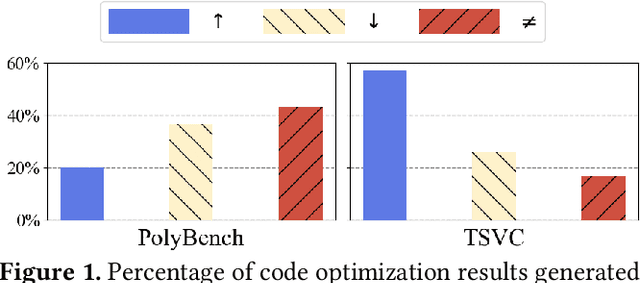
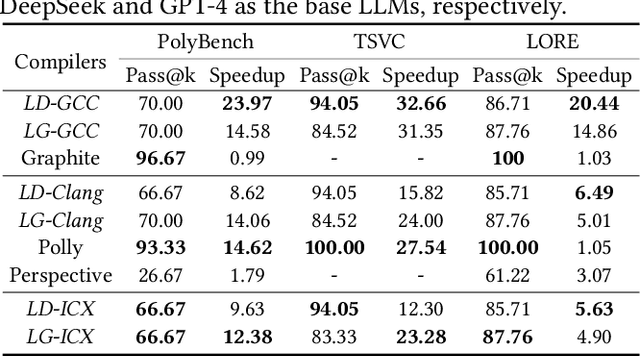
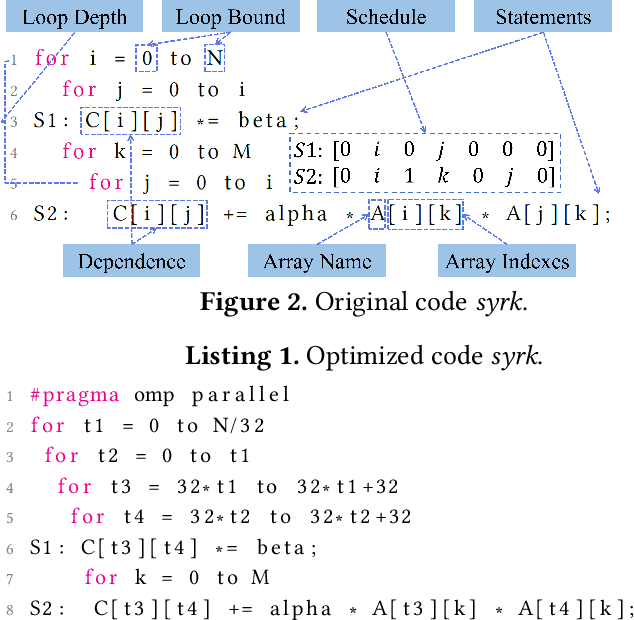
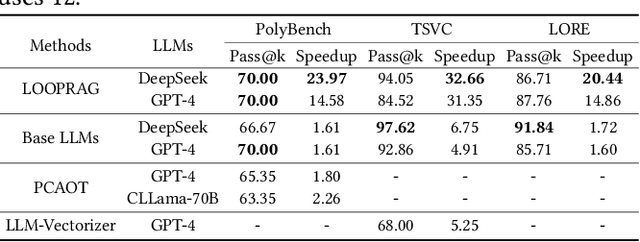
Loop transformations are semantics-preserving optimization techniques, widely used to maximize objectives such as parallelism. Despite decades of research, applying the optimal composition of loop transformations remains challenging due to inherent complexities, including cost modeling for optimization objectives. Recent studies have explored the potential of Large Language Models (LLMs) for code optimization. However, our key observation is that LLMs often struggle with effective loop transformation optimization, frequently leading to errors or suboptimal optimization, thereby missing opportunities for performance improvements. To bridge this gap, we propose LOOPRAG, a novel retrieval-augmented generation framework designed to guide LLMs in performing effective loop optimization on Static Control Part. We introduce a parameter-driven method to harness loop properties, which trigger various loop transformations, and generate diverse yet legal example codes serving as a demonstration source. To effectively obtain the most informative demonstrations, we propose a loop-aware algorithm based on loop features, which balances similarity and diversity for code retrieval. To enhance correct and efficient code generation, we introduce a feedback-based iterative mechanism that incorporates compilation, testing and performance results as feedback to guide LLMs. Each optimized code undergoes mutation, coverage and differential testing for equivalence checking. We evaluate LOOPRAG on PolyBench, TSVC and LORE benchmark suites, and compare it against compilers (GCC-Graphite, Clang-Polly, Perspective and ICX) and representative LLMs (DeepSeek and GPT-4). The results demonstrate average speedups over base compilers of up to 11.20$\times$, 14.34$\times$, and 9.29$\times$ for PolyBench, TSVC, and LORE, respectively, and speedups over base LLMs of up to 11.97$\times$, 5.61$\times$, and 11.59$\times$.