 Add to Chrome
 Add to Firefox
 Add to Edge
HierKick: Hierarchical Reinforcement Learning for Vision-Guided Soccer Robot Control
Mar 01, 2026
Controlling soccer robots involves multi-time-scale decision-making, which requires balancing long-term tactical planning and short-term motion execution. Traditional end-to-end reinforcement learning (RL) methods face challenges in complex dynamic environments. This paper proposes HierKick, a vision-guided soccer robot control framework based on dual-frequency hierarchical RL. The framework adopts a hierarchical control architecture featuring a 5 Hz high-level policy that integrates YOLOv8 for real-time detection and selects tasks via a coach model, and a pre-trained 50 Hz low-level controller for precise joint control. Through this architecture, the framework achieves the four steps of approaching, aligning, dribbling, and kicking. Experimental results show that the success rates of this framework are 95.2\% in IsaacGym, 89.8\% in Mujoco, and 80\% in the real world. HierKick provides an effective hierarchical paradigm for robot control in complex environments, extendable to multi-time-scale tasks, with its modular design and skill reuse offering a new path for intelligent robot control.

Rethinking Security of Diffusion-based Generative Steganography
Feb 10, 2026Generative image steganography is a technique that conceals secret messages within generated images, without relying on pre-existing cover images. Recently, a number of diffusion model-based generative image steganography (DM-GIS) methods have been introduced, which effectively combat traditional steganalysis techniques. In this paper, we identify the key factors that influence DM-GIS security and revisit the security of existing methods. Specifically, we first provide an overview of the general pipelines of current DM-GIS methods, finding that the noise space of diffusion models serves as the primary embedding domain. Further, we analyze the relationship between DM-GIS security and noise distribution of diffusion models, theoretically demonstrating that any steganographic operation that disrupts the noise distribution compromise DM-GIS security. Building on this insight, we propose a Noise Space-based Diffusion Steganalyzer (NS-DSer)-a simple yet effective steganalysis framework allowing for detecting DM-GIS generated images in the diffusion model noise space. We reevaluate the security of existing DM-GIS methods using NS-DSer across increasingly challenging detection scenarios. Experimental results validate our theoretical analysis of DM-GIS security and show the effectiveness of NS-DSer across diverse detection scenarios.
Ultrasound Liver Fibrosis Diagnosis using Multi-indicator guided Deep Neural Networks
Sep 10, 2020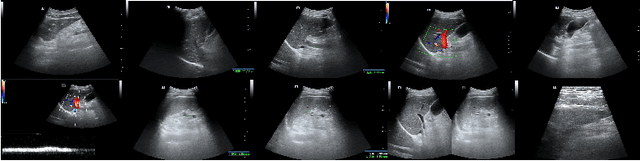
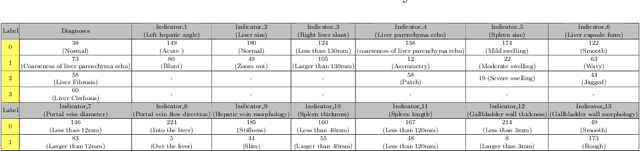
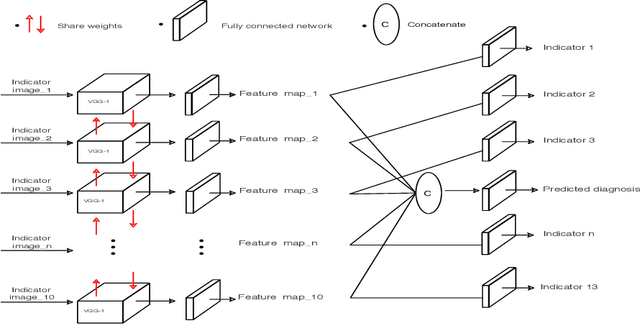
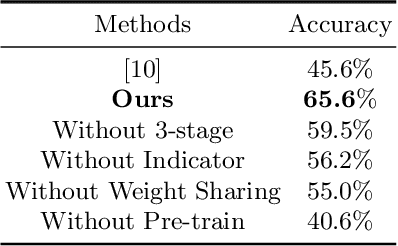
Accurate analysis of the fibrosis stage plays very important roles in follow-up of patients with chronic hepatitis B infection. In this paper, a deep learning framework is presented for automatically liver fibrosis prediction. On contrary of previous works, our approach can take use of the information provided by multiple ultrasound images. An indicator-guided learning mechanism is further proposed to ease the training of the proposed model. This follows the workflow of clinical diagnosis and make the prediction procedure interpretable. To support the training, a dataset is well-collected which contains the ultrasound videos/images, indicators and labels of 229 patients. As demonstrated in the experimental results, our proposed model shows its effectiveness by achieving the state-of-the-art performance, specifically, the accuracy is 65.6%(20% higher than previous best).
* Jiali Liu and Wenxuan Wang are equal contribution