 Add to Chrome
 Add to Firefox
 Add to Edge
SNR-ST-Mix: Sample-specific Neighborhood Regression Mixup for Augmented Spatial Transcriptomics Imputation with Deep Neural Network
Jun 07, 2026
Purpose: Spatial transcriptomics (ST) enables gene expression measurements within the tissue context. However, these measurements are often noisy, low-resolution, and sparsely sampled, which limits the recovery of fine spatial structure. Deep neural networks have become powerful tools for expression imputation from histology, but their performance remains constrained by limited sample sizes and a lack of biologically informed augmentation. Most of the existing augmentation strategies for learning are designed for classification tasks rather than regression, which neglect spatial and transcriptomic relationships, leading to biologically implausible interpolations that hinder prediction performance. Approach: To address these limitations, we propose SNR-ST-Mix, a geometry- and expression-aware data augmentation framework designed specifically for ST data. It constrains mixing to a spot's k-nearest spatial neighbors and adaptively weights interpolation coefficients based on expression similarity, generating augmented samples that preserve local biological structure while ensuring spatial smoothness. This dual conditioning yields synthetic examples that expand the effective training manifold, promote generalization, and enhance prediction stability under sample-specific training. Results: Extensive experiments with various tissue types demonstrate that SNR-ST-Mix consistently outperforms conventional augmentation methods without requiring architectural changes or additional computation. Conclusions: SNR-ST-Mix provides an effective and biologically principled augmentation strategy for spatial transcriptomics regression tasks. By explicitly leveraging spatial geometry and transcriptomic similarity, it expands the effective training manifold and improves predictive performance without increasing model complexity.

Towards end-to-end LLM-based censoring-aware survival analysis
May 25, 2026Objective: Survival analysis is central to medical prediction, yet large language models (LLMs) are rarely used as end-to-end survival models because censoring prevents straightforward supervised fine-tuning. Here we present LLMSurvival, a framework that enables censoring-aware survival analysis with unmodified LLMs operating directly on tabular clinical data. Materials and Methods: LLMSurvival reformulates time-to-event prediction as pairwise ranking among comparable subjects, and derives test-time risk by aggregating comparisons against anchor individuals from the training cohort. Results: Across two clinical tasks (ICU mortality prediction in MIMIC-IV and fragility fracture prediction in a NewYork-Presbyterian/Weill Cornell Medicine cohort), LLMSurvival improves overall concordance over Cox proportional hazards modeling by 3.1% for ICU mortality and 0.5% for fracture risk, 2.1% on average for ICU mortality and 2.8% for fracture risk over three established deep learning survival models. Discussion: The results show that survival modeling with censoring can be made compatible with LLM fine-tuning through comparison-based reformulation. The framework demonstrates high portability and superior performance over expert curated scores like SAPS-II and FRAX scores across diverse clinical context. Furthermore, the framework supports local deployment, as compact, publicly available base models provide sufficient performance. Conclusion: The LLMSurvival framework serves as a proof of concept for an integrated, censoring-conscious approach to survival analysis via LLMs.
Central-to-Local Adaptive Generative Diffusion Framework for Improving Gene Expression Prediction in Data-Limited Spatial Transcriptomics
Mar 27, 2026Spatial Transcriptomics (ST) provides spatially resolved gene expression profiles within intact tissue architecture, enabling molecular analysis in histological context. However, the high cost, limited throughput, and restricted data sharing of ST experiments result in severe data scarcity, constraining the development of robust computational models. To address this limitation, we present a Central-to-Local adaptive generative diffusion framework for ST (C2L-ST) that integrates large-scale morphological priors with limited molecular guidance. A global central model is first pretrained on extensive histopathology datasets to learn transferable morphological representations, and institution-specific local models are then adapted through lightweight gene-conditioned modulation using a small number of paired image-gene spots. This strategy enables the synthesis of realistic and molecularly consistent histology patches under data-limited conditions. The generated images exhibit high visual and structural fidelity, reproduce cellular composition, and show strong embedding overlap with real data across multiple organs, reflecting both realism and diversity. When incorporated into downstream training, synthetic image-gene pairs improve gene expression prediction accuracy and spatial coherence, achieving performance comparable to real data while requiring only a fraction of sampled spots. C2L-ST provides a scalable and data-efficient framework for molecular-level data augmentation, offering a domain-adaptive and generalizable approach for integrating histology and transcriptomics in spatial biology and related fields.
SkinGPT-R1: Adapter-Only Dual Distillation for Efficient Dermatology Reasoning
Nov 19, 2025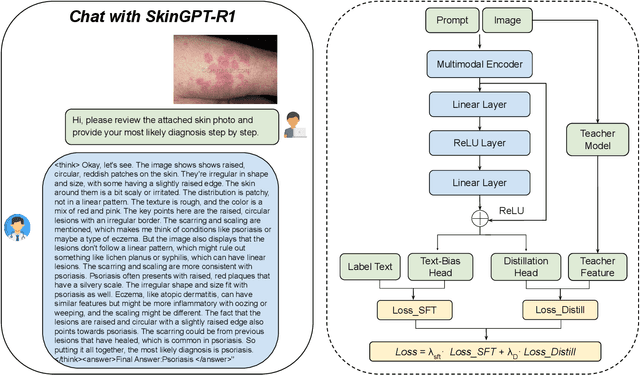
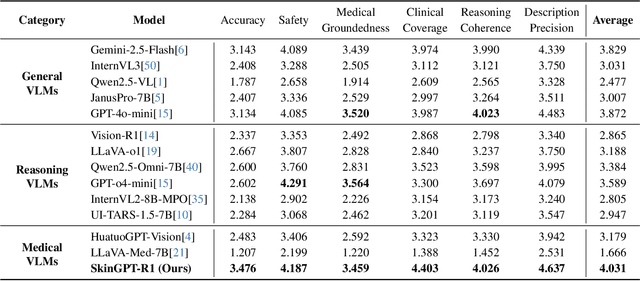
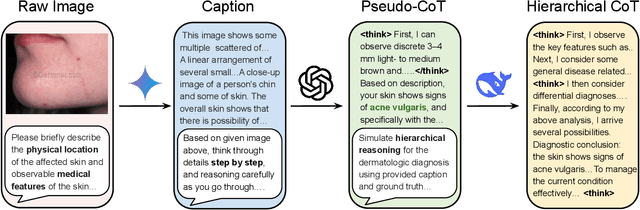
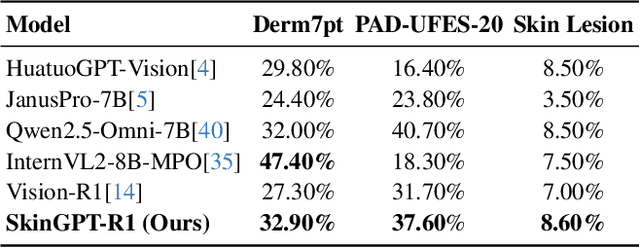
We present SkinGPT-R1, a dermatology focused vision language model that makes diagnostic chain of thought reasoning explicit, step by step, and verifiable. To support skin specific reasoning, we build DermCoT, a corpus of standardized dermatologic chain of thought narratives that combines 10,000 DermEval filtered training cases with 3,000 dermatologist scored certified cases, and we define DermEval as a physician aligned six dimensional evaluator and DermBench as the corresponding benchmark for dermatologic chain of thought quality. On DermBench, across 14 general, reasoning, and medical vision language models, SkinGPT-R1 achieves an average score of 4.031 out of 5 over the six clinician defined dimensions, ranks 1st among all systems, and improves the average score over Vision-R1 by about 41%. On three dermatology classification benchmarks, SkinGPT-R1 delivers stable accuracy gains over Vision-R1 and remains competitive among strong vision language models. Ablation results further show that DermCoT based chain of thought supervision provides substantial improvements over the base model and that adding dermatology aware visual distillation yields consistent additional gains in both narrative quality and recognition.
HiFusion: Hierarchical Intra-Spot Alignment and Regional Context Fusion for Spatial Gene Expression Prediction from Histopathology
Nov 19, 2025Spatial transcriptomics (ST) bridges gene expression and tissue morphology but faces clinical adoption barriers due to technical complexity and prohibitive costs. While computational methods predict gene expression from H&E-stained whole-slide images (WSIs), existing approaches often fail to capture the intricate biological heterogeneity within spots and are susceptible to morphological noise when integrating contextual information from surrounding tissue. To overcome these limitations, we propose HiFusion, a novel deep learning framework that integrates two complementary components. First, we introduce the Hierarchical Intra-Spot Modeling module that extracts fine-grained morphological representations through multi-resolution sub-patch decomposition, guided by a feature alignment loss to ensure semantic consistency across scales. Concurrently, we present the Context-aware Cross-scale Fusion module, which employs cross-attention to selectively incorporate biologically relevant regional context, thereby enhancing representational capacity. This architecture enables comprehensive modeling of both cellular-level features and tissue microenvironmental cues, which are essential for accurate gene expression prediction. Extensive experiments on two benchmark ST datasets demonstrate that HiFusion achieves state-of-the-art performance across both 2D slide-wise cross-validation and more challenging 3D sample-specific scenarios. These results underscore HiFusion's potential as a robust, accurate, and scalable solution for ST inference from routine histopathology.
CoTBox-TTT: Grounding Medical VQA with Visual Chain-of-Thought Boxes During Test-time Training
Nov 16, 2025Medical visual question answering could support clinical decision making, yet current systems often fail under domain shift and produce answers that are weakly grounded in image evidence. This reliability gap arises when models attend to spurious regions and when retraining or additional labels are impractical at deployment time. We address this setting with CoTBox-TTT, an evidence-first test-time training approach that adapts a vision-language model at inference while keeping all backbones frozen. The method updates only a small set of continuous soft prompts. It identifies question-relevant regions through a visual chain-of-thought signal and encourages answer consistency across the original image and a localized crop. The procedure is label free, and plug and play with diverse backbones. Experiments on medical VQA show that the approach is practical for real deployments. For instance, adding CoTBox-TTT to LLaVA increases closed-ended accuracy by 12.3% on pathVQA.
Towards Trustworthy Dermatology MLLMs: A Benchmark and Multimodal Evaluator for Diagnostic Narratives
Nov 12, 2025Multimodal large language models (LLMs) are increasingly used to generate dermatology diagnostic narratives directly from images. However, reliable evaluation remains the primary bottleneck for responsible clinical deployment. We introduce a novel evaluation framework that combines DermBench, a meticulously curated benchmark, with DermEval, a robust automatic evaluator, to enable clinically meaningful, reproducible, and scalable assessment. We build DermBench, which pairs 4,000 real-world dermatology images with expert-certified diagnostic narratives and uses an LLM-based judge to score candidate narratives across clinically grounded dimensions, enabling consistent and comprehensive evaluation of multimodal models. For individual case assessment, we train DermEval, a reference-free multimodal evaluator. Given an image and a generated narrative, DermEval produces a structured critique along with an overall score and per-dimension ratings. This capability enables fine-grained, per-case analysis, which is critical for identifying model limitations and biases. Experiments on a diverse dataset of 4,500 cases demonstrate that DermBench and DermEval achieve close alignment with expert ratings, with mean deviations of 0.251 and 0.117 (out of 5), respectively, providing reliable measurement of diagnostic ability and trustworthiness across different multimodal LLMs.
Sparser2Sparse: Single-shot Sparser-to-Sparse Learning for Spatial Transcriptomics Imputation with Natural Image Co-learning
Jul 22, 2025Spatial transcriptomics (ST) has revolutionized biomedical research by enabling high resolution gene expression profiling within tissues. However, the high cost and scarcity of high resolution ST data remain significant challenges. We present Single-shot Sparser-to-Sparse (S2S-ST), a novel framework for accurate ST imputation that requires only a single and low-cost sparsely sampled ST dataset alongside widely available natural images for co-training. Our approach integrates three key innovations: (1) a sparser-to-sparse self-supervised learning strategy that leverages intrinsic spatial patterns in ST data, (2) cross-domain co-learning with natural images to enhance feature representation, and (3) a Cascaded Data Consistent Imputation Network (CDCIN) that iteratively refines predictions while preserving sampled gene data fidelity. Extensive experiments on diverse tissue types, including breast cancer, liver, and lymphoid tissue, demonstrate that our method outperforms state-of-the-art approaches in imputation accuracy. By enabling robust ST reconstruction from sparse inputs, our framework significantly reduces reliance on costly high resolution data, facilitating potential broader adoption in biomedical research and clinical applications.
AMA-SAM: Adversarial Multi-Domain Alignment of Segment Anything Model for High-Fidelity Histology Nuclei Segmentation
Mar 27, 2025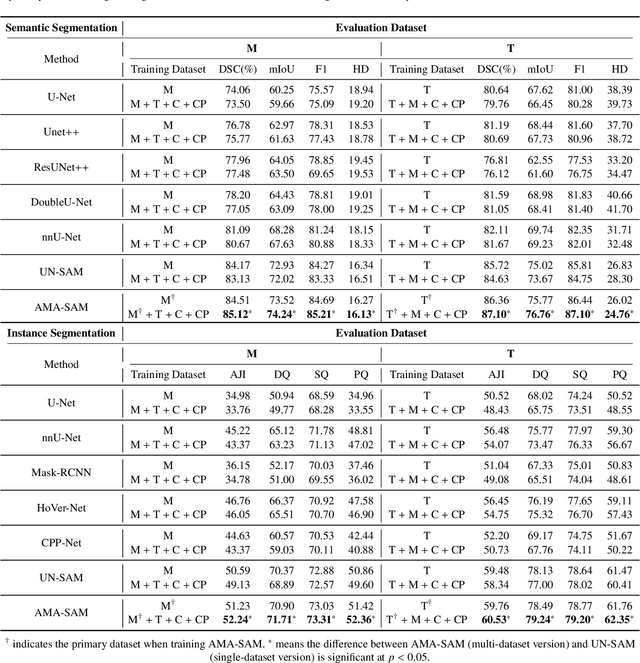
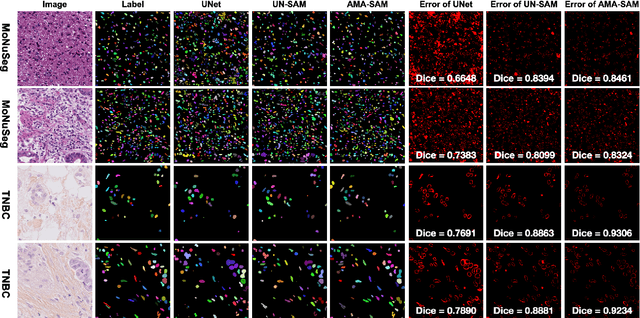
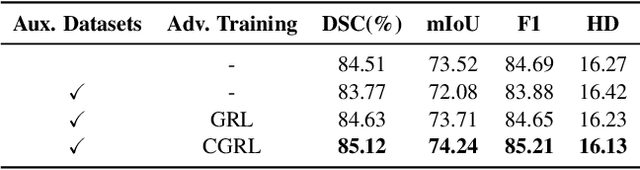
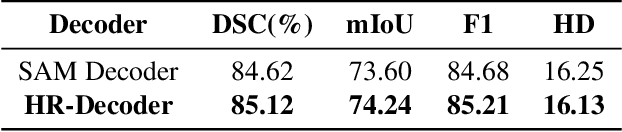
Accurate segmentation of cell nuclei in histopathology images is essential for numerous biomedical research and clinical applications. However, existing cell nucleus segmentation methods only consider a single dataset (i.e., primary domain), while neglecting to leverage supplementary data from diverse sources (i.e., auxiliary domains) to reduce overfitting and enhance the performance. Although incorporating multiple datasets could alleviate overfitting, it often exacerbates performance drops caused by domain shifts. In this work, we introduce Adversarial Multi-domain Alignment of Segment Anything Model (AMA-SAM) that extends the Segment Anything Model (SAM) to overcome these obstacles through two key innovations. First, we propose a Conditional Gradient Reversal Layer (CGRL), a multi-domain alignment module that harmonizes features from diverse domains to promote domain-invariant representation learning while preserving crucial discriminative features for the primary dataset. Second, we address SAM's inherent low-resolution output by designing a High-Resolution Decoder (HR-Decoder), which directly produces fine-grained segmentation maps in order to capture intricate nuclei boundaries in high-resolution histology images. To the best of our knowledge, this is the first attempt to adapt SAM for multi-dataset learning with application to histology nuclei segmentation. We validate our method on several publicly available datasets, demonstrating consistent and significant improvements over state-of-the-art approaches.