 Add to Chrome
 Add to Firefox
 Add to Edge
Beyond Prompt-Based Planning: MCP-Native Graph Planning-based Biomedical Agent System
Jun 03, 2026
Biomedical agents promise to automate complex biological workflows, yet current systems face two fundamental bottlenecks: bioinformatics tools are highly heterogeneous in interfaces and execution environments, while agent planning still relies on flat prompt-retrieved tool descriptions. As biomedical software ecosystems grow, this coupling between tool coverage and context size leads to tool confusion, unstable planning, and inefficient execution. We introduce BioManus, an MCP-native biomedical agent built on graph-scaffolded planning over structured biological capabilities. BioManus first introduces the BioinfoMCP Compiler, which converts heterogeneous bioinformatics software into standardized MCP servers, yielding a large executable MCP ecosystem. It then organizes this ecosystem as a typed heterogeneous MCP graph over tools, operations, datatypes, and workflow stages. At inference time, BioManus retrieves compact task-specific subgraphs, synthesizes operation-level workflow scaffolds. This design decouples planning complexity from raw tool inventory size, achieving a context compression ratio of Theta(N / (h * m_bar)) under high-recall retrieval, where N is the total tool count, h is the workflow horizon, and m_bar (much smaller than N) is the average number of candidate tools per operation. Experiments on BioAgentBench and LAB-Bench show that BioManus improves execution accuracy, workflow validity, and context efficiency over advanced biomedical agent baselines. This work suggests a paradigm shift: scalable biomedical reasoning requires structured executable capability graphs rather than increasingly larger prompt-level tool retrieval.

SkinGPT-X: A Self-Evolving Collaborative Multi-Agent System for Transparent and Trustworthy Dermatological Diagnosis
Mar 27, 2026While recent advancements in Large Language Models have significantly advanced dermatological diagnosis, monolithic LLMs frequently struggle with fine-grained, large-scale multi-class diagnostic tasks and rare skin disease diagnosis owing to training data sparsity, while also lacking the interpretability and traceability essential for clinical reasoning. Although multi-agent systems can offer more transparent and explainable diagnostics, existing frameworks are primarily concentrated on Visual Question Answering and conversational tasks, and their heavy reliance on static knowledge bases restricts adaptability in complex real-world clinical settings. Here, we present SkinGPT-X, a multimodal collaborative multi-agent system for dermatological diagnosis integrated with a self-evolving dermatological memory mechanism. By simulating the diagnostic workflow of dermatologists and enabling continuous memory evolution, SkinGPT-X delivers transparent and trustworthy diagnostics for the management of complex and rare dermatological cases. To validate the robustness of SkinGPT-X, we design a three-tier comparative experiment. First, we benchmark SkinGPT-X against four state-of-the-art LLMs across four public datasets, demonstrating its state-of-the-art performance with a +9.6% accuracy improvement on DDI31 and +13% weighted F1 gain on Dermnet over the state-of-the-art model. Second, we construct a large-scale multi-class dataset covering 498 distinct dermatological categories to evaluate its fine-grained classification capabilities. Finally, we curate the rare skin disease dataset, the first benchmark to address the scarcity of clinical rare skin diseases which contains 564 clinical samples with eight rare dermatological diseases. On this dataset, SkinGPT-X achieves a +9.8% accuracy improvement, a +7.1% weighted F1 improvement, a +10% Cohen's Kappa improvement.
SkinGPT-R1: Adapter-Only Dual Distillation for Efficient Dermatology Reasoning
Nov 19, 2025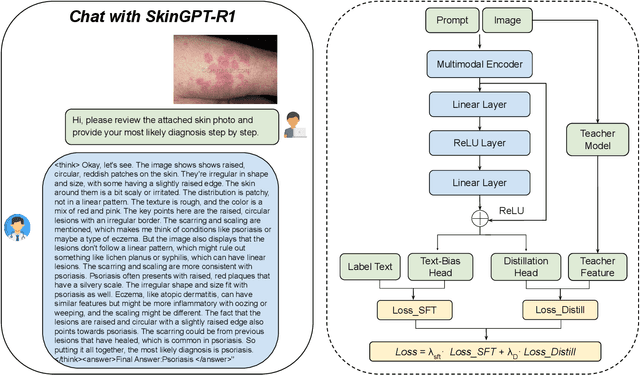
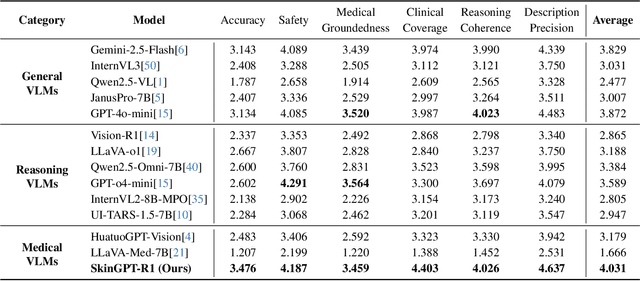
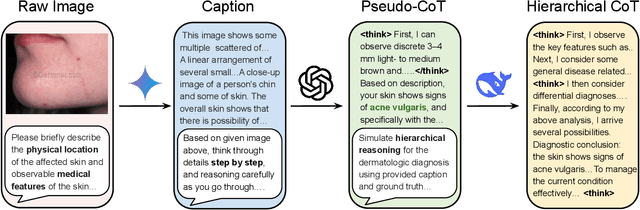
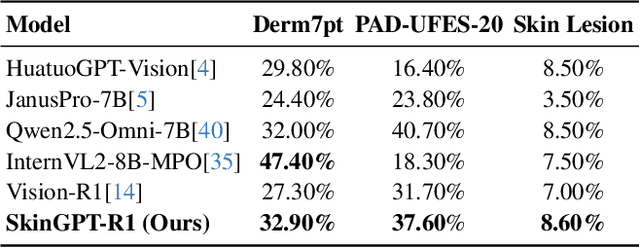
We present SkinGPT-R1, a dermatology focused vision language model that makes diagnostic chain of thought reasoning explicit, step by step, and verifiable. To support skin specific reasoning, we build DermCoT, a corpus of standardized dermatologic chain of thought narratives that combines 10,000 DermEval filtered training cases with 3,000 dermatologist scored certified cases, and we define DermEval as a physician aligned six dimensional evaluator and DermBench as the corresponding benchmark for dermatologic chain of thought quality. On DermBench, across 14 general, reasoning, and medical vision language models, SkinGPT-R1 achieves an average score of 4.031 out of 5 over the six clinician defined dimensions, ranks 1st among all systems, and improves the average score over Vision-R1 by about 41%. On three dermatology classification benchmarks, SkinGPT-R1 delivers stable accuracy gains over Vision-R1 and remains competitive among strong vision language models. Ablation results further show that DermCoT based chain of thought supervision provides substantial improvements over the base model and that adding dermatology aware visual distillation yields consistent additional gains in both narrative quality and recognition.
CoTBox-TTT: Grounding Medical VQA with Visual Chain-of-Thought Boxes During Test-time Training
Nov 16, 2025Medical visual question answering could support clinical decision making, yet current systems often fail under domain shift and produce answers that are weakly grounded in image evidence. This reliability gap arises when models attend to spurious regions and when retraining or additional labels are impractical at deployment time. We address this setting with CoTBox-TTT, an evidence-first test-time training approach that adapts a vision-language model at inference while keeping all backbones frozen. The method updates only a small set of continuous soft prompts. It identifies question-relevant regions through a visual chain-of-thought signal and encourages answer consistency across the original image and a localized crop. The procedure is label free, and plug and play with diverse backbones. Experiments on medical VQA show that the approach is practical for real deployments. For instance, adding CoTBox-TTT to LLaVA increases closed-ended accuracy by 12.3% on pathVQA.
Towards Trustworthy Dermatology MLLMs: A Benchmark and Multimodal Evaluator for Diagnostic Narratives
Nov 12, 2025Multimodal large language models (LLMs) are increasingly used to generate dermatology diagnostic narratives directly from images. However, reliable evaluation remains the primary bottleneck for responsible clinical deployment. We introduce a novel evaluation framework that combines DermBench, a meticulously curated benchmark, with DermEval, a robust automatic evaluator, to enable clinically meaningful, reproducible, and scalable assessment. We build DermBench, which pairs 4,000 real-world dermatology images with expert-certified diagnostic narratives and uses an LLM-based judge to score candidate narratives across clinically grounded dimensions, enabling consistent and comprehensive evaluation of multimodal models. For individual case assessment, we train DermEval, a reference-free multimodal evaluator. Given an image and a generated narrative, DermEval produces a structured critique along with an overall score and per-dimension ratings. This capability enables fine-grained, per-case analysis, which is critical for identifying model limitations and biases. Experiments on a diverse dataset of 4,500 cases demonstrate that DermBench and DermEval achieve close alignment with expert ratings, with mean deviations of 0.251 and 0.117 (out of 5), respectively, providing reliable measurement of diagnostic ability and trustworthiness across different multimodal LLMs.
BioinfoMCP: A Unified Platform Enabling MCP Interfaces in Agentic Bioinformatics
Oct 02, 2025Bioinformatics tools are essential for complex computational biology tasks, yet their integration with emerging AI-agent frameworks is hindered by incompatible interfaces, heterogeneous input-output formats, and inconsistent parameter conventions. The Model Context Protocol (MCP) provides a standardized framework for tool-AI communication, but manually converting hundreds of existing and rapidly growing specialized bioinformatics tools into MCP-compliant servers is labor-intensive and unsustainable. Here, we present BioinfoMCP, a unified platform comprising two components: BioinfoMCP Converter, which automatically generates robust MCP servers from tool documentation using large language models, and BioinfoMCP Benchmark, which systematically validates the reliability and versatility of converted tools across diverse computational tasks. We present a platform of 38 MCP-converted bioinformatics tools, extensively validated to show that 94.7% successfully executed complex workflows across three widely used AI-agent platforms. By removing technical barriers to AI automation, BioinfoMCP enables natural-language interaction with sophisticated bioinformatics analyses without requiring extensive programming expertise, offering a scalable path to intelligent, interoperable computational biology.