 Add to Chrome
 Add to Firefox
 Add to Edge
Collapse or Preserve: Data-Dependent Temporal Aggregation for Spiking Neural Network Acceleration
Mar 14, 2026
Spike sparsity is widely believed to enable efficient spiking neural network (SNN) inference on GPU hardware. We demonstrate this is an illusion: five distinct sparse computation strategies on Apple M3 Max all fail to outperform dense convolution, because SIMD architectures cannot exploit the fine-grained, unstructured sparsity of i.i.d. binary spikes. Instead, we propose Temporal Aggregated Convolution (TAC), which exploits convolution linearity to pre-aggregate $K$ spike frames before a single convolution call, reducing $T$ calls to $T/K$. On rate-coded data, TAC achieves 13.8times speedup with +1.6% accuracy on MNIST and +5.4% on Fashion-MNIST -- a simultaneous improvement in both speed and accuracy. However, on event-based data where the temporal dimension carries genuine motion information, TAC's temporal collapse is harmful. We therefore introduce TAC-TP (Temporal Preservation), which shares each group's convolution output across K independent LIF steps, preserving full temporal resolution for downstream layers. On DVS128-Gesture, TAC-TP achieves 95.1% accuracy (vs. 96.3% baseline) with 50% fewer convolution calls, while standard TAC drops to 91.3%. Our key finding is that the optimal temporal aggregation strategy is data-dependent: collapse the temporal dimension for rate-coded data (noise reduction) but preserve it for event data (information retention). Speedup is hardware-agnostic: TAC achieves 11.0times on NVIDIA V100, confirming the mechanism transfers across GPU architectures. All operators in the mlx-snn library are open source.

mlx-snn: Spiking Neural Networks on Apple Silicon via MLX
Mar 03, 2026We introduce mlx-snn, the first spiking neural network (SNN) library built natively on Apple's MLX framework. As SNN research grows rapidly, all major libraries -- snnTorch, Norse, SpikingJelly, Lava -- target PyTorch or custom backends, leaving Apple Silicon users without a native option. mlx-snn provides six neuron models (LIF, IF, Izhikevich, Adaptive LIF, Synaptic, Alpha), four surrogate gradient functions, four spike encoding methods (including an EEG-specific encoder), and a complete backpropagation-through-time training pipeline. The library leverages MLX's unified memory architecture, lazy evaluation, and composable function transforms (mx.grad, mx.compile) to enable efficient SNN research on Apple Silicon hardware. We validate mlx-snn on MNIST digit classification across five hyperparameter configurations and three backends, achieving up to 97.28% accuracy with 2.0--2.5 times faster training and 3--10 times lower GPU memory than snnTorch on the same M3 Max hardware. mlx-snn is open-source under the MIT license and available on PyPI. https://github.com/D-ST-Sword/mlx-snn
Position-Aware Scene-Appearance Disentanglement for Bidirectional Photoacoustic Microscopy Registration
Feb 17, 2026High-speed optical-resolution photoacoustic microscopy (OR-PAM) with bidirectional raster scanning doubles imaging speed but introduces coupled domain shift and geometric misalignment between forward and backward scan lines. Existing registration methods, constrained by brightness constancy assumptions, achieve limited alignment quality, while recent generative approaches address domain shift through complex architectures that lack temporal awareness across frames. We propose GPEReg-Net, a scene-appearance disentanglement framework that separates domain-invariant scene features from domain-specific appearance codes via Adaptive Instance Normalization (AdaIN), enabling direct image-to-image registration without explicit deformation field estimation. To exploit temporal structure in sequential acquisitions, we introduce a Global Position Encoding (GPE) module that combines learnable position embeddings with sinusoidal encoding and cross-frame attention, allowing the network to leverage context from neighboring frames for improved temporal coherence. On the OR-PAM-Reg-4K benchmark (432 test samples), GPEReg-Net achieves NCC of 0.953, SSIM of 0.932, and PSNR of 34.49dB, surpassing the state-of-the-art by 3.8% in SSIM and 1.99dB in PSNR while maintaining competitive NCC. Code is available at https://github.com/JiahaoQin/GPEReg-Net.
Progressive Contrast Registration for High-Fidelity Bidirectional Photoacoustic Microscopy Alignment
Feb 09, 2026High-speed optical-resolution photoacoustic microscopy (OR-PAM) with bidirectional raster scanning doubles imaging speed but introduces coupled domain shift and geometric misalignment between forward and backward scan lines. Existing methods, constrained by brightness constancy assumptions, achieve limited alignment quality (NCC~$\leq 0.96$). We propose PCReg-Net, a progressive contrast-guided registration framework that performs coarse-to-fine alignment through four lightweight modules: (1)~a registration U-Net for coarse alignment, (2)~a reference feature extractor capturing multi-scale structural cues, (3)~a contrast module that identifies residual misalignment by comparing coarse-registered and reference features, and (4)~a refinement U-Net with feature injection for high-fidelity output. We further propose the Temporal NCC (TNCC) and Temporal NCC Gap (TNCG) for reference-free evaluation of inter-frame temporal consistency. On OR-PAM-Reg-4K (432 test samples), PCReg-Net achieves NCC of 0.983, SSIM of 0.982, and PSNR of 46.96 dB, surpassing the state-of-the-art by over 14 dB at real-time speed. Code is available at https://github.com/JiahaoQin/PCReg-Net
SAS-Net: Scene-Appearance Separation Network for Robust Spatiotemporal Registration in Bidirectional Photoacoustic Microscopy
Feb 06, 2026High-speed optical-resolution photoacoustic microscopy (OR-PAM) with bidirectional scanning enables rapid functional brain imaging but introduces severe spatiotemporal misalignment from coupled scan-direction-dependent domain shift and geometric distortion. Conventional registration methods rely on brightness constancy, an assumption violated under bidirectional scanning, leading to unreliable alignment. A unified scene-appearance separation framework is proposed to jointly address domain shift and spatial misalignment. The proposed architecture separates domain-invariant scene content from domain-specific appearance characteristics, enabling cross-domain reconstruction with geometric preservation. A scene consistency loss promotes geometric correspondence in the latent space, linking domain shift correction with spatial registration within a single framework. For in vivo mouse brain vasculature imaging, the proposed method achieves normalized cross-correlation (NCC) of 0.961 and structural similarity index (SSIM) of 0.894, substantially outperforming conventional methods. Ablation studies demonstrate that domain alignment loss is critical, with its removal causing 82% NCC reduction (0.961 to 0.175), while scene consistency and cycle consistency losses provide complementary regularization for optimal performance. The method achieves 11.2 ms inference time per frame (86 fps), substantially exceeding typical OR-PAM acquisition rates and enabling real-time processing. These results suggest that the proposed framework enables robust high-speed bidirectional OR-PAM for reliable quantitative and longitudinal functional imaging. The code will be publicly available at https://github.com/D-ST-Sword/SAS-Net
DCER: Dual-Stage Compression and Energy-Based Reconstruction
Feb 03, 2026Multimodal fusion faces two robustness challenges: noisy inputs degrade representation quality, and missing modalities cause prediction failures. We propose DCER, a unified framework addressing both challenges through dual-stage compression and energy-based reconstruction. The compression stage operates at two levels: within-modality frequency transforms (wavelet for audio, DCT for video) remove noise while preserving task-relevant patterns, and cross-modality bottleneck tokens force genuine integration rather than modality-specific shortcuts. For missing modalities, energy-based reconstruction recovers representations via gradient descent on a learned energy function, with the final energy providing intrinsic uncertainty quantification (\r{ho} > 0.72 correlation with prediction error). Experiments on CMU-MOSI, CMU-MOSEI, and CH-SIMS demonstrate state-of-the-art performance across all benchmarks, with a U-shaped robustness pattern favoring multimodal fusion at both complete and high-missing conditions. The code will be available on Github.
Bio-Inspired Mamba: Temporal Locality and Bioplausible Learning in Selective State Space Models
Sep 17, 2024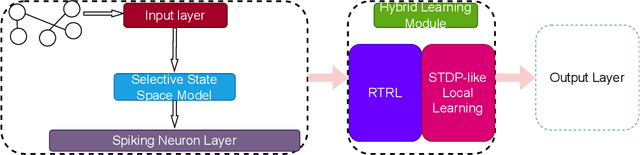
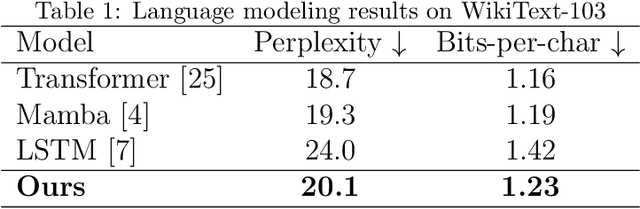
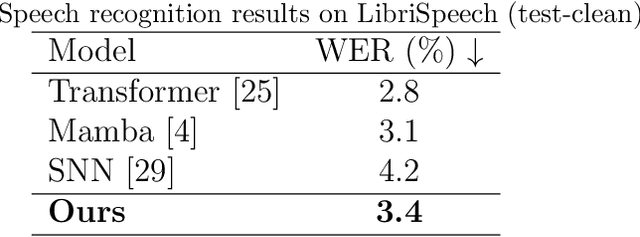
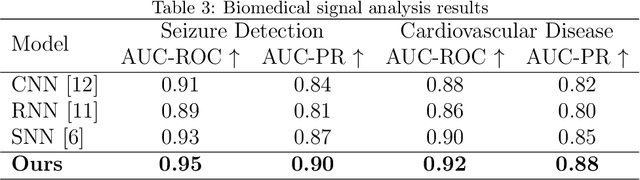
This paper introduces Bio-Inspired Mamba (BIM), a novel online learning framework for selective state space models that integrates biological learning principles with the Mamba architecture. BIM combines Real-Time Recurrent Learning (RTRL) with Spike-Timing-Dependent Plasticity (STDP)-like local learning rules, addressing the challenges of temporal locality and biological plausibility in training spiking neural networks. Our approach leverages the inherent connection between backpropagation through time and STDP, offering a computationally efficient alternative that maintains the ability to capture long-range dependencies. We evaluate BIM on language modeling, speech recognition, and biomedical signal analysis tasks, demonstrating competitive performance against traditional methods while adhering to biological learning principles. Results show improved energy efficiency and potential for neuromorphic hardware implementation. BIM not only advances the field of biologically plausible machine learning but also provides insights into the mechanisms of temporal information processing in biological neural networks.
Mamba-Spike: Enhancing the Mamba Architecture with a Spiking Front-End for Efficient Temporal Data Processing
Aug 04, 2024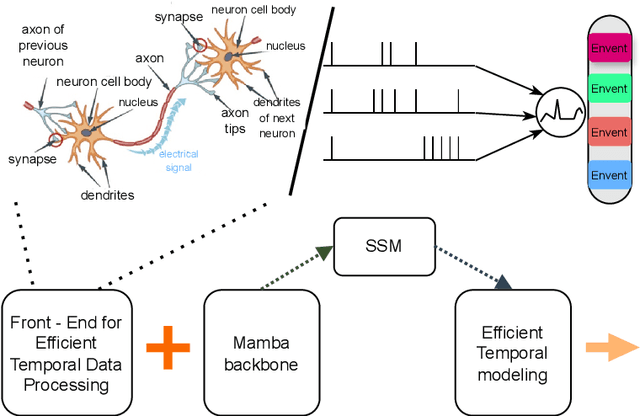
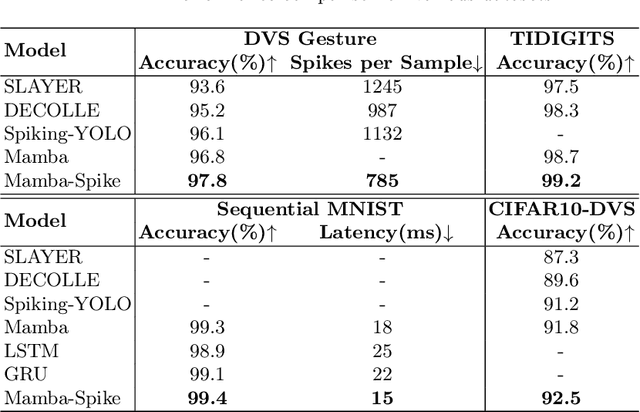
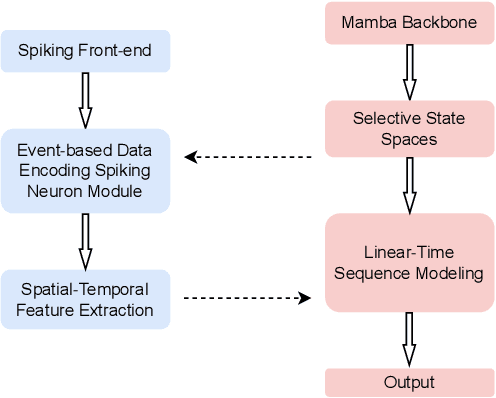
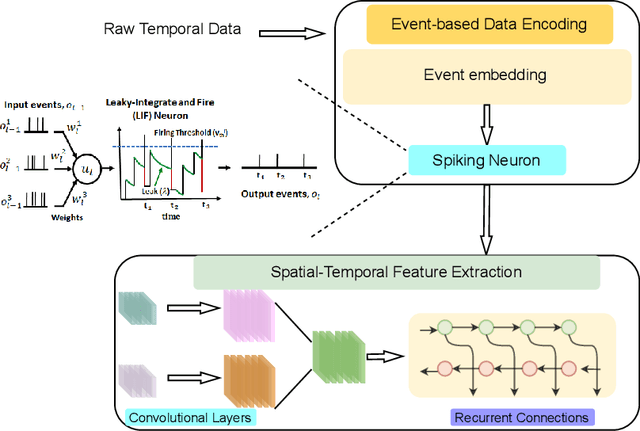
The field of neuromorphic computing has gained significant attention in recent years, aiming to bridge the gap between the efficiency of biological neural networks and the performance of artificial intelligence systems. This paper introduces Mamba-Spike, a novel neuromorphic architecture that integrates a spiking front-end with the Mamba backbone to achieve efficient and robust temporal data processing. The proposed approach leverages the event-driven nature of spiking neural networks (SNNs) to capture and process asynchronous, time-varying inputs, while harnessing the power of the Mamba backbone's selective state spaces and linear-time sequence modeling capabilities to model complex temporal dependencies effectively. The spiking front-end of Mamba-Spike employs biologically inspired neuron models, along with adaptive threshold and synaptic dynamics. These components enable efficient spatiotemporal feature extraction and encoding of the input data. The Mamba backbone, on the other hand, utilizes a hierarchical structure with gated recurrent units and attention mechanisms to capture long-term dependencies and selectively process relevant information. To evaluate the efficacy of the proposed architecture, a comprehensive empirical study is conducted on both neuromorphic datasets, including DVS Gesture and TIDIGITS, and standard datasets, such as Sequential MNIST and CIFAR10-DVS. The results demonstrate that Mamba-Spike consistently outperforms state-of-the-art baselines, achieving higher accuracy, lower latency, and improved energy efficiency. Moreover, the model exhibits robustness to various input perturbations and noise levels, highlighting its potential for real-world applications. The code will be available at https://github.com/ECNU-Cross-Innovation-Lab/Mamba-Spike.
Zoom and Shift are All You Need
Jun 13, 2024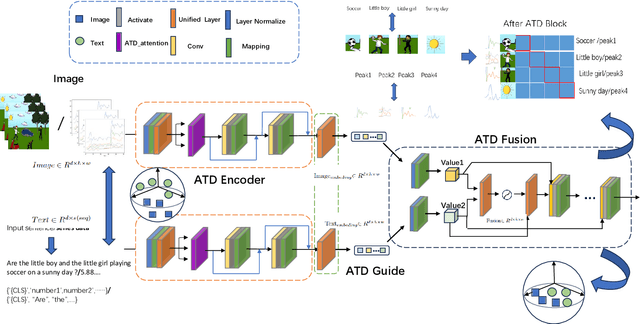
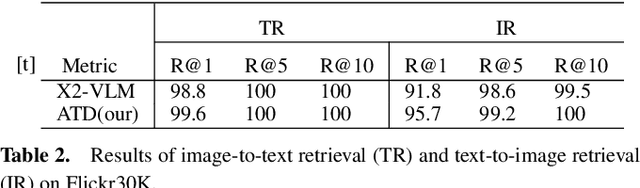
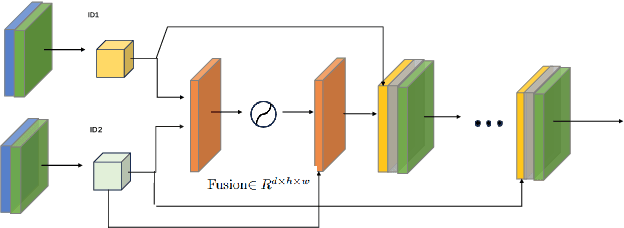
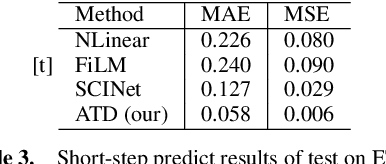
Feature alignment serves as the primary mechanism for fusing multimodal data. We put forth a feature alignment approach that achieves full integration of multimodal information. This is accomplished via an alternating process of shifting and expanding feature representations across modalities to obtain a consistent unified representation in a joint feature space. The proposed technique can reliably capture high-level interplay between features originating from distinct modalities. Consequently, substantial gains in multimodal learning performance are attained. Additionally, we demonstrate the superiority of our approach over other prevalent multimodal fusion schemes on a range of tasks. Extensive experimental evaluation conducted on multimodal datasets comprising time series, image, and text demonstrates that our method achieves state-of-the-art results.
MIPI 2024 Challenge on Few-shot RAW Image Denoising: Methods and Results
Jun 11, 2024

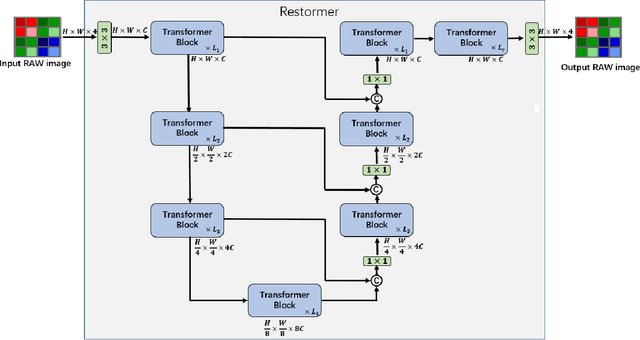

The increasing demand for computational photography and imaging on mobile platforms has led to the widespread development and integration of advanced image sensors with novel algorithms in camera systems. However, the scarcity of high-quality data for research and the rare opportunity for in-depth exchange of views from industry and academia constrain the development of mobile intelligent photography and imaging (MIPI). Building on the achievements of the previous MIPI Workshops held at ECCV 2022 and CVPR 2023, we introduce our third MIPI challenge including three tracks focusing on novel image sensors and imaging algorithms. In this paper, we summarize and review the Few-shot RAW Image Denoising track on MIPI 2024. In total, 165 participants were successfully registered, and 7 teams submitted results in the final testing phase. The developed solutions in this challenge achieved state-of-the-art erformance on Few-shot RAW Image Denoising. More details of this challenge and the link to the dataset can be found at https://mipichallenge.org/MIPI2024.