 Add to Chrome
 Add to Firefox
 Add to Edge
MR-LiDAR: A Multi-Resolution Roadside LiDAR Benchmark for Perception Diagnostics and Deployment Guidance
May 23, 2026
LiDAR model selection is a critical issue in roadside sensing systems, as it directly determines both perception capability and deployment cost. However, the lack of empirical benchmarks for comparing perception performance across different LiDAR configurations has greatly constrained scientific sensor selection and deployment planning. To address this gap, we present MR-LiDAR, a controlled multi-resolution LiDAR benchmark for roadside perception diagnostics. Using 16-, 32-, 80-, and 128-beam LiDARs in identical roadside scenarios, we collect point clouds and ground-truth annotations for diverse traffic participants, including vehicles and vulnerable road users (VRUs), across varying distances. This controlled design isolates intrinsic LiDAR specifications, particularly beam count and beam distribution, as the key variables for precise performance diagnostics. Based on MR-LiDAR, we conduct systematic empirical analyses to examine how beam count, beam distribution, target distance, object category, and vehicle occlusion affect LiDAR perception performance. The results reveal that all of these factors have substantial impacts. In particular, contrary to the common assumption that higher beam counts always yield better perception, we show that an 80-beam LiDAR with optimized beam distribution can match or even outperform a 128-beam LiDAR with uniform beam distribution. In addition, we provide a practical reference guide for LiDAR selection, including target point-count statistics and detection performance comparisons based on two widely used detection algorithms. This work offers a diagnostic benchmark and practical guidance for determining cost-effective LiDAR configurations in roadside perception applications.

A Novel Perception Entropy Metric for Optimizing Vehicle Perception with LiDAR Deployment
Jul 25, 2024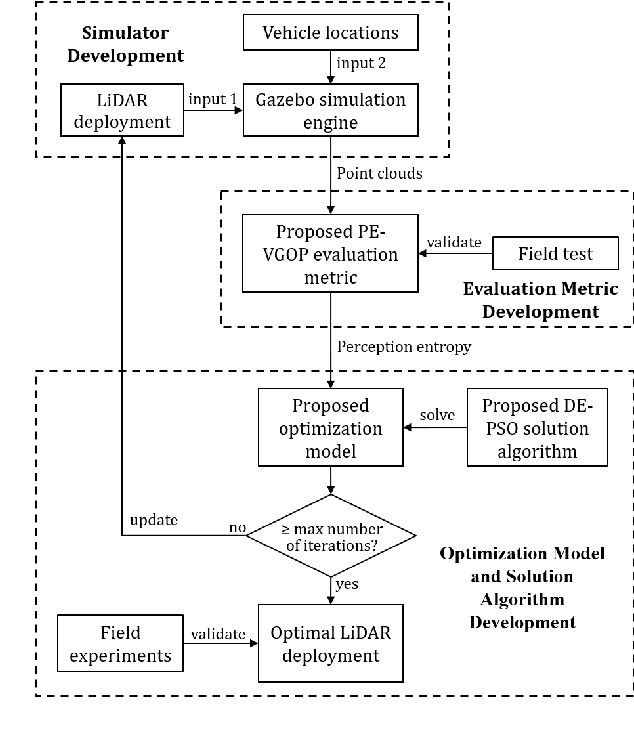
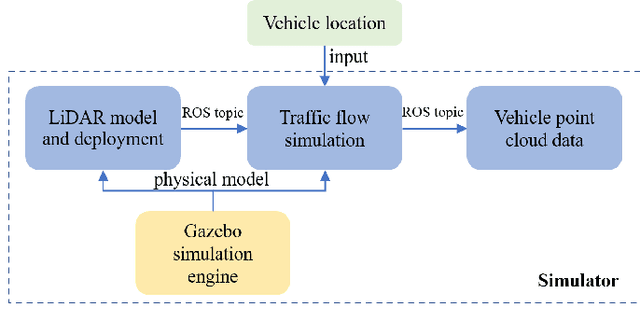

Developing an effective evaluation metric is crucial for accurately and swiftly measuring LiDAR perception performance. One major issue is the lack of metrics that can simultaneously generate fast and accurate evaluations based on either object detection or point cloud data. In this study, we propose a novel LiDAR perception entropy metric based on the probability of vehicle grid occupancy. This metric reflects the influence of point cloud distribution on vehicle detection performance. Based on this, we also introduce a LiDAR deployment optimization model, which is solved using a differential evolution-based particle swarm optimization algorithm. A comparative experiment demonstrated that the proposed PE-VGOP offers a correlation of more than 0.98 with vehicle detection ground truth in evaluating LiDAR perception performance. Furthermore, compared to the base deployment, field experiments indicate that the proposed optimization model can significantly enhance the perception capabilities of various types of LiDARs, including RS-16, RS-32, and RS-80. Notably, it achieves a 25% increase in detection Recall for the RS-32 LiDAR.