 Add to Chrome
 Add to Firefox
 Add to Edge
Effective Synthetic Image Detection via Noise Residual Clustering
Jul 12, 2026
The rapid advancement of generative artificial intelligence (AI) has made synthetic images remarkably realistic, posing security threats such as misinformation and fraud. It is significant to detect the synthetic image in the manner of passive and blind image authentication. Most existing detectors rely on supervised training with large labeled datasets, leading to high costs and degraded performance on unknown generative models. To attenuate such deficiencies, we propose a training-free detection method. Specifically, noise residual fingerprints are first extracted by a simple yet effective pre-trained Noiseprint++ model. Then multi-scale features are further extracted from such residual by a frozen Vision Transformer (ViT), followed by adaptive weighted fusion. Only a few real image samples are used needed to initialize the clustering centers for unsupervised K-Means, distinguishing real and synthetic images without training. Extensive evaluations on four benchmark datasets show that our proposed scheme achieves an average accuracy of 82.2%, outperforming the state-of-the-art detectors on generalization ability. Superior performance is gained on the popular diffusion type of synthetic images, and the effectiveness of each module is validated by ablation studies. Source code will be publicly available at https://github.com/multimediaFor/NoiseCluSID.

Generalized Synthetic Image Detection with Enhanced RGB-Noise Representation Learning
Jul 07, 2026The rapid advancement of large-scale generative models has accelerated the spread of highly deceptive AI-generated images, making generalized synthetic image detection a critical imperative. Existing forensic networks often struggle with cross-model generalization and realworld degradations due to their reliance on single-domain representations and conventional binary classification optimization. To overcome these limitations, we propose RNSIDNet, a novel forensic framework that achieves robust detection through enhanced RGB-Noise representation learning. Specifically, our method employs a dual-branch architecture where global RGB semantics, extracted by an attention-refined CLIP backbone, dynamically modulate highfrequency noise artifacts captured by Bayar convolutions via a Feature-wise Linear Modulation (FiLM) module. To further enhance the learned representations, we design a Hard Sample-aware Contrastive Learning (HSCL) strategy. By explicitly penalizing challenging training samples, HSCL reshapes the latent feature space to maximize the discriminative margin between pristine and synthetic domains. Extensive experiments across eight public benchmark datasets verify that our model achieves state-of-the-art performance, delivering superior generalization ability, robustness, and computational efficiency. Code and dataset will be publicly available on https://github.com/multimediaFor/RNSIDNet.
MR-LiDAR: A Multi-Resolution Roadside LiDAR Benchmark for Perception Diagnostics and Deployment Guidance
May 23, 2026LiDAR model selection is a critical issue in roadside sensing systems, as it directly determines both perception capability and deployment cost. However, the lack of empirical benchmarks for comparing perception performance across different LiDAR configurations has greatly constrained scientific sensor selection and deployment planning. To address this gap, we present MR-LiDAR, a controlled multi-resolution LiDAR benchmark for roadside perception diagnostics. Using 16-, 32-, 80-, and 128-beam LiDARs in identical roadside scenarios, we collect point clouds and ground-truth annotations for diverse traffic participants, including vehicles and vulnerable road users (VRUs), across varying distances. This controlled design isolates intrinsic LiDAR specifications, particularly beam count and beam distribution, as the key variables for precise performance diagnostics. Based on MR-LiDAR, we conduct systematic empirical analyses to examine how beam count, beam distribution, target distance, object category, and vehicle occlusion affect LiDAR perception performance. The results reveal that all of these factors have substantial impacts. In particular, contrary to the common assumption that higher beam counts always yield better perception, we show that an 80-beam LiDAR with optimized beam distribution can match or even outperform a 128-beam LiDAR with uniform beam distribution. In addition, we provide a practical reference guide for LiDAR selection, including target point-count statistics and detection performance comparisons based on two widely used detection algorithms. This work offers a diagnostic benchmark and practical guidance for determining cost-effective LiDAR configurations in roadside perception applications.
GUI-GENESIS: Automated Synthesis of Efficient Environments with Verifiable Rewards for GUI Agent Post-Training
Feb 15, 2026Post-training GUI agents in interactive environments is critical for developing generalization and long-horizon planning capabilities. However, training on real-world applications is hindered by high latency, poor reproducibility, and unverifiable rewards relying on noisy visual proxies. To address the limitations, we present GUI-GENESIS, the first framework to automatically synthesize efficient GUI training environments with verifiable rewards. GUI-GENESIS reconstructs real-world applications into lightweight web environments using multimodal code models and equips them with code-native rewards, executable assertions that provide deterministic reward signals and eliminate visual estimation noise. Extensive experiments show that GUI-GENESIS reduces environment latency by 10 times and costs by over $28,000 per epoch compared to training on real applications. Notably, agents trained with GUI-GENESIS outperform the base model by 14.54% and even real-world RL baselines by 3.27% on held-out real-world tasks. Finally, we observe that models can synthesize environments they cannot yet solve, highlighting a pathway for self-improving agents.
From User Interface to Agent Interface: Efficiency Optimization of UI Representations for LLM Agents
Dec 15, 2025
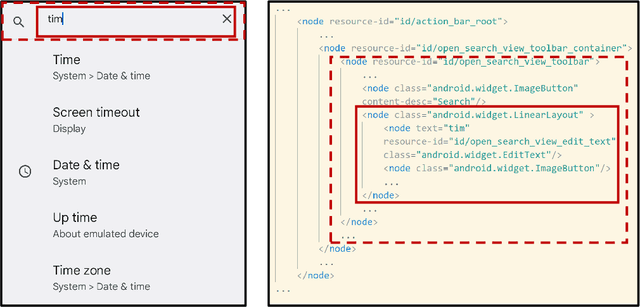
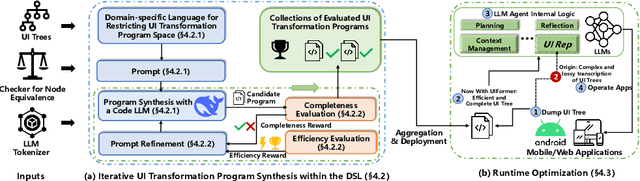
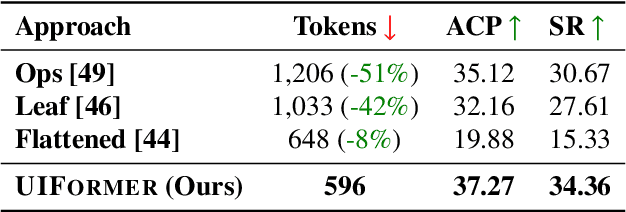
While Large Language Model (LLM) agents show great potential for automated UI navigation such as automated UI testing and AI assistants, their efficiency has been largely overlooked. Our motivating study reveals that inefficient UI representation creates a critical performance bottleneck. However, UI representation optimization, formulated as the task of automatically generating programs that transform UI representations, faces two unique challenges. First, the lack of Boolean oracles, which traditional program synthesis uses to decisively validate semantic correctness, poses a fundamental challenge to co-optimization of token efficiency and completeness. Second, the need to process large, complex UI trees as input while generating long, compositional transformation programs, making the search space vast and error-prone. Toward addressing the preceding limitations, we present UIFormer, the first automated optimization framework that synthesizes UI transformation programs by conducting constraint-based optimization with structured decomposition of the complex synthesis task. First, UIFormer restricts the program space using a domain-specific language (DSL) that captures UI-specific operations. Second, UIFormer conducts LLM-based iterative refinement with correctness and efficiency rewards, providing guidance for achieving the efficiency-completeness co-optimization. UIFormer operates as a lightweight plugin that applies transformation programs for seamless integration with existing LLM agents, requiring minimal modifications to their core logic. Evaluations across three UI navigation benchmarks spanning Android and Web platforms with five LLMs demonstrate that UIFormer achieves 48.7% to 55.8% token reduction with minimal runtime overhead while maintaining or improving agent performance. Real-world industry deployment at WeChat further validates the practical impact of UIFormer.
Transferable Dual-Domain Feature Importance Attack against AI-Generated Image Detector
Nov 19, 2025Recent AI-generated image (AIGI) detectors achieve impressive accuracy under clean condition. In view of antiforensics, it is significant to develop advanced adversarial attacks for evaluating the security of such detectors, which remains unexplored sufficiently. This letter proposes a Dual-domain Feature Importance Attack (DuFIA) scheme to invalidate AIGI detectors to some extent. Forensically important features are captured by the spatially interpolated gradient and frequency-aware perturbation. The adversarial transferability is enhanced by jointly modeling spatial and frequency-domain feature importances, which are fused to guide the optimization-based adversarial example generation. Extensive experiments across various AIGI detectors verify the cross-model transferability, transparency and robustness of DuFIA.
Image Forgery Localization with State Space Models
Dec 15, 2024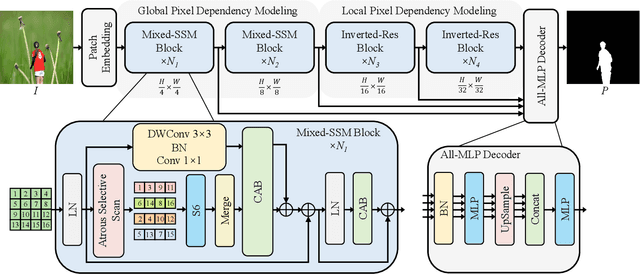
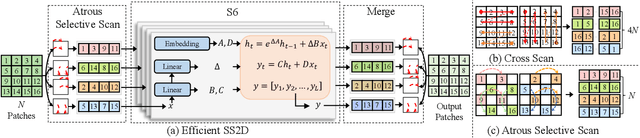
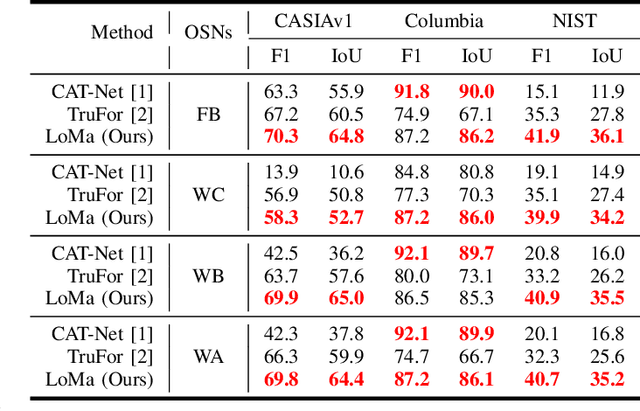
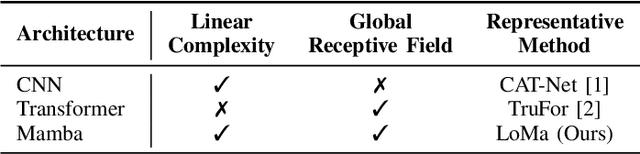
Pixel dependency modeling from tampered images is pivotal for image forgery localization. Current approaches predominantly rely on convolutional neural network (CNN) or Transformer-based models, which often either lack sufficient receptive fields or entail significant computational overheads. In this paper, we propose LoMa, a novel image forgery localization method that leverages the Selective State Space (S6) model for global pixel dependency modeling and inverted residual CNN for local pixel dependency modeling. Our method introduces the Mixed-SSM Block, which initially employs atrous selective scan to traverse the spatial domain and convert the tampered image into order patch sequences, and subsequently applies multidirectional S6 modeling. In addition, an auxiliary convolutional branch is introduced to enhance local feature extraction. This design facilitates the efficient extraction of global dependencies while upholding linear complexity. Upon modeling the pixel dependency with the SSM and CNN blocks, the pixel-wise forgery localization results are obtained by a simple MLP decoder. Extensive experimental results validate the superiority of LoMa over CNN-based and Transformer-based state-of-the-arts.
Video Inpainting Localization with Contrastive Learning
Jun 25, 2024
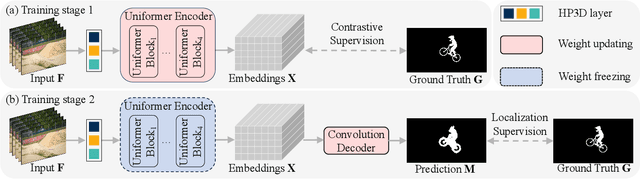
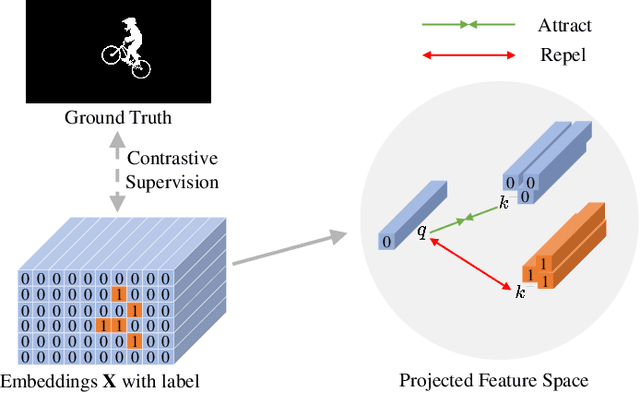

Deep video inpainting is typically used as malicious manipulation to remove important objects for creating fake videos. It is significant to identify the inpainted regions blindly. This letter proposes a simple yet effective forensic scheme for Video Inpainting LOcalization with ContrAstive Learning (ViLocal). Specifically, a 3D Uniformer encoder is applied to the video noise residual for learning effective spatiotemporal forensic features. To enhance the discriminative power, supervised contrastive learning is adopted to capture the local inconsistency of inpainted videos through attracting/repelling the positive/negative pristine and forged pixel pairs. A pixel-wise inpainting localization map is yielded by a lightweight convolution decoder with a specialized two-stage training strategy. To prepare enough training samples, we build a video object segmentation dataset of 2500 videos with pixel-level annotations per frame. Extensive experimental results validate the superiority of ViLocal over state-of-the-arts. Code and dataset will be available at https://github.com/multimediaFor/ViLocal.
Trusted Video Inpainting Localization via Deep Attentive Noise Learning
Jun 19, 2024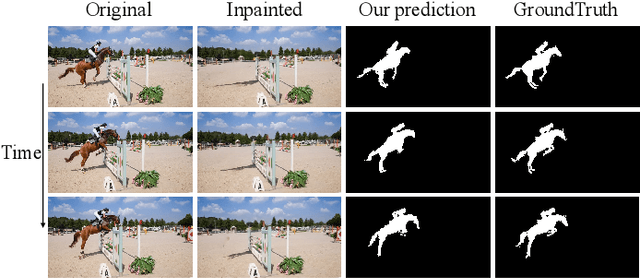
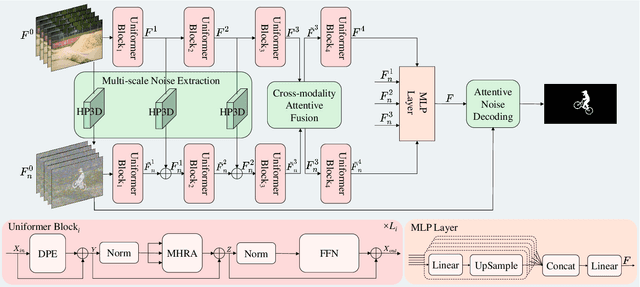
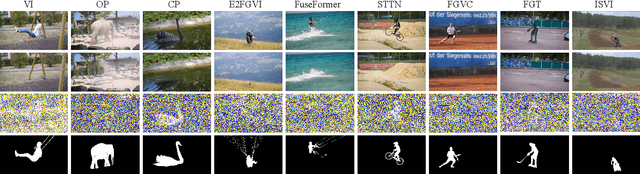
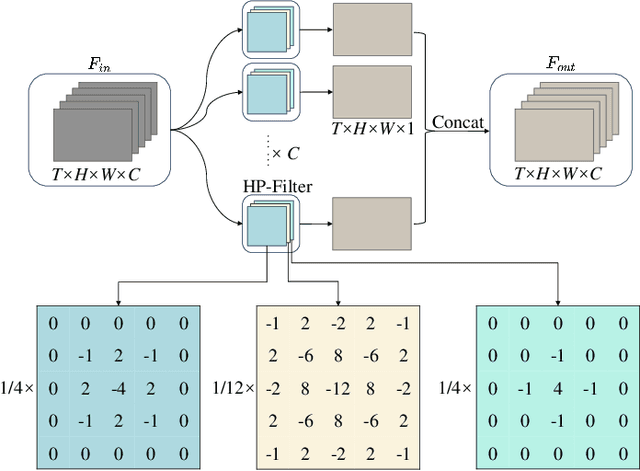
Digital video inpainting techniques have been substantially improved with deep learning in recent years. Although inpainting is originally designed to repair damaged areas, it can also be used as malicious manipulation to remove important objects for creating false scenes and facts. As such it is significant to identify inpainted regions blindly. In this paper, we present a Trusted Video Inpainting Localization network (TruVIL) with excellent robustness and generalization ability. Observing that high-frequency noise can effectively unveil the inpainted regions, we design deep attentive noise learning in multiple stages to capture the inpainting traces. Firstly, a multi-scale noise extraction module based on 3D High Pass (HP3D) layers is used to create the noise modality from input RGB frames. Then the correlation between such two complementary modalities are explored by a cross-modality attentive fusion module to facilitate mutual feature learning. Lastly, spatial details are selectively enhanced by an attentive noise decoding module to boost the localization performance of the network. To prepare enough training samples, we also build a frame-level video object segmentation dataset of 2500 videos with pixel-level annotation for all frames. Extensive experimental results validate the superiority of TruVIL compared with the state-of-the-arts. In particular, both quantitative and qualitative evaluations on various inpainted videos verify the remarkable robustness and generalization ability of our proposed TruVIL. Code and dataset will be available at https://github.com/multimediaFor/TruVIL.
Exploring Multi-view Pixel Contrast for General and Robust Image Forgery Localization
Jun 19, 2024
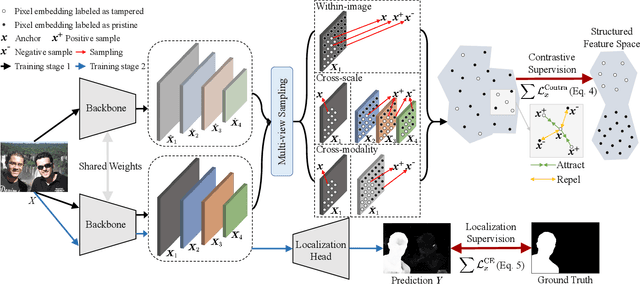
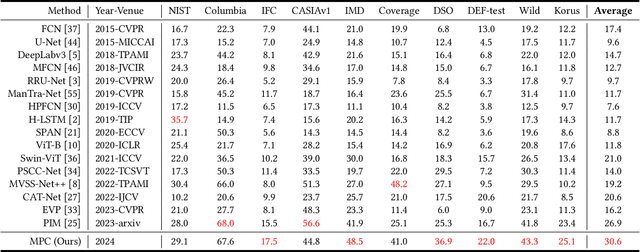
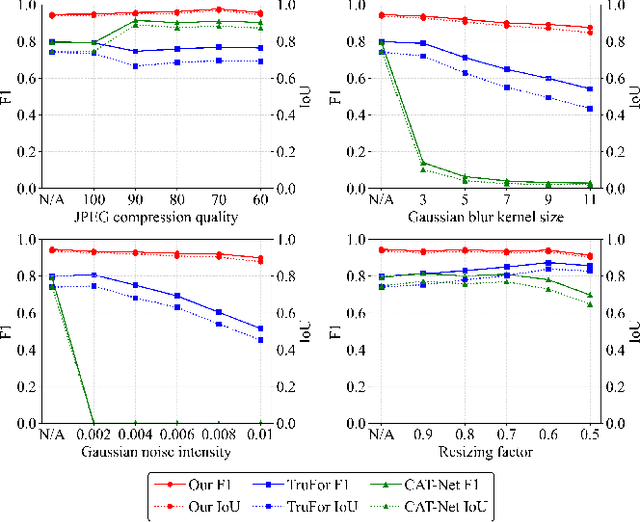
Image forgery localization, which aims to segment tampered regions in an image, is a fundamental yet challenging digital forensic task. While some deep learning-based forensic methods have achieved impressive results, they directly learn pixel-to-label mappings without fully exploiting the relationship between pixels in the feature space. To address such deficiency, we propose a Multi-view Pixel-wise Contrastive algorithm (MPC) for image forgery localization. Specifically, we first pre-train the backbone network with the supervised contrastive loss to model pixel relationships from the perspectives of within-image, cross-scale and cross-modality. That is aimed at increasing intra-class compactness and inter-class separability. Then the localization head is fine-tuned using the cross-entropy loss, resulting in a better pixel localizer. The MPC is trained on three different scale training datasets to make a comprehensive and fair comparison with existing image forgery localization algorithms. Extensive experiments on the small, medium and large scale training datasets show that the proposed MPC achieves higher generalization performance and robustness against post-processing than the state-of-the-arts. Code will be available at https://github.com/multimediaFor/MPC.