 Add to Chrome
 Add to Firefox
 Add to Edge
Just Ask for a Table: A Thirty-Token User Prompt Defeats Sponsored Recommendations in Twelve LLMs
May 12, 2026
Wu et al. (2026) showed that most frontier large language models (LLMs) recommend a sponsored, roughly twice-as-expensive flight when their system prompt contains a soft sponsorship cue. We reproduce their evaluation on ten open-weight chat models plus the two of their twenty-three models that are still reachable today (gpt-3.5-turbo, gpt-4o). All reported rates in this paper are produced under the same judge the original paper used (gpt-4o); we additionally store every label under an open-weight (gpt-oss-120b) and a smaller proprietary (gpt-4o-mini) judge for an ablation. Three findings emerge. First, a prose description of an LLM evaluation pipeline is not, on its own, sufficient for accurate reproduction: we surfaced three silent implementation failures that each shifted a reported rate by tens of percentage points. Second, the central claims do generalise - the gpt-3.5-turbo logistic-regression intercept of alpha = 0.81 is within four points of the original alpha = 0.86, and 200 of 200 trials on gpt-3.5-turbo and gpt-4o promote a payday lender to a financially distressed user. Third, a thirty-token user prompt that asks the assistant for a neutral comparison table first cuts sponsored recommendation from 46.9% to 1.0% averaged across our ten open-source models, and from 53.0% to 0% averaged across the two OpenAI models. AI literacy and price-comparison portals are likely market-level mitigations; the harmful-product cell is bounded by neither. Raw data, labels and analysis scripts are at https://github.com/akmaier/Paper-LLM-Ads .

Safety and accuracy follow different scaling laws in clinical large language models
May 05, 2026Clinical LLMs are often scaled by increasing model size, context length, retrieval complexity, or inference-time compute, with the implicit expectation that higher accuracy implies safer behavior. This assumption is incomplete in medicine, where a few confident, high-risk, or evidence-contradicting errors can matter more than average benchmark performance. We introduce SaFE-Scale, a framework for measuring how clinical LLM safety changes across model scale, evidence quality, retrieval strategy, context exposure, and inference-time compute. To instantiate this framework, we introduce RadSaFE-200, a Radiology Safety-Focused Evaluation benchmark of 200 multiple-choice questions with clinician-defined clean evidence, conflict evidence, and option-level labels for high-risk error, unsafe answer, and evidence contradiction. We evaluated 34 locally deployed LLMs across six deployment conditions: closed-book prompting (zero-shot), clean evidence, conflict evidence, standard RAG, agentic RAG, and max-context prompting. Clean evidence produced the strongest improvement, increasing mean accuracy from 73.5% to 94.1%, while reducing high-risk error from 12.0% to 2.6%, contradiction from 12.7% to 2.3%, and dangerous overconfidence from 8.0% to 1.6%. Standard RAG and agentic RAG did not reproduce this safety profile: agentic RAG improved accuracy over standard RAG and reduced contradiction, but high-risk error and dangerous overconfidence remained elevated. Max-context prompting increased latency without closing the safety gap, and additional inference-time compute produced only limited gains. Worst-case analysis showed that clinically consequential errors concentrated in a small subset of questions. Clinical LLM safety is therefore not a passive consequence of scaling, but a deployment property shaped by evidence quality, retrieval design, context construction, and collective failure behavior.
SteuerLLM: Local specialized large language model for German tax law analysis
Feb 11, 2026Large language models (LLMs) demonstrate strong general reasoning and language understanding, yet their performance degrades in domains governed by strict formal rules, precise terminology, and legally binding structure. Tax law exemplifies these challenges, as correct answers require exact statutory citation, structured legal argumentation, and numerical accuracy under rigid grading schemes. We algorithmically generate SteuerEx, the first open benchmark derived from authentic German university tax law examinations. SteuerEx comprises 115 expert-validated examination questions spanning six core tax law domains and multiple academic levels, and employs a statement-level, partial-credit evaluation framework that closely mirrors real examination practice. We further present SteuerLLM, a domain-adapted LLM for German tax law trained on a large-scale synthetic dataset generated from authentic examination material using a controlled retrieval-augmented pipeline. SteuerLLM (28B parameters) consistently outperforms general-purpose instruction-tuned models of comparable size and, in several cases, substantially larger systems, demonstrating that domain-specific data and architectural adaptation are more decisive than parameter scale for performance on realistic legal reasoning tasks. All benchmark data, training datasets, model weights, and evaluation code are released openly to support reproducible research in domain-specific legal artificial intelligence. A web-based demo of SteuerLLM is available at https://steuerllm.i5.ai.fau.de.
Agentic large language models improve retrieval-based radiology question answering
Aug 01, 2025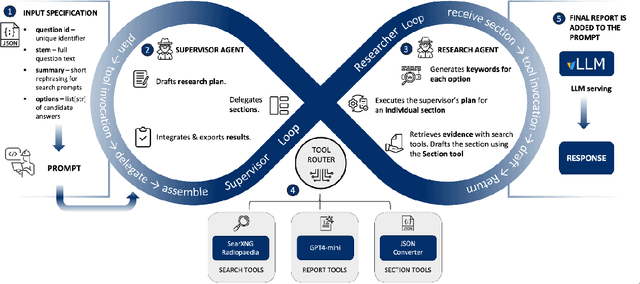
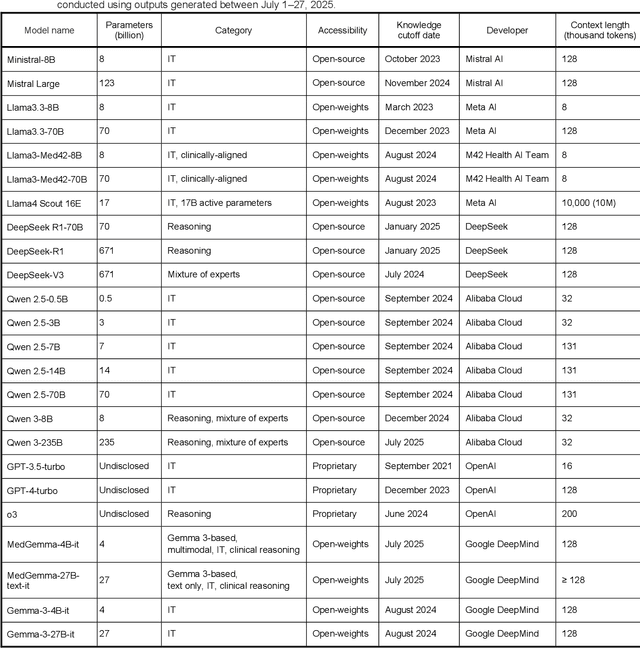
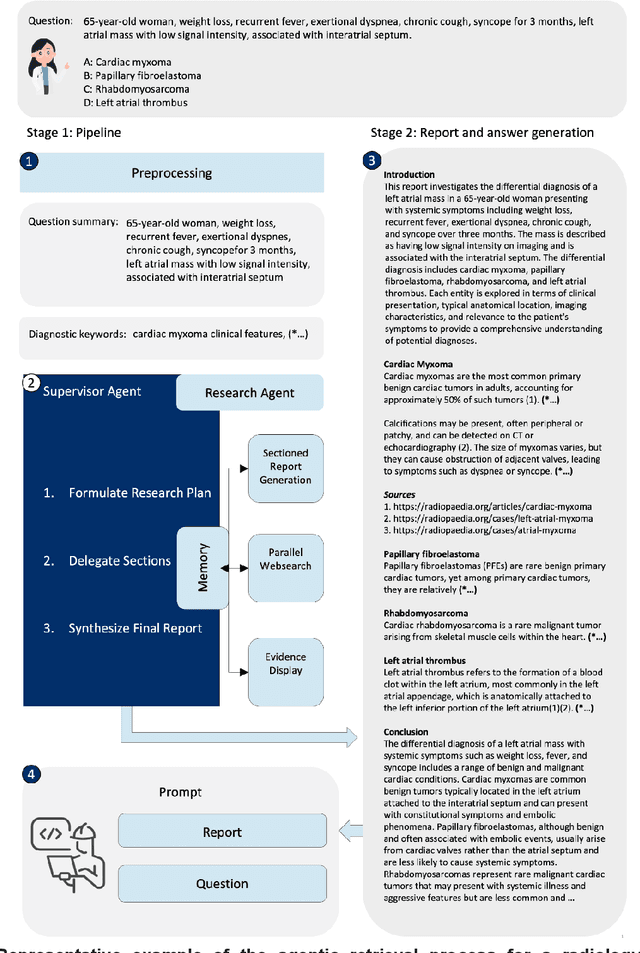
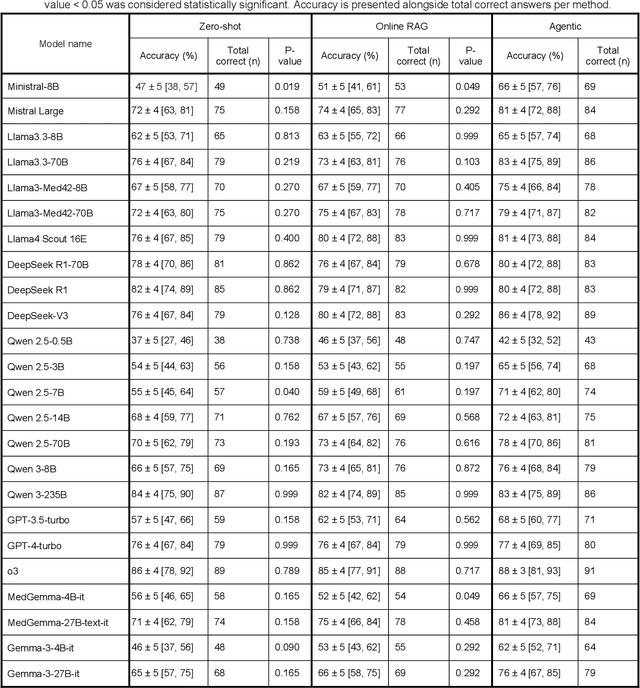
Clinical decision-making in radiology increasingly benefits from artificial intelligence (AI), particularly through large language models (LLMs). However, traditional retrieval-augmented generation (RAG) systems for radiology question answering (QA) typically rely on single-step retrieval, limiting their ability to handle complex clinical reasoning tasks. Here we propose an agentic RAG framework enabling LLMs to autonomously decompose radiology questions, iteratively retrieve targeted clinical evidence from Radiopaedia, and dynamically synthesize evidence-based responses. We evaluated 24 LLMs spanning diverse architectures, parameter scales (0.5B to >670B), and training paradigms (general-purpose, reasoning-optimized, clinically fine-tuned), using 104 expert-curated radiology questions from previously established RSNA-RadioQA and ExtendedQA datasets. Agentic retrieval significantly improved mean diagnostic accuracy over zero-shot prompting (73% vs. 64%; P<0.001) and conventional online RAG (73% vs. 68%; P<0.001). The greatest gains occurred in mid-sized models (e.g., Mistral Large improved from 72% to 81%) and small-scale models (e.g., Qwen 2.5-7B improved from 55% to 71%), while very large models (>200B parameters) demonstrated minimal changes (<2% improvement). Additionally, agentic retrieval reduced hallucinations (mean 9.4%) and retrieved clinically relevant context in 46% of cases, substantially aiding factual grounding. Even clinically fine-tuned models exhibited meaningful improvements (e.g., MedGemma-27B improved from 71% to 81%), indicating complementary roles of retrieval and fine-tuning. These results highlight the potential of agentic frameworks to enhance factuality and diagnostic accuracy in radiology QA, particularly among mid-sized LLMs, warranting future studies to validate their clinical utility.