 Add to Chrome
 Add to Firefox
 Add to Edge
Safety and accuracy follow different scaling laws in clinical large language models
May 05, 2026
Clinical LLMs are often scaled by increasing model size, context length, retrieval complexity, or inference-time compute, with the implicit expectation that higher accuracy implies safer behavior. This assumption is incomplete in medicine, where a few confident, high-risk, or evidence-contradicting errors can matter more than average benchmark performance. We introduce SaFE-Scale, a framework for measuring how clinical LLM safety changes across model scale, evidence quality, retrieval strategy, context exposure, and inference-time compute. To instantiate this framework, we introduce RadSaFE-200, a Radiology Safety-Focused Evaluation benchmark of 200 multiple-choice questions with clinician-defined clean evidence, conflict evidence, and option-level labels for high-risk error, unsafe answer, and evidence contradiction. We evaluated 34 locally deployed LLMs across six deployment conditions: closed-book prompting (zero-shot), clean evidence, conflict evidence, standard RAG, agentic RAG, and max-context prompting. Clean evidence produced the strongest improvement, increasing mean accuracy from 73.5% to 94.1%, while reducing high-risk error from 12.0% to 2.6%, contradiction from 12.7% to 2.3%, and dangerous overconfidence from 8.0% to 1.6%. Standard RAG and agentic RAG did not reproduce this safety profile: agentic RAG improved accuracy over standard RAG and reduced contradiction, but high-risk error and dangerous overconfidence remained elevated. Max-context prompting increased latency without closing the safety gap, and additional inference-time compute produced only limited gains. Worst-case analysis showed that clinically consequential errors concentrated in a small subset of questions. Clinical LLM safety is therefore not a passive consequence of scaling, but a deployment property shaped by evidence quality, retrieval design, context construction, and collective failure behavior.

SteuerLLM: Local specialized large language model for German tax law analysis
Feb 11, 2026Large language models (LLMs) demonstrate strong general reasoning and language understanding, yet their performance degrades in domains governed by strict formal rules, precise terminology, and legally binding structure. Tax law exemplifies these challenges, as correct answers require exact statutory citation, structured legal argumentation, and numerical accuracy under rigid grading schemes. We algorithmically generate SteuerEx, the first open benchmark derived from authentic German university tax law examinations. SteuerEx comprises 115 expert-validated examination questions spanning six core tax law domains and multiple academic levels, and employs a statement-level, partial-credit evaluation framework that closely mirrors real examination practice. We further present SteuerLLM, a domain-adapted LLM for German tax law trained on a large-scale synthetic dataset generated from authentic examination material using a controlled retrieval-augmented pipeline. SteuerLLM (28B parameters) consistently outperforms general-purpose instruction-tuned models of comparable size and, in several cases, substantially larger systems, demonstrating that domain-specific data and architectural adaptation are more decisive than parameter scale for performance on realistic legal reasoning tasks. All benchmark data, training datasets, model weights, and evaluation code are released openly to support reproducible research in domain-specific legal artificial intelligence. A web-based demo of SteuerLLM is available at https://steuerllm.i5.ai.fau.de.
AMD-HookNet++: Evolution of AMD-HookNet with Hybrid CNN-Transformer Feature Enhancement for Glacier Calving Front Segmentation
Dec 16, 2025The dynamics of glaciers and ice shelf fronts significantly impact the mass balance of ice sheets and coastal sea levels. To effectively monitor glacier conditions, it is crucial to consistently estimate positional shifts of glacier calving fronts. AMD-HookNet firstly introduces a pure two-branch convolutional neural network (CNN) for glacier segmentation. Yet, the local nature and translational invariance of convolution operations, while beneficial for capturing low-level details, restricts the model ability to maintain long-range dependencies. In this study, we propose AMD-HookNet++, a novel advanced hybrid CNN-Transformer feature enhancement method for segmenting glaciers and delineating calving fronts in synthetic aperture radar images. Our hybrid structure consists of two branches: a Transformer-based context branch to capture long-range dependencies, which provides global contextual information in a larger view, and a CNN-based target branch to preserve local details. To strengthen the representation of the connected hybrid features, we devise an enhanced spatial-channel attention module to foster interactions between the hybrid CNN-Transformer branches through dynamically adjusting the token relationships from both spatial and channel perspectives. Additionally, we develop a pixel-to-pixel contrastive deep supervision to optimize our hybrid model by integrating pixelwise metric learning into glacier segmentation. Through extensive experiments and comprehensive quantitative and qualitative analyses on the challenging glacier segmentation benchmark dataset CaFFe, we show that AMD-HookNet++ sets a new state of the art with an IoU of 78.2 and a HD95 of 1,318 m, while maintaining a competitive MDE of 367 m. More importantly, our hybrid model produces smoother delineations of calving fronts, resolving the issue of jagged edges typically seen in pure Transformer-based approaches.
Agentic large language models improve retrieval-based radiology question answering
Aug 01, 2025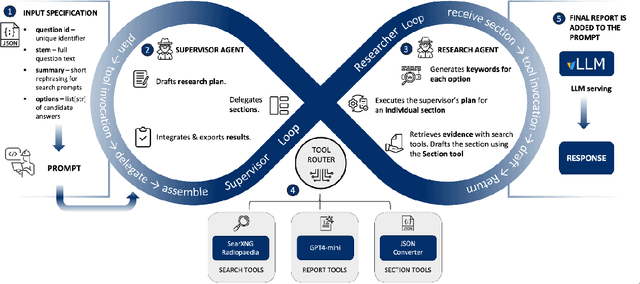
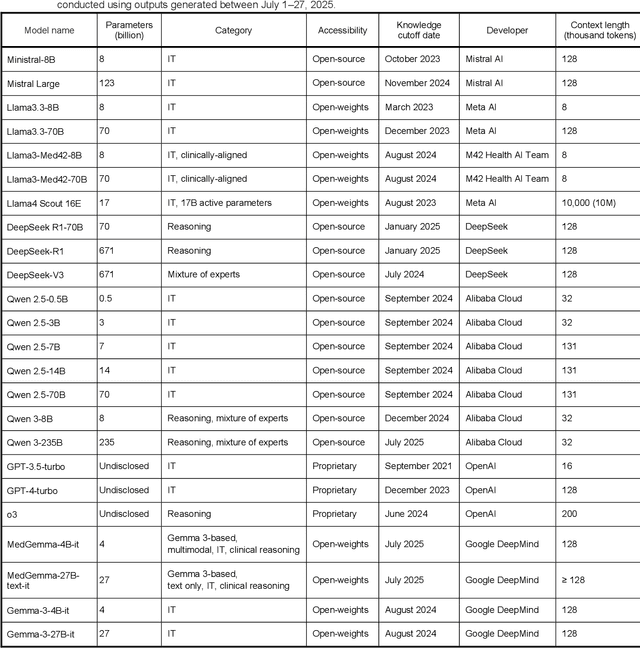
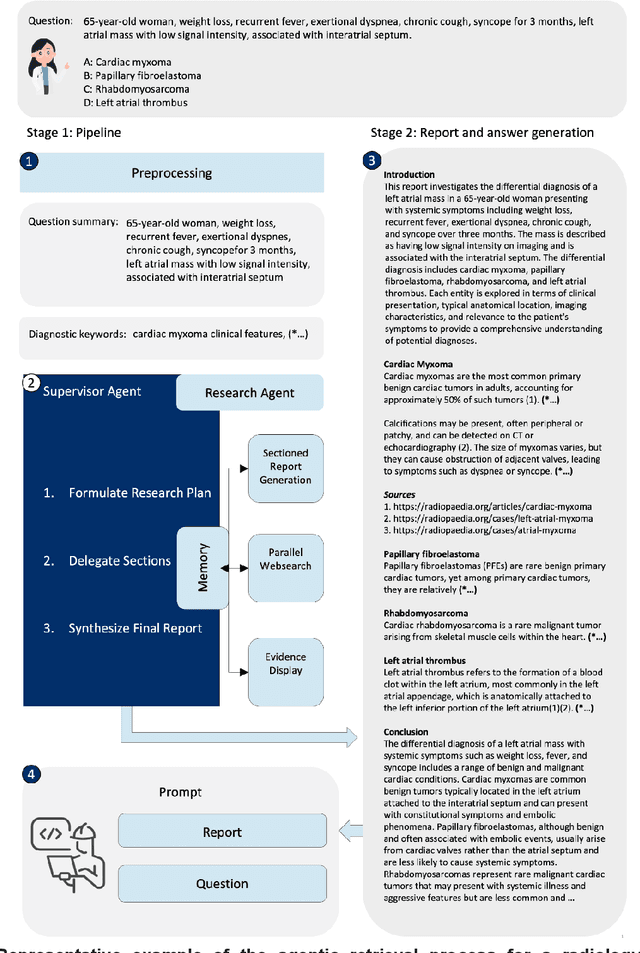
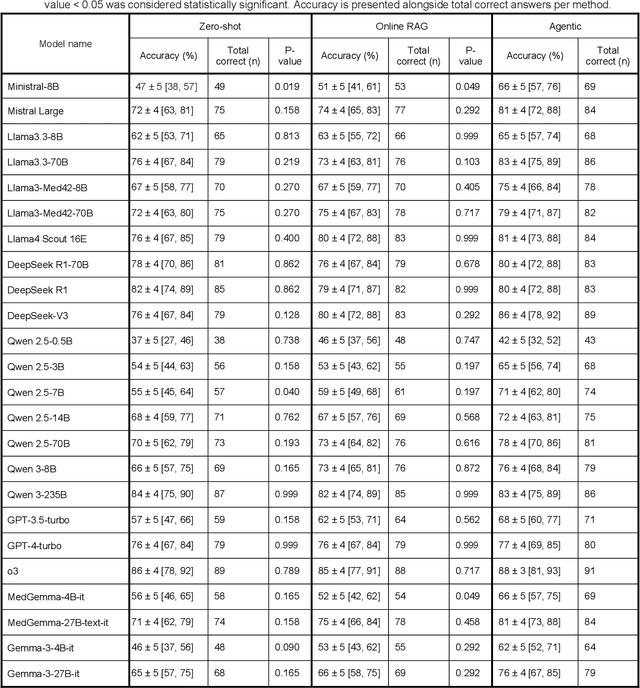
Clinical decision-making in radiology increasingly benefits from artificial intelligence (AI), particularly through large language models (LLMs). However, traditional retrieval-augmented generation (RAG) systems for radiology question answering (QA) typically rely on single-step retrieval, limiting their ability to handle complex clinical reasoning tasks. Here we propose an agentic RAG framework enabling LLMs to autonomously decompose radiology questions, iteratively retrieve targeted clinical evidence from Radiopaedia, and dynamically synthesize evidence-based responses. We evaluated 24 LLMs spanning diverse architectures, parameter scales (0.5B to >670B), and training paradigms (general-purpose, reasoning-optimized, clinically fine-tuned), using 104 expert-curated radiology questions from previously established RSNA-RadioQA and ExtendedQA datasets. Agentic retrieval significantly improved mean diagnostic accuracy over zero-shot prompting (73% vs. 64%; P<0.001) and conventional online RAG (73% vs. 68%; P<0.001). The greatest gains occurred in mid-sized models (e.g., Mistral Large improved from 72% to 81%) and small-scale models (e.g., Qwen 2.5-7B improved from 55% to 71%), while very large models (>200B parameters) demonstrated minimal changes (<2% improvement). Additionally, agentic retrieval reduced hallucinations (mean 9.4%) and retrieved clinically relevant context in 46% of cases, substantially aiding factual grounding. Even clinically fine-tuned models exhibited meaningful improvements (e.g., MedGemma-27B improved from 71% to 81%), indicating complementary roles of retrieval and fine-tuning. These results highlight the potential of agentic frameworks to enhance factuality and diagnostic accuracy in radiology QA, particularly among mid-sized LLMs, warranting future studies to validate their clinical utility.