 Add to Chrome
 Add to Firefox
 Add to Edge
Muon learns balanced solutions in matrix factorization without slow saddle-to-saddle dynamics
Jun 29, 2026
Matrix factorization (i.e., problems of the form $\min_{\mathbf{P},\mathbf{Q}} \|\mathbf{M}^\star - \mathbf{P}^\top\mathbf{Q}\|_\mathrm{F}^2$) is a minimal learning problem that exhibits both nonlinear parameter dynamics and representation learning. In this setting, we study how parameter trajectories under the Muon optimizer differ from those of gradient descent. We identify three main dynamical differences: 1) Muon avoids the slow saddle-to-saddle dynamics from small initialization. Muon instead learns all the top modes of $\mathbf{M}^\star$ at the same rate, with the smaller modes converging first. 2) Muon remains stable even when the learning rate exceeds the critical threshold set by the local loss sharpness. This frees the learning rate from the condition number of the problem, enabling rapid convergence via exponential learning rate annealing. 3) Once the weights are aligned with each other and the target, Muon flow conserves the matrix quantity $\sqrt{\mathbf{P}^\top \mathbf{P}}-\sqrt{\mathbf{Q}^\top \mathbf{Q}}$, while gradient flow is known to conserve the matrix $\mathbf{P}^\top\mathbf{P} - \mathbf{Q}^\top\mathbf{Q}$. Despite having distinct conserved quantities, both optimizers find the so-called \textit{balanced} solution from vanishing initialization. When training from small random initialization, the weights spontaneously align early in training. We derive the alignment rates in simple settings and show that they predict the empirical alignment rates in general. Finally, we exploit structural properties of Muon to construct a learning rate schedule that achieves near-perfect alignment in only two optimization steps.

There Will Be a Scientific Theory of Deep Learning
Apr 23, 2026In this paper, we make the case that a scientific theory of deep learning is emerging. By this we mean a theory which characterizes important properties and statistics of the training process, hidden representations, final weights, and performance of neural networks. We pull together major strands of ongoing research in deep learning theory and identify five growing bodies of work that point toward such a theory: (a) solvable idealized settings that provide intuition for learning dynamics in realistic systems; (b) tractable limits that reveal insights into fundamental learning phenomena; (c) simple mathematical laws that capture important macroscopic observables; (d) theories of hyperparameters that disentangle them from the rest of the training process, leaving simpler systems behind; and (e) universal behaviors shared across systems and settings which clarify which phenomena call for explanation. Taken together, these bodies of work share certain broad traits: they are concerned with the dynamics of the training process; they primarily seek to describe coarse aggregate statistics; and they emphasize falsifiable quantitative predictions. We argue that the emerging theory is best thought of as a mechanics of the learning process, and suggest the name learning mechanics. We discuss the relationship between this mechanics perspective and other approaches for building a theory of deep learning, including the statistical and information-theoretic perspectives. In particular, we anticipate a symbiotic relationship between learning mechanics and mechanistic interpretability. We also review and address common arguments that fundamental theory will not be possible or is not important. We conclude with a portrait of important open directions in learning mechanics and advice for beginners. We host further introductory materials, perspectives, and open questions at learningmechanics.pub.
NL-Augmenter: A Framework for Task-Sensitive Natural Language Augmentation
Dec 06, 2021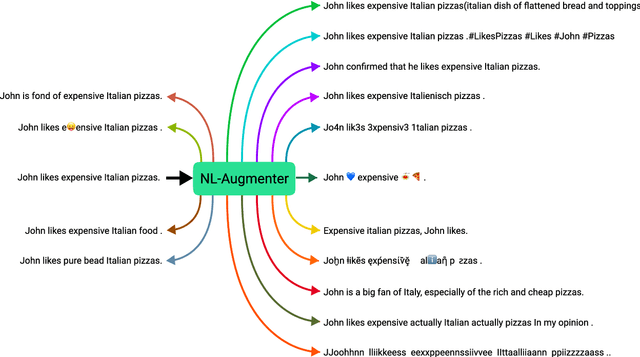
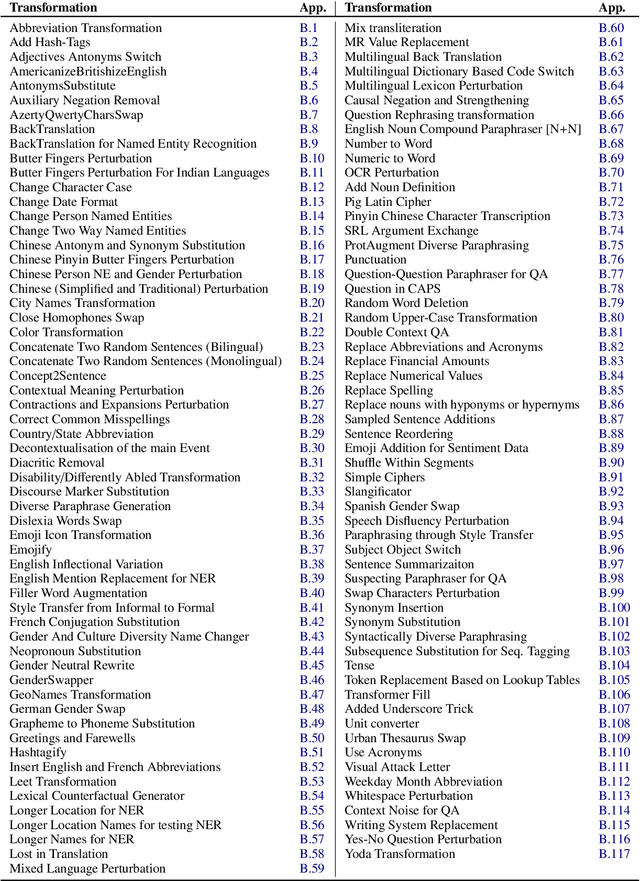
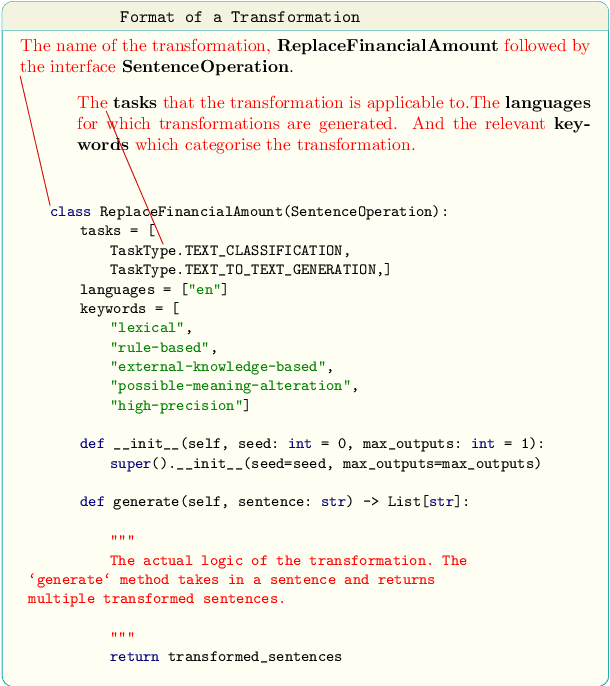
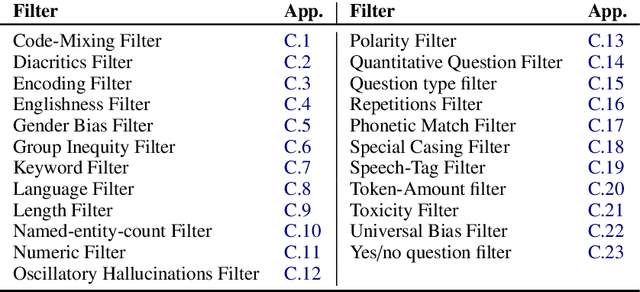
Data augmentation is an important component in the robustness evaluation of models in natural language processing (NLP) and in enhancing the diversity of the data they are trained on. In this paper, we present NL-Augmenter, a new participatory Python-based natural language augmentation framework which supports the creation of both transformations (modifications to the data) and filters (data splits according to specific features). We describe the framework and an initial set of 117 transformations and 23 filters for a variety of natural language tasks. We demonstrate the efficacy of NL-Augmenter by using several of its transformations to analyze the robustness of popular natural language models. The infrastructure, datacards and robustness analysis results are available publicly on the NL-Augmenter repository (\url{https://github.com/GEM-benchmark/NL-Augmenter}).