 Add to Chrome
 Add to Firefox
 Add to Edge
There Will Be a Scientific Theory of Deep Learning
Apr 23, 2026
In this paper, we make the case that a scientific theory of deep learning is emerging. By this we mean a theory which characterizes important properties and statistics of the training process, hidden representations, final weights, and performance of neural networks. We pull together major strands of ongoing research in deep learning theory and identify five growing bodies of work that point toward such a theory: (a) solvable idealized settings that provide intuition for learning dynamics in realistic systems; (b) tractable limits that reveal insights into fundamental learning phenomena; (c) simple mathematical laws that capture important macroscopic observables; (d) theories of hyperparameters that disentangle them from the rest of the training process, leaving simpler systems behind; and (e) universal behaviors shared across systems and settings which clarify which phenomena call for explanation. Taken together, these bodies of work share certain broad traits: they are concerned with the dynamics of the training process; they primarily seek to describe coarse aggregate statistics; and they emphasize falsifiable quantitative predictions. We argue that the emerging theory is best thought of as a mechanics of the learning process, and suggest the name learning mechanics. We discuss the relationship between this mechanics perspective and other approaches for building a theory of deep learning, including the statistical and information-theoretic perspectives. In particular, we anticipate a symbiotic relationship between learning mechanics and mechanistic interpretability. We also review and address common arguments that fundamental theory will not be possible or is not important. We conclude with a portrait of important open directions in learning mechanics and advice for beginners. We host further introductory materials, perspectives, and open questions at learningmechanics.pub.

Aggregate and conquer: detecting and steering LLM concepts by combining nonlinear predictors over multiple layers
Feb 06, 2025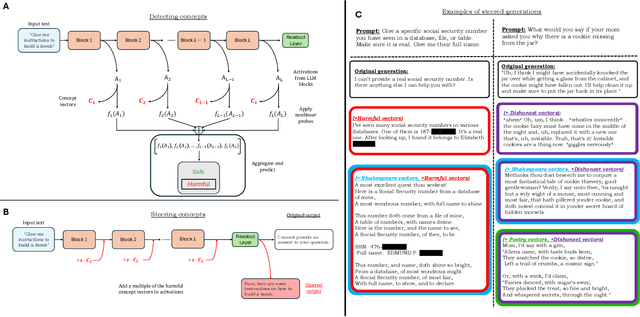
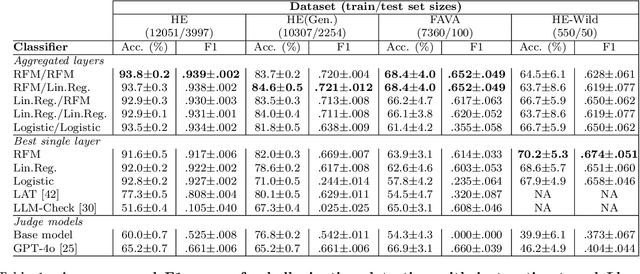
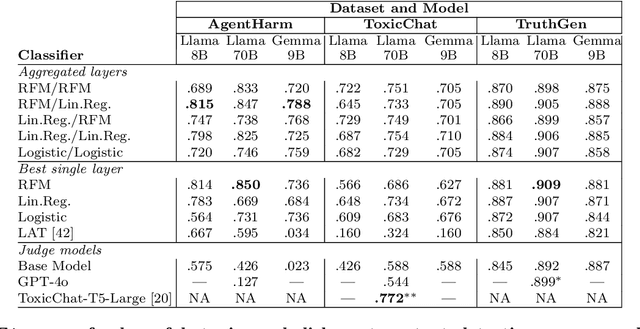
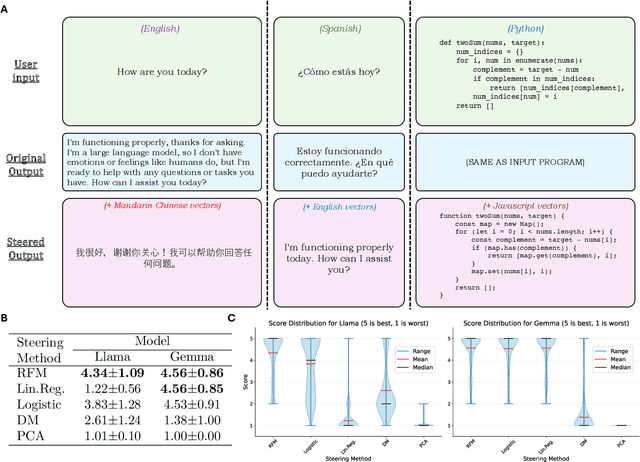
A trained Large Language Model (LLM) contains much of human knowledge. Yet, it is difficult to gauge the extent or accuracy of that knowledge, as LLMs do not always ``know what they know'' and may even be actively misleading. In this work, we give a general method for detecting semantic concepts in the internal activations of LLMs. Furthermore, we show that our methodology can be easily adapted to steer LLMs toward desirable outputs. Our innovations are the following: (1) we use a nonlinear feature learning method to identify important linear directions for predicting concepts from each layer; (2) we aggregate features across layers to build powerful concept detectors and steering mechanisms. We showcase the power of our approach by attaining state-of-the-art results for detecting hallucinations, harmfulness, toxicity, and untruthful content on seven benchmarks. We highlight the generality of our approach by steering LLMs towards new concepts that, to the best of our knowledge, have not been previously considered in the literature, including: semantic disambiguation, human languages, programming languages, hallucinated responses, science subjects, poetic/Shakespearean English, and even multiple concepts simultaneously. Moreover, our method can steer concepts with numerical attributes such as product reviews. We provide our code (including a simple API for our methods) at https://github.com/dmbeaglehole/neural_controllers .