 Add to Chrome
 Add to Firefox
 Add to Edge
Interpretable Inverse Design of Metal-Organic Frameworks with Large Language Model Agents
Jun 28, 2026
Inverse design of metal-organic frameworks (MOFs) requires searching a combinatorially vast space where property labels are expensive and most machine-learning models reveal little about why a structure succeeds. We introduce LLM4MOF, a closed-loop framework in which language-model agents reason about chemistry, build candidate MOFs, and test them in simulation, refining hypotheses over ten autonomous iterations. One agent proposes interpretable design hypotheses over metal nodes, linkers, pore geometry, and functional chemistry, and a second translates them into constraints that select candidate MOFs, each made of a metal node, organic linker, and matching topology. Each hypothesis is tested through four diagnostic beams that apply different subsets of its constraints, so comparing them shows whether geometry, chemistry, or metal choice drives performance. Even when blind to the global property landscape of databases, LLM4MOF concentrates its search on top-performing structures across six adsorption, separation, and electronic-structure tasks within 400 property evaluations. The same loop also generates new MOFs de novo and validates them in live simulation, where it adapts the geometry to each requested condition, outperforming random search and a genetic algorithm at roughly $1 per campaign. LLM4MOF shows that language-model agents can run interpretable, simulation-grounded inverse design without training a model per objective.

Multimodal Transformer for Sample-Aware Prediction of Metal-Organic Framework Properties
Apr 21, 2026Metal-organic frameworks (MOFs) are a major target of machine-learning-based property prediction, yet most models assume that a single framework representation maps to a single property value. This assumption becomes problematic for experimental MOFs, where samples reported as the same framework can exhibit different properties because of differences in crystallinity, phase purity, defects, and other sample-dependent factors. Here we introduce Experimental X-ray Diffraction Integrated Transformer (EXIT), a multimodal transformer for sample-aware prediction of MOF properties that combines MOFid with X-ray diffraction (XRD). In EXIT, MOFid encodes MOF identity, whereas XRD provides complementary information about the experimentally realized sample state. EXIT is pre-trained on one million hypothetical MOFs with simulated XRD to learn transferable representations, leading to improved downstream performance relative to existing approaches. EXIT is fine-tuned on literature-derived experimental datasets for surface area and pore volume prediction. Incorporating experimental XRD improves predictive performance relative to models without experimental XRD, and attention analysis and sample-level case studies further show that EXIT assigns different predictions to samples sharing the same MOF identity when their XRD patterns differ. These results establish a practical step from framework-aware to sample-aware MOF property prediction and highlight the value of incorporating experimental characterization into porous materials informatics.
SimMOF: AI agent for Automated MOF Simulations
Mar 31, 2026Metal-organic frameworks (MOFs) offer a vast design space, and as such, computational simulations play a critical role in predicting their structural and physicochemical properties. However, MOF simulations remain difficult to access because reliable analysis require expert decisions for workflow construction, parameter selection, tool interoperability, and the preparation of computational ready structures. Here, we introduce SimMOF, a large language model based multi agent framework that automates end-to-end MOF simulation workflows from natural language queries. SimMOF translates user requests into dependency aware plans, generates runnable inputs, orchestrates multiple agents to execute simulations, and summarizes results with analysis aligned to the user query. Through representative case studies, we show that SimMOF enables adaptive and cognitively autonomous workflows that reflect the iterative and decision driven behavior of human researchers and as such provides a scalable foundation for data driven MOF research.
Data-driven development of cycle prediction models for lithium metal batteries using multi modal mining
Nov 26, 2024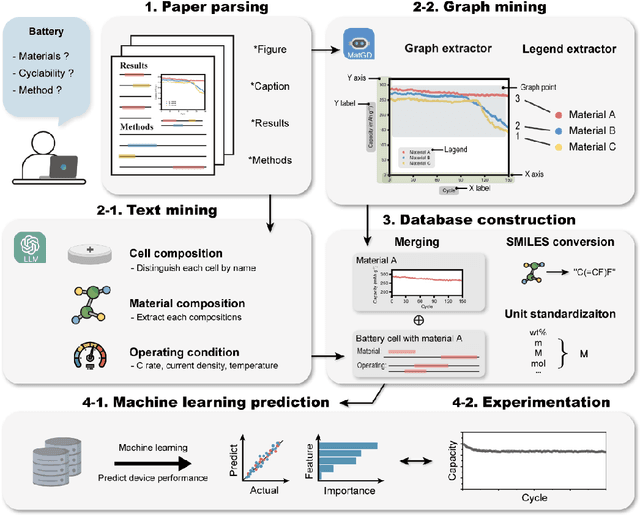
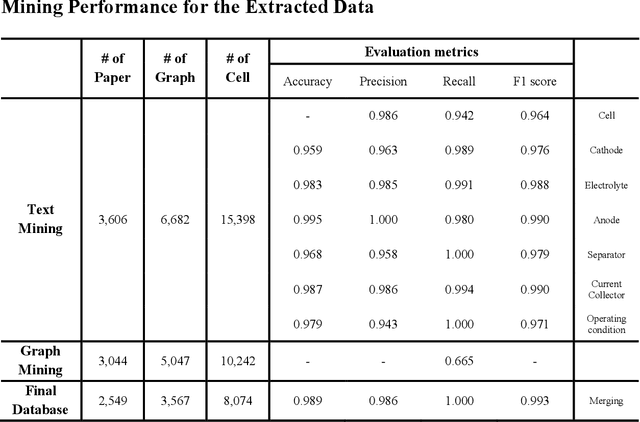
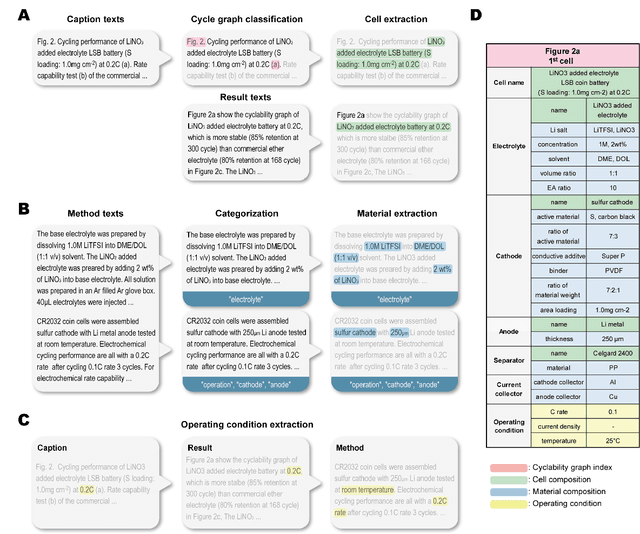
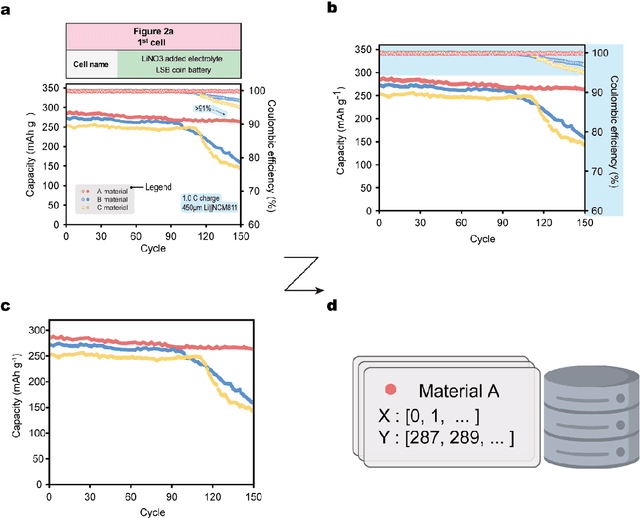
Recent advances in data-driven research have shown great potential in understanding the intricate relationships between materials and their performances. Herein, we introduce a novel multi modal data-driven approach employing an Automatic Battery data Collector (ABC) that integrates a large language model (LLM) with an automatic graph mining tool, Material Graph Digitizer (MatGD). This platform enables state-of-the-art accurate extraction of battery material data and cyclability performance metrics from diverse textual and graphical data sources. From the database derived through the ABC platform, we developed machine learning models that can accurately predict the capacity and stability of lithium metal batteries, which is the first-ever model developed to achieve such predictions. Our models were also experimentally validated, confirming practical applicability and reliability of our data-driven approach.
Inverse Design of Metal-Organic Frameworks Using Quantum Natural Language Processing
May 20, 2024In this study, we explore the potential of using quantum natural language processing (QNLP) to inverse design metal-organic frameworks (MOFs) with targeted properties. Specifically, by analyzing 150 hypothetical MOF structures consisting of 10 metal nodes and 15 organic ligands, we categorize these structures into four distinct classes for pore volume and $H_{2}$ uptake values. We then compare various QNLP models (i.e. the bag-of-words, DisCoCat (Distributional Compositional Categorical), and sequence-based models) to identify the most effective approach to process the MOF dataset. Using a classical simulator provided by the IBM Qiskit, the bag-of-words model is identified to be the optimum model, achieving validation accuracies of 85.7% and 86.7% for binary classification tasks on pore volume and $H_{2}$ uptake, respectively. Further, we developed multi-class classification models tailored to the probabilistic nature of quantum circuits, with average test accuracies of 88.4% and 80.7% across different classes for pore volume and $H_{2}$ uptake datasets. Finally, the performance of generating MOF with target properties showed accuracies of 93.5% for pore volume and 89% for $H_{2}$ uptake, respectively. Although our investigation covers only a fraction of the vast MOF search space, it marks a promising first step towards using quantum computing for materials design, offering a new perspective through which to explore the complex landscape of MOFs.
ChatMOF: An Autonomous AI System for Predicting and Generating Metal-Organic Frameworks
Aug 01, 2023ChatMOF is an autonomous Artificial Intelligence (AI) system that is built to predict and generate of metal-organic frameworks (MOFs). By leveraging a large-scale language model (gpt-3.5-turbo), ChatMOF extracts key details from textual inputs and delivers appropriate responses, thus eliminating the necessity for rigid structured queries. The system is comprised of three core components (i.e. an agent, a toolkit, and an evaluator) and it forms a robust pipeline that manages a variety of tasks, including data retrieval, property prediction, and structure generation. The study further explores the merits and constraints of using large language models (LLMs) AI system in material sciences using and showcases its transformative potential for future advancements.