 Add to Chrome
 Add to Firefox
 Add to Edge
Agentic LLM Reasoning in a Self-Driving Laboratory for Air-Sensitive Lithium Halide Spinel Conductors
Apr 13, 2026
Self-driving laboratories promise to accelerate materials discovery. Yet current automated solid-state synthesis platforms are limited to ambient conditions, thereby precluding their use for air-sensitive materials. Here, we present A-Lab for Glovebox Powder Solid-state Synthesis (A-Lab GPSS), a robotic platform capable of synthesizing and characterizing air-sensitive inorganic materials under strict air-free conditions. By integrating an agentic AI framework into the A-Lab GPSS platform, we structure autonomous experimental design through abductive and inductive reasoning. We deploy this platform to explore the vast compositional space of lithium halide spinel solid-state ionic conductors. Across a synthesis campaign comprising 352 samples with diverse compositions, the system explores a broad chemical space, experimentally realizing 72% of the 171 possible pairwise combinations among the 19 metals considered in this study. Over the course of the campaign, the fraction of compositions exhibiting both good ionic conductivity (> 0.05 mS/cm) and high halide spinel phase purity increases from 1.33% in the first 75 agent-proposed samples to 5.33% in the final 75. Furthermore, by inspecting the AI's reasoning processes, we reveal distinct yet complementary discovery strategies: abductive reasoning interrogates abnormal observations within already explored regions, whereas inductive reasoning expands the search into broader, previously unvisited chemical space. This work establishes a scalable platform for the autonomous discovery of complex, air-sensitive solid-state materials.

Data-driven development of cycle prediction models for lithium metal batteries using multi modal mining
Nov 26, 2024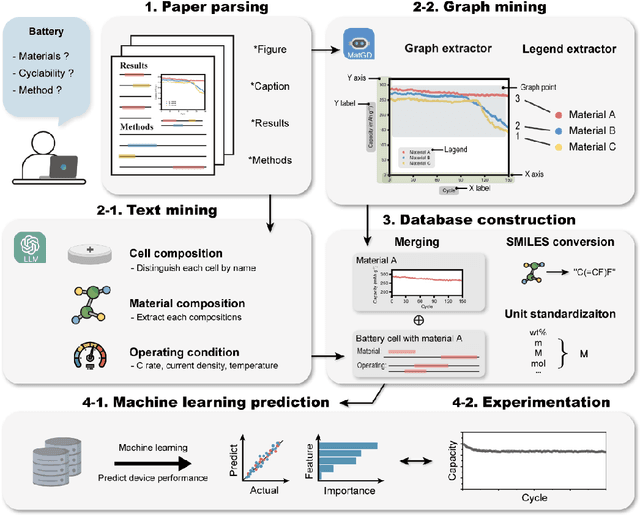
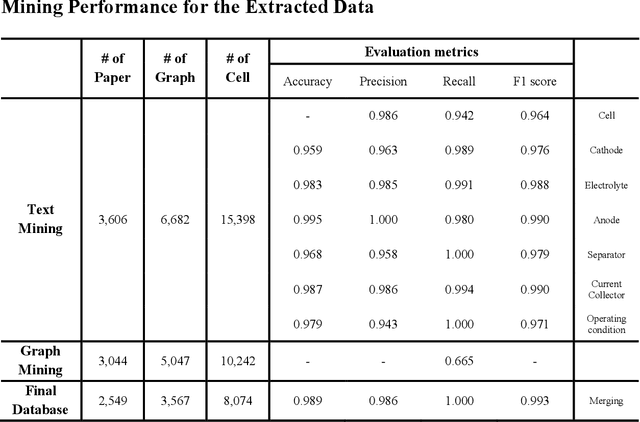
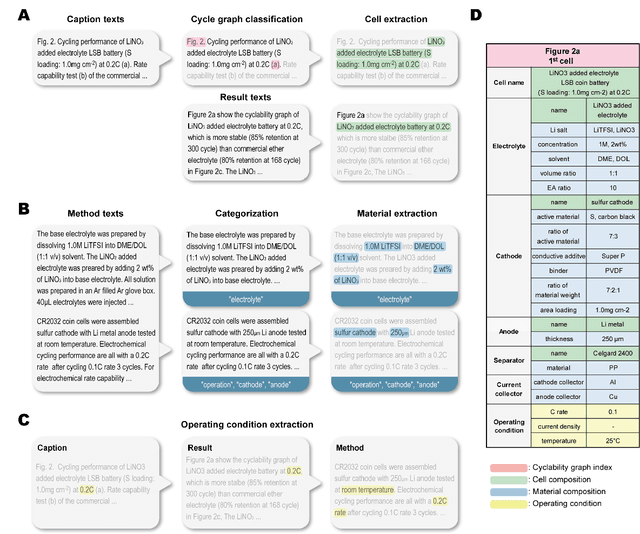
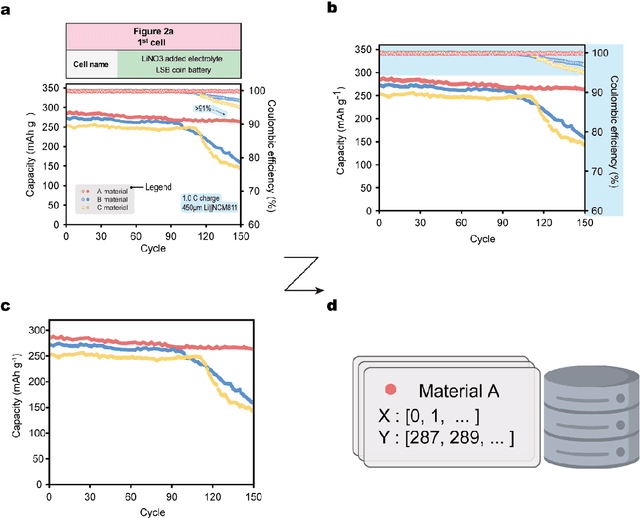
Recent advances in data-driven research have shown great potential in understanding the intricate relationships between materials and their performances. Herein, we introduce a novel multi modal data-driven approach employing an Automatic Battery data Collector (ABC) that integrates a large language model (LLM) with an automatic graph mining tool, Material Graph Digitizer (MatGD). This platform enables state-of-the-art accurate extraction of battery material data and cyclability performance metrics from diverse textual and graphical data sources. From the database derived through the ABC platform, we developed machine learning models that can accurately predict the capacity and stability of lithium metal batteries, which is the first-ever model developed to achieve such predictions. Our models were also experimentally validated, confirming practical applicability and reliability of our data-driven approach.