 Add to Chrome
 Add to Firefox
 Add to Edge
Automating and Scaling Behavioral Scientific Research on AI Agents
Aug 10, 2026
As AI agents are increasingly deployed in complex environments, understanding their behaviors becomes critical. Yet behavioral scientific research on AI agents remains manual and labor-intensive. We introduce AEROBAT, the first multi-agent system to automate behavioral scientific research on AI agents. Given an arbitrary target behavior by its user, AEROBAT automatically executes a full pipeline of behavioral scientific research---generating hypotheses about the behavior, designing and executing controlled experiments, making behavioral assessments, analyzing the results, and writing reports. For 12 target behaviors, we used AEROBAT to generate and test 79 hypotheses: designing 1,240 controlled experiments and executing 23,512 simulation rounds in total. Moderate-to-strong statistical evidence was found for 26 hypotheses, including some novel ones. In sum, our results demonstrate that automated behavioral scientific research on AI agents can complement and extend the reach of manual research.

Node4All: Learning Node Representation Beyond Datasets
Jul 19, 2026Node representation learning has advanced rapidly, yet most existing methods rely on per-dataset training and hyperparameter tuning. This dataset-specific optimization comes from the difficulty of designing reusable graph models that generalize across diverse graph datasets. In this work, we introduce Node4All, a node representation learner applicable to arbitrary graph datasets without any dataset-specific optimization. Node4All is built on two complementary ideas. At the architectural level, we introduce the Channel Graph Transformer (CGT), which enables a single fixed parameterization to process arbitrary graph datasets. At the learning level, we propose a self-supervised learning based on a series of synthetic graphs. Together, these components enable generalization beyond individual datasets, which is infeasible with existing architectures and learning frameworks. We extensively evaluate Node4All on node classification across 25 benchmarks against 21 baselines, covering both supervised and self-supervised methods. Despite all baselines being trained and optimized for each dataset, a single Node4All, applied uniformly across the datasets, achieves a competitive ranking of 5th among 21 baselines. Moreover, Node4All supports one-shot and in-context learning with an appropriate predictor and outperforms recent graph foundation models (GFMs) in these settings. These results demonstrate that Node4All not only achieves reusability across arbitrary graph datasets, but also remains an effective solution in practice. Code and model checkpoints are available in https://github.com/dooho00/node4all.
Bounded Context Management for Tabular Foundation Models on Stream Learning
Jun 17, 2026Tabular stream learning requires predictions on sequentially arriving examples under distribution shift. While standard methods adapt by updating model states, tabular foundation models (TFMs) make predictions conditioned on a labeled context in an in-context manner, making them a natural alternative for stream learning. This shifts the challenge from how to update the model to how to manage the context. We propose a future information view that yields three practical requirements for context management: preserve recent examples, retain uncertain examples, and remove redundant examples. We instantiate these requirements as CURE (Context management via Uncertainty-aware admission and Redundancy aware Eviction), a context-managing policy with entropy-gated admission and redundancy-aware eviction. Across seven streams, CURE shows up to 27.0% relative improvement over classical stream learners, remains robust across multiple TFM backbones, and ranks first among other policy variants. Code and datasets are available at https://github.com/morcellinus/CURE-ICML-FMSD.
Generalizing Multi-Scale Time-Series Modeling with a Single Operator
May 29, 2026Multi-scale modeling has emerged as an effective design principle for time-series forecasting by capturing temporal dynamics at multiple resolutions. As no principled foundation has been established in the literature, we unify existing scaling methods into a scaling operator family, revealing a fundamental limitation of existing approaches: reliance on fixed and discrete scaling. To address this limitation, we propose SiGMA (Single Generalized Multi-scale Architecture), which enables distance-aware scaling via the learnable discrete Gaussian (LDG) kernel grounded in scale-space theory. We evaluate SiGMA comprehensively on long- and short-term forecasting benchmarks against state-of-the-art multi-scale baselines. SiGMA outperforms all competitors on both tasks, especially achieving the best performance in 13 out of 16 long-term evaluation settings. Beyond accuracy, SiGMA significantly improves training speed by up to 5.3 times and reduces memory consumption by up to 3.8 times over the strongest competitors. Code is available at https://github.com/cheonwoolee/SiGMA.
PULSE: Socially-Aware User Representation Modeling Toward Parameter-Efficient Graph Collaborative Filtering
Jan 21, 2026Graph-based social recommendation (SocialRec) has emerged as a powerful extension of graph collaborative filtering (GCF), which leverages graph neural networks (GNNs) to capture multi-hop collaborative signals from user-item interactions. These methods enrich user representations by incorporating social network information into GCF, thereby integrating additional collaborative signals from social relations. However, existing GCF and graph-based SocialRec approaches face significant challenges: they incur high computational costs and suffer from limited scalability due to the large number of parameters required to assign explicit embeddings to all users and items. In this work, we propose PULSE (Parameter-efficient User representation Learning with Social Knowledge), a framework that addresses this limitation by constructing user representations from socially meaningful signals without creating an explicit learnable embedding for each user. PULSE reduces the parameter size by up to 50% compared to the most lightweight GCF baseline. Beyond parameter efficiency, our method achieves state-of-the-art performance, outperforming 13 GCF and graph-based social recommendation baselines across varying levels of interaction sparsity, from cold-start to highly active users, through a time- and memory-efficient modeling process.
Feature-Centric Unsupervised Node Representation Learning Without Homophily Assumption
Dec 17, 2025Unsupervised node representation learning aims to obtain meaningful node embeddings without relying on node labels. To achieve this, graph convolution, which aggregates information from neighboring nodes, is commonly employed to encode node features and graph topology. However, excessive reliance on graph convolution can be suboptimal-especially in non-homophilic graphs-since it may yield unduly similar embeddings for nodes that differ in their features or topological properties. As a result, adjusting the degree of graph convolution usage has been actively explored in supervised learning settings, whereas such approaches remain underexplored in unsupervised scenarios. To tackle this, we propose FUEL, which adaptively learns the adequate degree of graph convolution usage by aiming to enhance intra-class similarity and inter-class separability in the embedding space. Since classes are unknown, FUEL leverages node features to identify node clusters and treats these clusters as proxies for classes. Through extensive experiments using 15 baseline methods and 14 benchmark datasets, we demonstrate the effectiveness of FUEL in downstream tasks, achieving state-of-the-art performance across graphs with diverse levels of homophily.
Fully Inductive Node Representation Learning via Graph View Transformation
Dec 12, 2025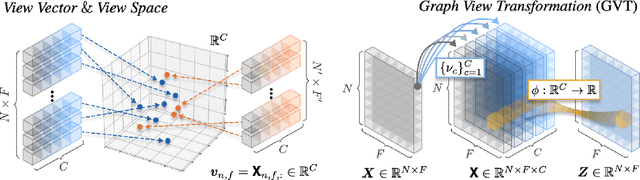
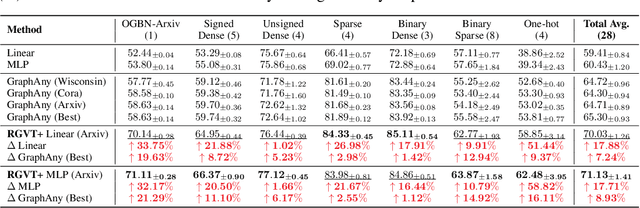
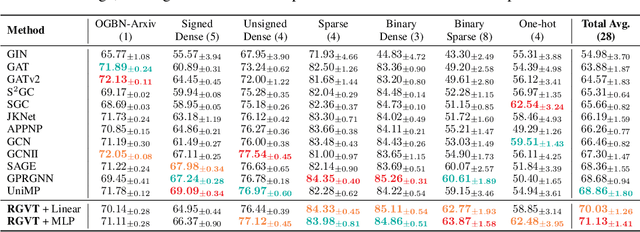
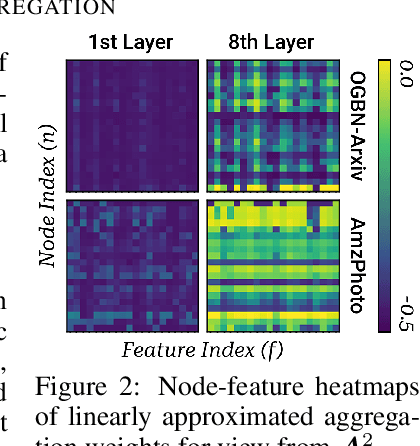
Generalizing a pretrained model to unseen datasets without retraining is an essential step toward a foundation model. However, achieving such cross-dataset, fully inductive inference is difficult in graph-structured data where feature spaces vary widely in both dimensionality and semantics. Any transformation in the feature space can easily violate the inductive applicability to unseen datasets, strictly limiting the design space of a graph model. In this work, we introduce the view space, a novel representational axis in which arbitrary graphs can be naturally encoded in a unified manner. We then propose Graph View Transformation (GVT), a node- and feature-permutation-equivariant mapping in the view space. GVT serves as the building block for Recurrent GVT, a fully inductive model for node representation learning. Pretrained on OGBN-Arxiv and evaluated on 27 node-classification benchmarks, Recurrent GVT outperforms GraphAny, the prior fully inductive graph model, by +8.93% and surpasses 12 individually tuned GNNs by at least +3.30%. These results establish the view space as a principled and effective ground for fully inductive node representation learning.
ItemRAG: Item-Based Retrieval-Augmented Generation for LLM-Based Recommendation
Nov 19, 2025Recently, large language models (LLMs) have been widely used as recommender systems, owing to their strong reasoning capability and their effectiveness in handling cold-start items. To better adapt LLMs for recommendation, retrieval-augmented generation (RAG) has been incorporated. Most existing RAG methods are user-based, retrieving purchase patterns of users similar to the target user and providing them to the LLM. In this work, we propose ItemRAG, an item-based RAG method for LLM-based recommendation that retrieves relevant items (rather than users) from item-item co-purchase histories. ItemRAG helps LLMs capture co-purchase patterns among items, which are beneficial for recommendations. Especially, our retrieval strategy incorporates semantically similar items to better handle cold-start items and uses co-purchase frequencies to improve the relevance of the retrieved items. Through extensive experiments, we demonstrate that ItemRAG consistently (1) improves the zero-shot LLM-based recommender by up to 43% in Hit-Ratio-1 and (2) outperforms user-based RAG baselines under both standard and cold-start item recommendation settings.
Parameter-Free Hypergraph Neural Network for Few-Shot Node Classification
Oct 24, 2025Few-shot node classification on hypergraphs requires models that generalize from scarce labels while capturing high-order structures. Existing hypergraph neural networks (HNNs) effectively encode such structures but often suffer from overfitting and scalability issues due to complex, black-box architectures. In this work, we propose ZEN (Zero-Parameter Hypergraph Neural Network), a fully linear and parameter-free model that achieves both expressiveness and efficiency. Built upon a unified formulation of linearized HNNs, ZEN introduces a tractable closed-form solution for the weight matrix and a redundancy-aware propagation scheme to avoid iterative training and to eliminate redundant self information. On 11 real-world hypergraph benchmarks, ZEN consistently outperforms eight baseline models in classification accuracy while achieving up to 696x speedups over the fastest competitor. Moreover, the decision process of ZEN is fully interpretable, providing insights into the characteristic of a dataset. Our code and datasets are fully available at https://github.com/chaewoonbae/ZEN.
'Hello, World!': Making GNNs Talk with LLMs
May 27, 2025While graph neural networks (GNNs) have shown remarkable performance across diverse graph-related tasks, their high-dimensional hidden representations render them black boxes. In this work, we propose Graph Lingual Network (GLN), a GNN built on large language models (LLMs), with hidden representations in the form of human-readable text. Through careful prompt design, GLN incorporates not only the message passing module of GNNs but also advanced GNN techniques, including graph attention and initial residual connection. The comprehensibility of GLN's hidden representations enables an intuitive analysis of how node representations change (1) across layers and (2) under advanced GNN techniques, shedding light on the inner workings of GNNs. Furthermore, we demonstrate that GLN achieves strong zero-shot performance on node classification and link prediction, outperforming existing LLM-based baseline methods.