 Add to Chrome
 Add to Firefox
 Add to Edge
Node4All: Learning Node Representation Beyond Datasets
Jul 19, 2026
Node representation learning has advanced rapidly, yet most existing methods rely on per-dataset training and hyperparameter tuning. This dataset-specific optimization comes from the difficulty of designing reusable graph models that generalize across diverse graph datasets. In this work, we introduce Node4All, a node representation learner applicable to arbitrary graph datasets without any dataset-specific optimization. Node4All is built on two complementary ideas. At the architectural level, we introduce the Channel Graph Transformer (CGT), which enables a single fixed parameterization to process arbitrary graph datasets. At the learning level, we propose a self-supervised learning based on a series of synthetic graphs. Together, these components enable generalization beyond individual datasets, which is infeasible with existing architectures and learning frameworks. We extensively evaluate Node4All on node classification across 25 benchmarks against 21 baselines, covering both supervised and self-supervised methods. Despite all baselines being trained and optimized for each dataset, a single Node4All, applied uniformly across the datasets, achieves a competitive ranking of 5th among 21 baselines. Moreover, Node4All supports one-shot and in-context learning with an appropriate predictor and outperforms recent graph foundation models (GFMs) in these settings. These results demonstrate that Node4All not only achieves reusability across arbitrary graph datasets, but also remains an effective solution in practice. Code and model checkpoints are available in https://github.com/dooho00/node4all.

Generalizing Multi-Scale Time-Series Modeling with a Single Operator
May 29, 2026Multi-scale modeling has emerged as an effective design principle for time-series forecasting by capturing temporal dynamics at multiple resolutions. As no principled foundation has been established in the literature, we unify existing scaling methods into a scaling operator family, revealing a fundamental limitation of existing approaches: reliance on fixed and discrete scaling. To address this limitation, we propose SiGMA (Single Generalized Multi-scale Architecture), which enables distance-aware scaling via the learnable discrete Gaussian (LDG) kernel grounded in scale-space theory. We evaluate SiGMA comprehensively on long- and short-term forecasting benchmarks against state-of-the-art multi-scale baselines. SiGMA outperforms all competitors on both tasks, especially achieving the best performance in 13 out of 16 long-term evaluation settings. Beyond accuracy, SiGMA significantly improves training speed by up to 5.3 times and reduces memory consumption by up to 3.8 times over the strongest competitors. Code is available at https://github.com/cheonwoolee/SiGMA.
Fully Inductive Node Representation Learning via Graph View Transformation
Dec 12, 2025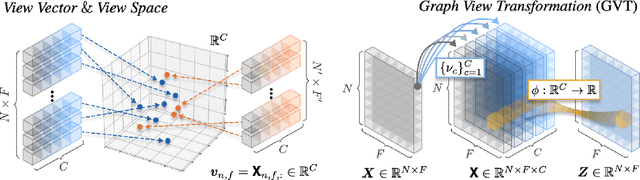
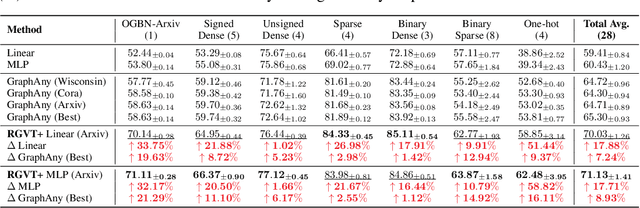
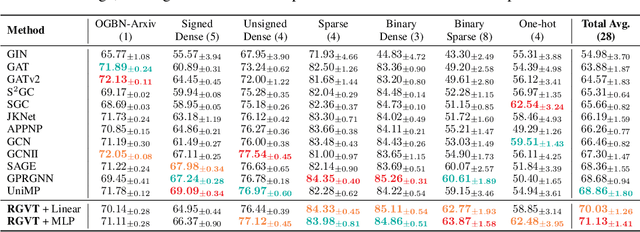
Generalizing a pretrained model to unseen datasets without retraining is an essential step toward a foundation model. However, achieving such cross-dataset, fully inductive inference is difficult in graph-structured data where feature spaces vary widely in both dimensionality and semantics. Any transformation in the feature space can easily violate the inductive applicability to unseen datasets, strictly limiting the design space of a graph model. In this work, we introduce the view space, a novel representational axis in which arbitrary graphs can be naturally encoded in a unified manner. We then propose Graph View Transformation (GVT), a node- and feature-permutation-equivariant mapping in the view space. GVT serves as the building block for Recurrent GVT, a fully inductive model for node representation learning. Pretrained on OGBN-Arxiv and evaluated on 27 node-classification benchmarks, Recurrent GVT outperforms GraphAny, the prior fully inductive graph model, by +8.93% and surpasses 12 individually tuned GNNs by at least +3.30%. These results establish the view space as a principled and effective ground for fully inductive node representation learning.
Aggregation Buffer: Revisiting DropEdge with a New Parameter Block
May 27, 2025We revisit DropEdge, a data augmentation technique for GNNs which randomly removes edges to expose diverse graph structures during training. While being a promising approach to effectively reduce overfitting on specific connections in the graph, we observe that its potential performance gain in supervised learning tasks is significantly limited. To understand why, we provide a theoretical analysis showing that the limited performance of DropEdge comes from the fundamental limitation that exists in many GNN architectures. Based on this analysis, we propose Aggregation Buffer, a parameter block specifically designed to improve the robustness of GNNs by addressing the limitation of DropEdge. Our method is compatible with any GNN model, and shows consistent performance improvements on multiple datasets. Moreover, our method effectively addresses well-known problems such as degree bias or structural disparity as a unifying solution. Code and datasets are available at https://github.com/dooho00/agg-buffer.