 Add to Chrome
 Add to Firefox
 Add to Edge
Confidence Horizons
Aug 04, 2026
Anytime-valid inference enables analysts to continuously monitor their data and stop experiments early. However, the majority of these methods incur a certain conservativeness by remaining valid on infinite time horizons. In practice, a bound on the horizon may be imposed due to budgetary, practical, or ethical constraints. In this paper, we ask the question: "Is it possible to obtain sharper large-sample anytime-valid inference by forgoing validity beyond some finite time horizon?". We provide a positive answer to this question by proposing a family of statistical objects that we call "confidence horizons". These objects can be viewed as large-sample confidence sequences on bounded time horizons, or alternatively as group sequential repeated confidence intervals with a maximal number of interim peeking times. We make explicit connections to the group sequential boundaries of Pocock [1977], O'Brien--Fleming [1979], and Wang--Tsiatis [1987]. We derive closed-form distribution functions of certain statistics which can be used to calculate the asymptotic quantiles of confidence horizons exactly, sidestepping the repeated integration typically employed in group sequential methods. We illustrate the use of confidence horizons for treatment effect estimation in sequentially randomized experiments under adaptive Neyman allocation.

Post-Training at the Edge of Detectability: A Game-Theoretic Approach to Fine-Tuning
Jul 29, 2026Reinforcement learning (RL) fine-tuning is widely used in language model training to improve model performance on a target task while limiting drift from a reference policy. A standard way to balance this trade-off is via a KL-regularized RL objective, although this formulation does not by itself provide a principled way to set the regularization coefficient. In practice, the coefficient is typically chosen heuristically or via hyperparameter search, which can lead to unnecessary overhead in training cost or undesirable reward-retention trade-offs. We instead propose a game-theoretic framework that gives this trade-off an explicit statistical interpretation. Specifically, we study a sequential game in which an agent chooses a policy to maximize cumulative reward while a monitor observes policy outputs over time and tests for deviations from the reference policy. Although not originating from the same perspective, we show that the resulting equilibrium policy can nonetheless be expressed as the solution to a KL-regularized RL problem for an optimal regularization parameter that can be viewed as maximizing reward per unit of statistical distinguishability. Drawing on classical results from concave-convex fractional programming, we provide a principled method for learning this equilibrium coefficient via reduction to the KL-regularized RL objective, thus allowing for flexible integration into standard fine-tuning pipelines. In experiments with Qwen3-8B and Llama-3.2-1B, we demonstrate that our methods result in competitive reward-retention trade-offs in a continual learning setting, and illustrate how our framework may be used to audit API providers serving open-source models.
Gaffke's confidence interval for the mean of bounded data is inadmissible but asymptotically efficient
Jul 21, 2026Given observations $\mathbf x=(x_1,\dots,x_n)$, Gaffke (2005) defined \[ K_n(\mathbf x)=\mathbb{P}_{\mathbf D}\!\left\{\sum_{i=1}^n x_iD_i\le 1\right\}, \qquad (D_0,D_1,\ldots,D_n)\sim\mathrm{Dirichlet}(1,\ldots,1), \] and conjectured that it is a $p$-value whenever the inputs are independent e-values. Recently, Vlassis and Thomas (2026) proved this conjecture. Inverting the tests for observations in $[0,1]$ gives the confidence interval studied by Learned-Miller and Thomas (2020), which reduces to Clopper--Pearson for Bernoulli data. We give a finite- and large-sample account of Gaffke's test and interval. First, for every $\mathbf x\in[0,\infty)^n$ and every elementary symmetric polynomial $e_k$, \( K_n(\mathbf x)e_k(\mathbf x)\le {n\choose k}, \) so the Gaffke $p$-value never larger than the SymPol $p$-value of Ming et al. (2026). However, Gaffke's p-value is inadmissible. For $n=2$, we construct a valid rule that is strictly smaller on mixed configurations and is the unique admissible rule that dominates $K_2$. A neutral-face extension proves inadmissibility of $K_n$ for every $n\ge2$. If one independent uniform random variable is allowed, there is an even simpler full-dimensional improvement: on the upper orthant, where $K_n(\mathbf x)=1/\prod_i x_i$, replace it by $U/\prod_i x_i$. The equal-tail Gaffke confidence interval $I_n$ is nevertheless first-order asymptotically efficient: for iid observations on $[0,1]$ with unknown variance $σ^2>0$, \[ \sqrt n\,\operatorname{Width}(I_n)\longrightarrow 2σz_{1-α/2}\qquad\text{almost surely}. \] Our simulations also find that, among a variety of bounded-mean intervals considered, the Gaffke interval is the shortest, including comparisons with a recent empirical Berry--Esseen procedure having the same first-order Gaussian target.
Multi-Armed Sequential Hypothesis Testing by Betting
Mar 18, 2026We consider a variant of sequential testing by betting where, at each time step, the statistician is presented with multiple data sources (arms) and obtains data by choosing one of the arms. We consider the composite global null hypothesis $\mathscr{P}$ that all arms are null in a certain sense (e.g. all dosages of a treatment are ineffective) and we are interested in rejecting $\mathscr{P}$ in favor of a composite alternative $\mathscr{Q}$ where at least one arm is non-null (e.g. there exists an effective treatment dosage). We posit an optimality desideratum that we describe informally as follows: even if several arms are non-null, we seek $e$-processes and sequential tests whose performance are as strong as the ones that have oracle knowledge about which arm generates the most evidence against $\mathscr{P}$. Formally, we generalize notions of log-optimality and expected rejection time optimality to more than one arm, obtaining matching lower and upper bounds for both. A key technical device in this optimality analysis is a modified upper-confidence-bound-like algorithm for unobservable but sufficiently "estimable" rewards. In the design of this algorithm, we derive nonasymptotic concentration inequalities for optimal wealth growth rates in the sense of Kelly [1956]. These may be of independent interest.
On Nonasymptotic Confidence Intervals for Treatment Effects in Randomized Experiments
Jan 16, 2026We study nonasymptotic (finite-sample) confidence intervals for treatment effects in randomized experiments. In the existing literature, the effective sample sizes of nonasymptotic confidence intervals tend to be looser than the corresponding central-limit-theorem-based confidence intervals by a factor depending on the square root of the propensity score. We show that this performance gap can be closed, designing nonasymptotic confidence intervals that have the same effective sample size as their asymptotic counterparts. Our approach involves systematic exploitation of negative dependence or variance adaptivity (or both). We also show that the nonasymptotic rates that we achieve are unimprovable in an information-theoretic sense.
Anytime-valid off-policy inference for contextual bandits
Oct 19, 2022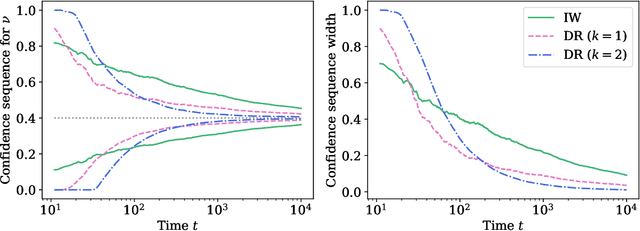
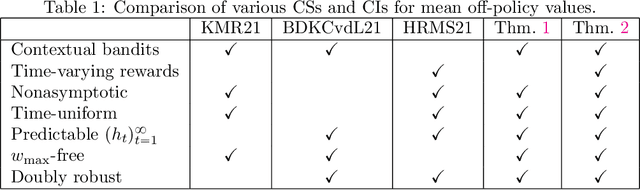
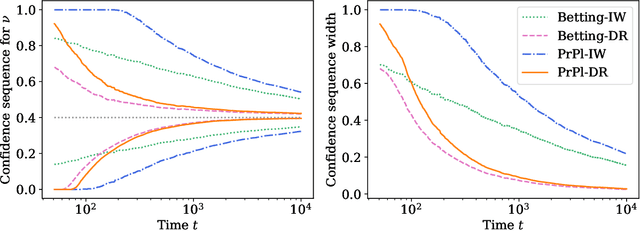
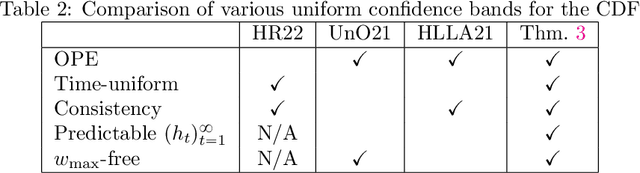
Contextual bandits are a modern staple tool for active sequential experimentation in the tech industry. They involve online learning algorithms that adaptively (over time) learn policies to map observed contexts $X_t$ to actions $A_t$ in an attempt to maximize stochastic rewards $R_t$. This adaptivity raises interesting but hard statistical inference questions, especially counterfactual ones: for example, it is often of interest to estimate the properties of a hypothetical policy that is different from the logging policy that was used to collect the data -- a problem known as "off-policy evaluation" (OPE). Using modern martingale techniques, we present a comprehensive framework for OPE inference that relax many unnecessary assumptions made in past work, significantly improving on them theoretically and empirically. Our methods remain valid in very general settings, and can be employed while the original experiment is still running (that is, not necessarily post-hoc), when the logging policy may be itself changing (due to learning), and even if the context distributions are drifting over time. More concretely, we derive confidence sequences for various functionals of interest in OPE. These include doubly robust ones for time-varying off-policy mean reward values, but also confidence bands for the entire CDF of the off-policy reward distribution. All of our methods (a) are valid at arbitrary stopping times (b) only make nonparametric assumptions, and (c) do not require known bounds on the maximal importance weights, and (d) adapt to the empirical variance of the reward and weight distributions. In summary, our methods enable anytime-valid off-policy inference using adaptively collected contextual bandit data.
Locally private nonparametric confidence intervals and sequences
Feb 17, 2022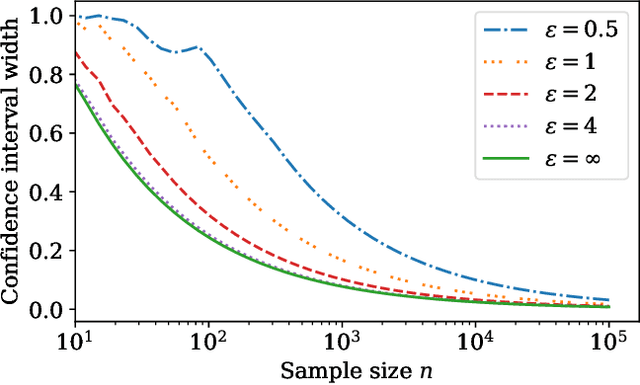
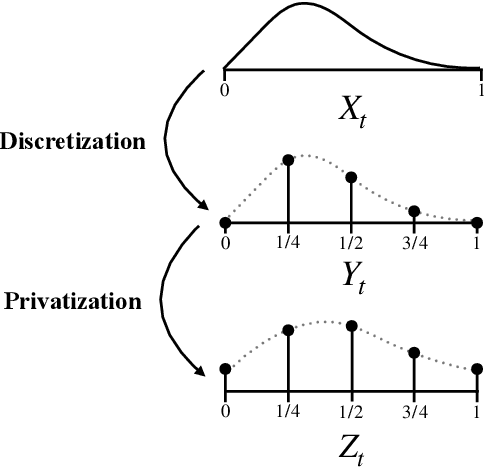
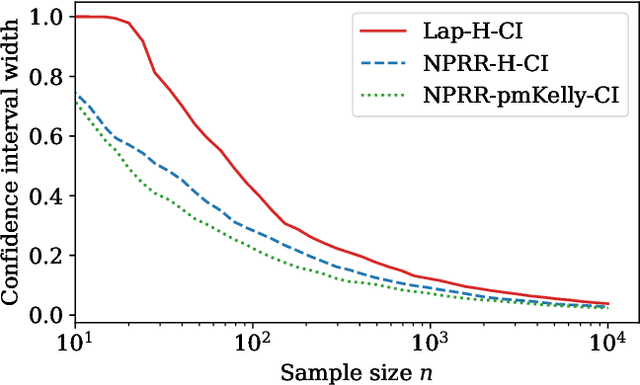
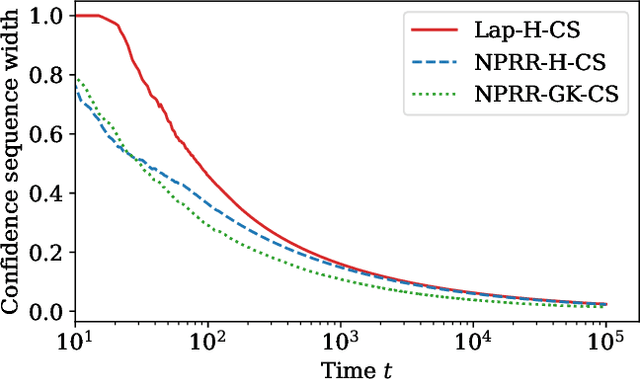
This work derives methods for performing nonparametric, nonasymptotic statistical inference for population parameters under the constraint of local differential privacy (LDP). Given observations $(X_1, \dots, X_n)$ with mean $\mu^\star$ that are privatized into $(Z_1, \dots, Z_n)$, we introduce confidence intervals (CI) and time-uniform confidence sequences (CS) for $\mu^\star \in \mathbb R$ when only given access to the privatized data. We introduce a nonparametric and sequentially interactive generalization of Warner's famous "randomized response" mechanism, satisfying LDP for arbitrary bounded random variables, and then provide CIs and CSs for their means given access to the resulting privatized observations. We extend these CSs to capture time-varying (non-stationary) means, and conclude by illustrating how these methods can be used to conduct private online A/B tests.
Doubly robust confidence sequences for sequential causal inference
Mar 11, 2021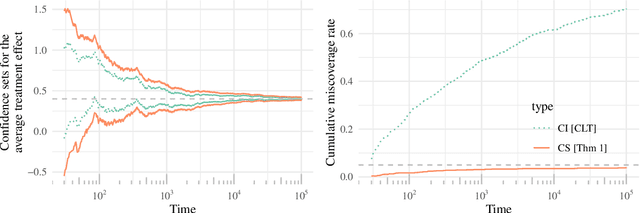
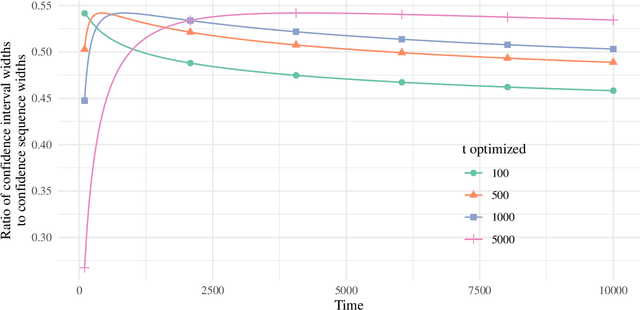
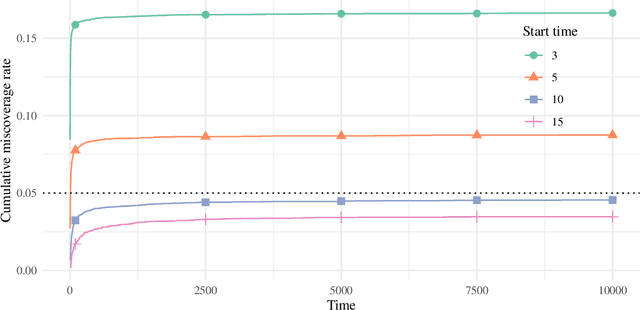
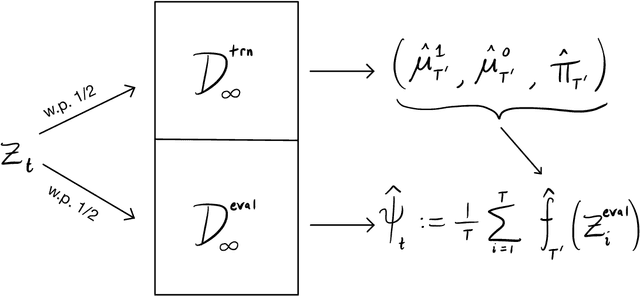
This paper derives time-uniform confidence sequences (CS) for causal effects in experimental and observational settings. A confidence sequence for a target parameter $\psi$ is a sequence of confidence intervals $(C_t)_{t=1}^\infty$ such that every one of these intervals simultaneously captures $\psi$ with high probability. Such CSs provide valid statistical inference for $\psi$ at arbitrary stopping times, unlike classical fixed-time confidence intervals which require the sample size to be fixed in advance. Existing methods for constructing CSs focus on the nonasymptotic regime where certain assumptions (such as known bounds on the random variables) are imposed, while doubly-robust estimators of causal effects rely on (asymptotic) semiparametric theory. We use sequential versions of central limit theorem arguments to construct large-sample CSs for causal estimands, with a particular focus on the average treatment effect (ATE) under nonparametric conditions. These CSs allow analysts to update statistical inferences about the ATE in lieu of new data, and experiments can be continuously monitored, stopped, or continued for any data-dependent reason, all while controlling the type-I error rate. Finally, we describe how these CSs readily extend to other causal estimands and estimators, providing a new framework for sequential causal inference in a wide array of problems.
Variance-adaptive confidence sequences by betting
Oct 19, 2020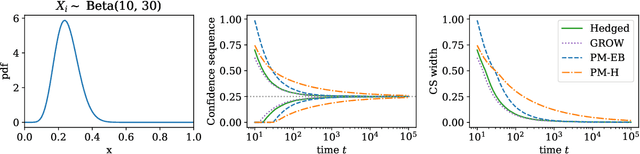
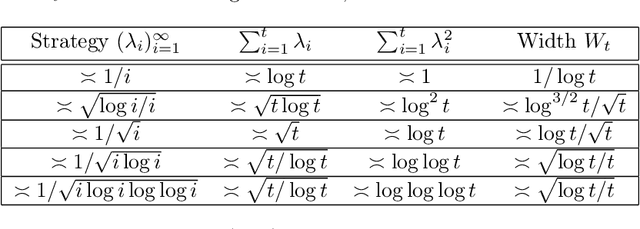
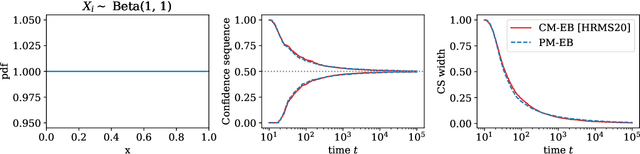
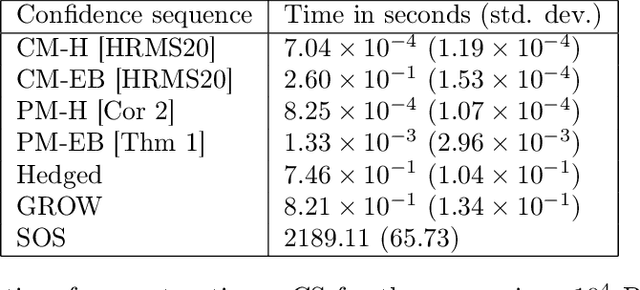
This paper derives confidence intervals (CI) and time-uniform confidence sequences (CS) for an unknown mean based on bounded observations. Our methods are based on a new general approach for deriving concentration bounds, that can be seen as a generalization (and improvement) of the classical Chernoff method. At its heart, it is based on deriving a new class of composite nonnegative martingales with initial value one, with strong connections to betting and the method of mixtures. We show how to extend these ideas to sampling without replacement. In all cases considered, the bounds are adaptive to the unknown variance, and empirically outperform competing approaches based on Hoeffding's or empirical Bernstein's inequalities and their recent supermartingale generalizations.
Confidence sequences for sampling without replacement
Jun 08, 2020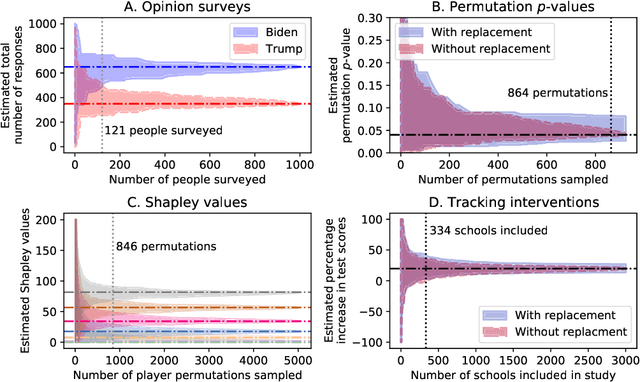
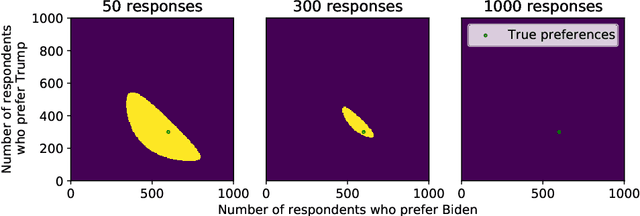
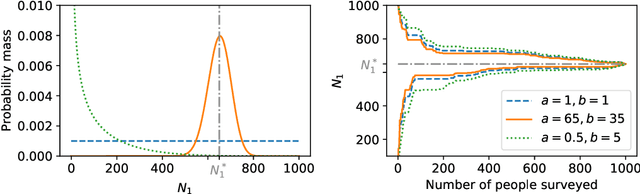
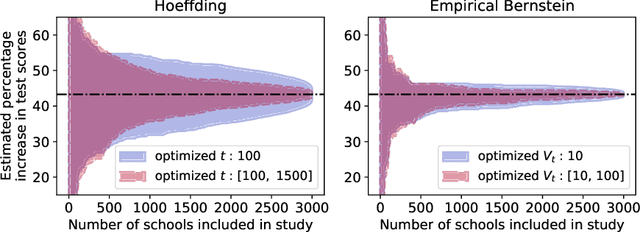
Many practical tasks involve sampling sequentially without replacement from a finite population of size $N$, in an attempt to estimate some parameter $\theta^\star$. Accurately quantifying uncertainty throughout this process is a nontrivial task, but is necessary because it often determines when we stop collecting samples and confidently report a result. We present a suite of tools to design confidence sequences (CS) for $\theta^\star$. A CS is a sequence of confidence sets $(C_n)_{n=1}^N$, that shrink in size, and all contain $\theta^\star$ simultaneously with high probability. We demonstrate their empirical performance using four example applications: local opinion surveys, calculating permutation $p$-values, estimating Shapley values, and tracking the effect of an intervention. We highlight two marked advantages over naive with-replacement sampling and/or uncertainty estimates: (1) each member of the finite population need only be queried once, saving time and money, and (2) our confidence sets are tighter and shrink to exactly zero width in $N$ steps.