 Add to Chrome
 Add to Firefox
 Add to Edge
UrbanGS: A Scalable and Efficient Architecture for Geometrically Accurate Large-Scene Reconstruction
Feb 02, 2026
While 3D Gaussian Splatting (3DGS) enables high-quality, real-time rendering for bounded scenes, its extension to large-scale urban environments gives rise to critical challenges in terms of geometric consistency, memory efficiency, and computational scalability. To address these issues, we present UrbanGS, a scalable reconstruction framework that effectively tackles these challenges for city-scale applications. First, we propose a Depth-Consistent D-Normal Regularization module. Unlike existing approaches that rely solely on monocular normal estimators, which can effectively update rotation parameters yet struggle to update position parameters, our method integrates D-Normal constraints with external depth supervision. This allows for comprehensive updates of all geometric parameters. By further incorporating an adaptive confidence weighting mechanism based on gradient consistency and inverse depth deviation, our approach significantly enhances multi-view depth alignment and geometric coherence, which effectively resolves the issue of geometric accuracy in complex large-scale scenes. To improve scalability, we introduce a Spatially Adaptive Gaussian Pruning (SAGP) strategy, which dynamically adjusts Gaussian density based on local geometric complexity and visibility to reduce redundancy. Additionally, a unified partitioning and view assignment scheme is designed to eliminate boundary artifacts and optimize computational load. Extensive experiments on multiple urban datasets demonstrate that UrbanGS achieves superior performance in rendering quality, geometric accuracy, and memory efficiency, providing a systematic solution for high-fidelity large-scale scene reconstruction.

LLM-based MOFs Synthesis Condition Extraction using Few-Shot Demonstrations
Aug 06, 2024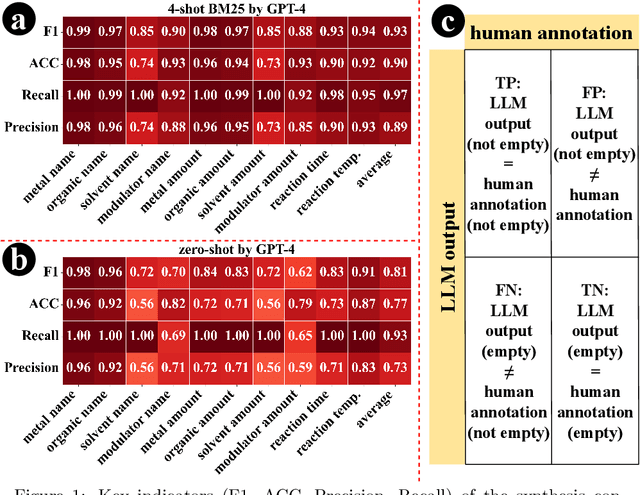
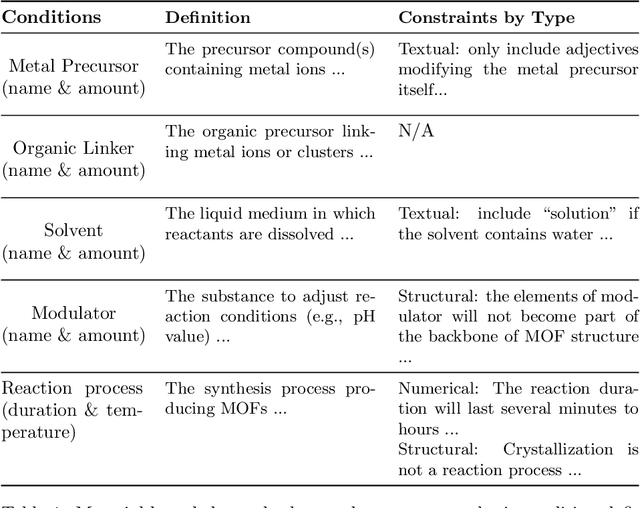
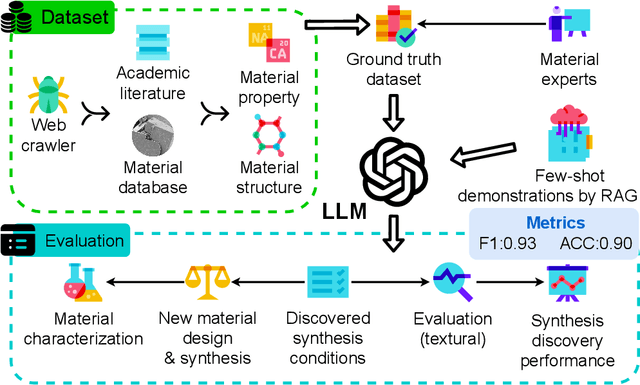
The extraction of Metal-Organic Frameworks (MOFs) synthesis conditions from literature text has been challenging but crucial for the logical design of new MOFs with desirable functionality. The recent advent of large language models (LLMs) provides disruptively new solution to this long-standing problem and latest researches have reported over 90% F1 in extracting correct conditions from MOFs literature. We argue in this paper that most existing synthesis extraction practices with LLMs stay with the primitive zero-shot learning, which could lead to downgraded extraction and application performance due to the lack of specialized knowledge. This work pioneers and optimizes the few-shot in-context learning paradigm for LLM extraction of material synthesis conditions. First, we propose a human-AI joint data curation process to secure high-quality ground-truth demonstrations for few-shot learning. Second, we apply a BM25 algorithm based on the retrieval-augmented generation (RAG) technique to adaptively select few-shot demonstrations for each MOF's extraction. Over a dataset randomly sampled from 84,898 well-defined MOFs, the proposed few-shot method achieves much higher average F1 performance (0.93 vs. 0.81, +14.8%) than the native zero-shot LLM using the same GPT-4 model, under fully automatic evaluation that are more objective than the previous human evaluation. The proposed method is further validated through real-world material experiments: compared with the baseline zero-shot LLM, the proposed few-shot approach increases the MOFs structural inference performance (R^2) by 29.4% in average.
VuLASTE: Long Sequence Model with Abstract Syntax Tree Embedding for vulnerability Detection
Feb 05, 2023In this paper, we build a model named VuLASTE, which regards vulnerability detection as a special text classification task. To solve the vocabulary explosion problem, VuLASTE uses a byte level BPE algorithm from natural language processing. In VuLASTE, a new AST path embedding is added to represent source code nesting information. We also use a combination of global and dilated window attention from Longformer to extract long sequence semantic from source code. To solve the data imbalance problem, which is a common problem in vulnerability detection datasets, focal loss is used as loss function to make model focus on poorly classified cases during training. To test our model performance on real-world source code, we build a cross-language and multi-repository vulnerability dataset from Github Security Advisory Database. On this dataset, VuLASTE achieved top 50, top 100, top 200, top 500 hits of 29, 51, 86, 228, which are higher than state-of-art researches.