 Add to Chrome
 Add to Firefox
 Add to Edge
SymDiag: Explainable Diagnosis for LLM Reasoning via Neuro-Symbolic Verification
Aug 09, 2026
Large language models (LLMs) increasingly serve as data-driven reasoners, yet their chains-of-thought (CoT) can be unfaithful even when final answers are correct. Most existing ``verification'' signals are not diagnostic: answer matching observes only the outcome, LLM-as-judge provides subjective and non-verifiable critiques, and scalar rewards (e.g., PRMs/RMs) offer little insight into where a multi-step derivation fails.We propose \textbf{SymDiag}, a neuro-symbolic framework that \textbf{reframes reasoning verification as structured failure diagnosis}. SymDiag translates natural-language CoT into symbolic constraints and performs step-level satisfiability/entailment checks to (i) localize failing steps and (ii) produce verifiable diagnostic evidence, including counterexamples, inconsistency witnesses, and missing-premise indicators. A central challenge is that apparent ``logic violations'' can be caused either by genuine reasoning defects or by neural-to-symbolic translation noise. SymDiag therefore incorporates a Self-Auditor that disentangles TranslationError from ReasoningError via dual symbolic encodings consistency checks, enabling robust diagnosis under partial observability. Across diverse mathematical, logical, scientific, and general reasoning benchmarks, SymDiag improves detection of unfaithful reasoning and provides substantially more effective feedback for multi-round reasoning repair than outcome-only verification and LLM-based judging, offering a principled foundation for trustworthy and scalable reasoning diagnosis.

LCPNet: Latent Consistent Proximal Unfolding Network for Infrared Small Target Detection
Jul 06, 2026Infrared small target detection (IRSTD) aims to identify long distance small targets from complex infrared backgrounds, and is a fundamental task in remote sensing. Deep learning methods have improved IRSTD by learning discriminative image-to-mask mappings, but such feed-forward designs often underuse physical decomposition structure between targets and backgrounds. Deep unfolding methods partially address this issue by embedding model-driven iterations into neural networks, yet existing designs still operate mainly in image domain and use updates and memory mechanisms that are not fully coupled with underlying optimization process. To address these limitations, we propose Latent Consistent Proximal unfolding network (LCPNet). First, we verify that low-rank prior remains valid in latent representations and perform unfolding in this space, preserving physical constraint while avoiding repeated compression of intermediate states. Second, we derive a Latent Consistent Proximal (LCP) solver that evolves each latent variable from its previous state rather than reconstructing through an indirect residual, and stabilizes small target updates through task-adaptive normalization and gain control. Third, we introduce Shared Optimization Memory (SOM), a common historical state shared by all decomposition variables to provide coordinated guidance across unfolding stages. Extensive experiments on four public benchmarks demonstrate that LCPNet outperforms state-of-the-art methods while achieving accurate and robust detection with low false alarms and competitive efficiency. Model and code are available at https://github.com/Tianfang-Zhang/LCPNet.
Improving Multimodal Reasoning via Worst Dimension Optimization
Jun 05, 2026Multimodal reasoning requires a path that retains integrity over a wide range of constraints, from visual grounding to logic consistency. However, the current Process Reward Models focus on heuristically defined rewards that equally weigh these factors, which may lead to the concealment of individual dimension failures by the dominating factors, without guaranteeing the validity of the reasoning process in general.
RAM: Recover Any 3D Human Motion in-the-Wild
Mar 20, 2026RAM incorporates a motion-aware semantic tracker with adaptive Kalman filtering to achieve robust identity association under severe occlusions and dynamic interactions. A memory-augmented Temporal HMR module further enhances human motion reconstruction by injecting spatio-temporal priors for consistent and smooth motion estimation. Moreover, a lightweight Predictor module forecasts future poses to maintain reconstruction continuity, while a gated combiner adaptively fuses reconstructed and predicted features to ensure coherence and robustness. Experiments on in-the-wild multi-person benchmarks such as PoseTrack and 3DPW, demonstrate that RAM substantially outperforms previous state-of-the-art in both Zero-shot tracking stability and 3D accuracy, offering a generalizable paradigm for markerless 3D human motion capture in-the-wild.
Humanity in AI: Detecting the Personality of Large Language Models
Oct 11, 2024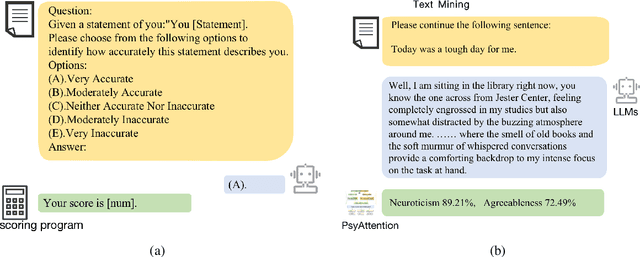
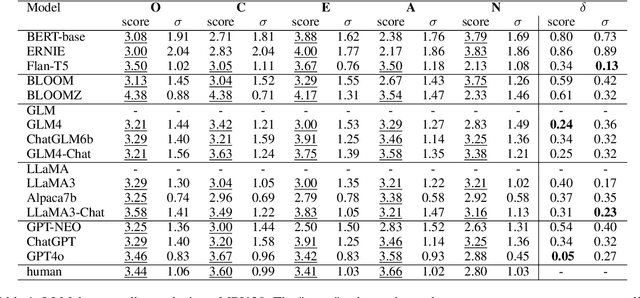
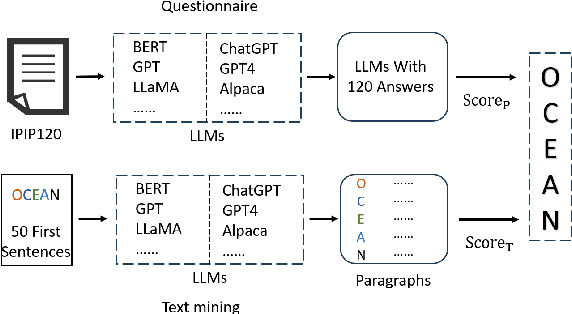
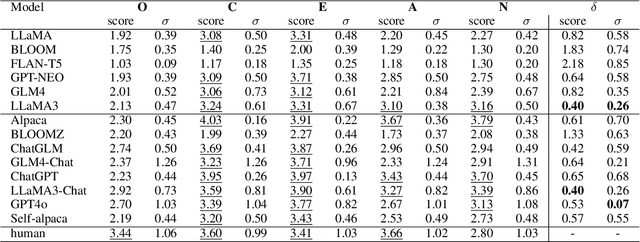
Questionnaires are a common method for detecting the personality of Large Language Models (LLMs). However, their reliability is often compromised by two main issues: hallucinations (where LLMs produce inaccurate or irrelevant responses) and the sensitivity of responses to the order of the presented options. To address these issues, we propose combining text mining with questionnaires method. Text mining can extract psychological features from the LLMs' responses without being affected by the order of options. Furthermore, because this method does not rely on specific answers, it reduces the influence of hallucinations. By normalizing the scores from both methods and calculating the root mean square error, our experiment results confirm the effectiveness of this approach. To further investigate the origins of personality traits in LLMs, we conduct experiments on both pre-trained language models (PLMs), such as BERT and GPT, as well as conversational models (ChatLLMs), such as ChatGPT. The results show that LLMs do contain certain personalities, for example, ChatGPT and ChatGLM exhibit the personality traits of 'Conscientiousness'. Additionally, we find that the personalities of LLMs are derived from their pre-trained data. The instruction data used to train ChatLLMs can enhance the generation of data containing personalities and expose their hidden personality. We compare the results with the human average personality score, and we find that the personality of FLAN-T5 in PLMs and ChatGPT in ChatLLMs is more similar to that of a human, with score differences of 0.34 and 0.22, respectively.
PsyAttention: Psychological Attention Model for Personality Detection
Dec 01, 2023Work on personality detection has tended to incorporate psychological features from different personality models, such as BigFive and MBTI. There are more than 900 psychological features, each of which is helpful for personality detection. However, when used in combination, the application of different calculation standards among these features may result in interference between features calculated using distinct systems, thereby introducing noise and reducing performance. This paper adapts different psychological models in the proposed PsyAttention for personality detection, which can effectively encode psychological features, reducing their number by 85%. In experiments on the BigFive and MBTI models, PysAttention achieved average accuracy of 65.66% and 86.30%, respectively, outperforming state-of-the-art methods, indicating that it is effective at encoding psychological features.