 Add to Chrome
 Add to Firefox
 Add to Edge
SUGFW+: An Uncertainty-guided Feature Weighting Framework for Cold Start Active Adaptation of SAM in Medical Image Segmentation
Aug 17, 2026
Cold Start Active Learning (CSAL) is important in improving the performance of a medical image segmentation model with low annotation budget by querying a small subset for annotation from an unlabeled training set. Existing CSAL methods typically rely on inefficient dataset-specific Self-Supervised Learning (SSL) to map the unlabeled images into a feature space for sample selection. Recently, the advent of foundation models such as the Segment Anything Model (SAM) offer a promising alternative as the pre-trained model can provide strong generalizable feature embeddings, and allow high performance in downstream tasks after fine-tuning (adaptation). However, how to systematically exploit SAM's inherent embeddings for cold-start sample selection during adaptation with low annotation budget remains underexplored. To address this, we propose an extended SAM-based Uncertainty-guided Feature Weighting (SUGFW+) framework for CSAL and adaptation of SAM. Specifically, it leverages the SAM for Patch-level Feature and Uncertainty Calculation (PFUC), and introduces a Patch-based Global Distinct Representation (PGDR) module that aggregates patch-level embeddings into highly discriminative, uncertainty-aware image-level features. These features are then utilized by a Greedy Selection with Cluster and Uncertainty (GSCU) strategy to combine diversity and uncertainty during sample selection. Unlike prior CSAL methods that decouple sample selection from model training, SUGFW+ tightly integrates these two stages via an Uncertainty-Prompted Fine-Tuning (UPFT) process of SAM in model training. Extensive experiments on four public datasets demonstrate that SUGFW+ achieves state-of-the-art performance against existing CSAL methods. Code is available at https://github.com/HiLab-git/SUGFW-plus.

One Knob to Rule Them All: A Unified Optimal Transport View of Cold-Start Active Learning
Aug 04, 2026Cold-Start Active Learning (CSAL) aims to select a valuable subset from an unlabeled pool without any prior knowledge or human assistance. Existing methods take diverse routes based on typicality, coverage, or diversity. Each rests on its own inductive bias and therefore performs well on some tasks yet poorly on others. We argue that the real challenge is not to design yet another selection heuristic, but to make CSAL adapt automatically to the data and task at hand. To this end, we revisit CSAL through the lens of optimal transport. First, we propose a generalized transport selection framework that reveals the shared allocation structure of existing methods and exactly subsumes representative formulations. Second, we introduce a theoretical analysis that characterizes the trade-off controlled by entropic regularization and establishes a task-agnostic minimax bound for cold-start selection. These results provide a principled foundation for adapting the regularization strength to the unlabeled data. Third, we derive a data-adaptive regularization rule and present a novel Sinkhorn-based CSAL algorithm, termed $ε$-Adaptive Selection ($ε$-AS). Extensive experiments on six public datasets and multiple annotation budgets show that $ε$-AS consistently achieves state-of-the-art performance. On ImageNet-1k, it improves the average accuracy over ActiveFT by 1.29% while reducing selection time by 56.2%. Code will be released at https://github.com/Z-yiwei/OT-CSAL
Rectify Then Diffuse: Disentangling Concepts Before Denoising Trajectory Unfolds
Aug 04, 2026Text-to-image diffusion models can generate individual concepts well, but they often omit or merge concepts incorrectly with multiple concepts. We trace these failures to an early coordination bottleneck: before denoising begins, prompt-conditioned attention may allocate different concepts to strongly overlapping spatial support, which can keep their attention coupled as denoising proceeds. This observation motivates treating compositional generation as a boundary-condition problem rather than repeatedly controlling the evolving trajectory. To this end, we propose Rectify-then-Diffuse (RTD), a training-free framework that rectifies the initial allocation once before standard denoising. Firstly, we propose Soft-Overlap Disentanglement (SOD), which converts normalized overlap between pilot concept maps into a differentiable and layout-agnostic separation objective. Secondly, we introduce Isotropic Gradient Rectification (IGR), which normalizes the SOD gradient and applies a bounded latent displacement with a consistent scale across prompts and initializations. Extensive experiments show that RTD achieves state-of-the-art compositional fidelity and robust gains. On the AE-Bench object pair subset, RTD improves BLIP-VQA by 45.8% and ImageReward by 19.6% over CO3 while running 2.3$\times$ faster. Code will be released at https://github.com/Z-yiwei/rectify-then-diffuse
Semantic Iterative Reconstruction: One-Shot Universal Anomaly Detection
Mar 24, 2026Unsupervised medical anomaly detection is severely limited by the scarcity of normal training samples. Existing methods typically train dedicated models for each dataset or disease, requiring hundreds of normal images per task and lacking cross-modality generalization. We propose Semantic Iterative Reconstruction (SIR), a framework that enables a single universal model to detect anomalies across diverse medical domains using extremely few normal samples. SIR leverages a pretrained teacher encoder to extract multi-scale deep features and employs a compact up-then-down decoder with multi-loop iterative refinement to enforce robust normality priors in deep feature space. The framework adopts a one-shot universal design: a single model is trained by mixing exactly one normal sample from each of nine heterogeneous datasets, enabling effective anomaly detection on all corresponding test sets without task-specific retraining. Extensive experiments on nine medical benchmarks demonstrate that SIR achieves state-of-the-art under all four settings -- one-shot universal, full-shot universal, one-shot specialized, and full-shot specialized -- consistently outperforming previous methods. SIR offers an efficient and scalable solution for multi-domain clinical anomaly detection. Code is available at https://github.com/jusufzn212427/sir4ad.
RAM: Recover Any 3D Human Motion in-the-Wild
Mar 20, 2026RAM incorporates a motion-aware semantic tracker with adaptive Kalman filtering to achieve robust identity association under severe occlusions and dynamic interactions. A memory-augmented Temporal HMR module further enhances human motion reconstruction by injecting spatio-temporal priors for consistent and smooth motion estimation. Moreover, a lightweight Predictor module forecasts future poses to maintain reconstruction continuity, while a gated combiner adaptively fuses reconstructed and predicted features to ensure coherence and robustness. Experiments on in-the-wild multi-person benchmarks such as PoseTrack and 3DPW, demonstrate that RAM substantially outperforms previous state-of-the-art in both Zero-shot tracking stability and 3D accuracy, offering a generalizable paradigm for markerless 3D human motion capture in-the-wild.
ChatRadio-Valuer: A Chat Large Language Model for Generalizable Radiology Report Generation Based on Multi-institution and Multi-system Data
Oct 10, 2023


Radiology report generation, as a key step in medical image analysis, is critical to the quantitative analysis of clinically informed decision-making levels. However, complex and diverse radiology reports with cross-source heterogeneity pose a huge generalizability challenge to the current methods under massive data volume, mainly because the style and normativity of radiology reports are obviously distinctive among institutions, body regions inspected and radiologists. Recently, the advent of large language models (LLM) offers great potential for recognizing signs of health conditions. To resolve the above problem, we collaborate with the Second Xiangya Hospital in China and propose ChatRadio-Valuer based on the LLM, a tailored model for automatic radiology report generation that learns generalizable representations and provides a basis pattern for model adaptation in sophisticated analysts' cases. Specifically, ChatRadio-Valuer is trained based on the radiology reports from a single institution by means of supervised fine-tuning, and then adapted to disease diagnosis tasks for human multi-system evaluation (i.e., chest, abdomen, muscle-skeleton, head, and maxillofacial $\&$ neck) from six different institutions in clinical-level events. The clinical dataset utilized in this study encompasses a remarkable total of \textbf{332,673} observations. From the comprehensive results on engineering indicators, clinical efficacy and deployment cost metrics, it can be shown that ChatRadio-Valuer consistently outperforms state-of-the-art models, especially ChatGPT (GPT-3.5-Turbo) and GPT-4 et al., in terms of the diseases diagnosis from radiology reports. ChatRadio-Valuer provides an effective avenue to boost model generalization performance and alleviate the annotation workload of experts to enable the promotion of clinical AI applications in radiology reports.
Neural Architecture Search for Deep Face Recognition
Apr 26, 2019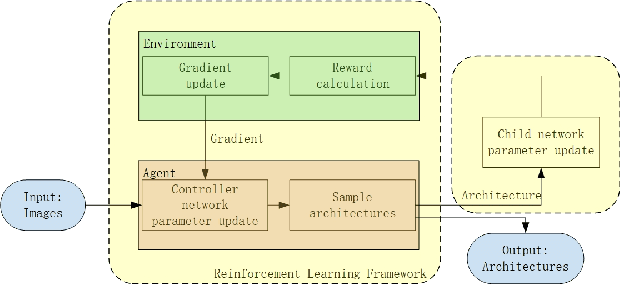
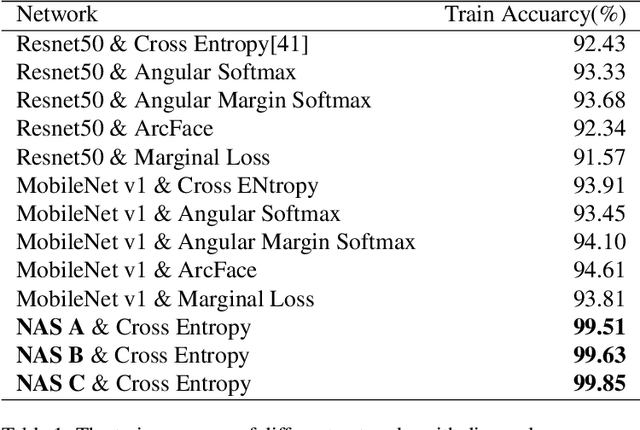
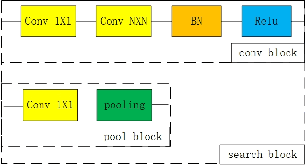
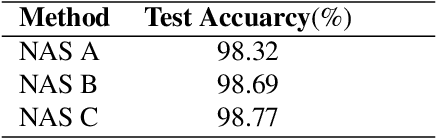
By the widespread popularity of electronic devices, the emergence of biometric technology has brought significant convenience to user authentication compared with the traditional password and mode unlocking. Among many biological characteristics, the face is a universal and irreplaceable feature that does not need too much cooperation and can significantly improve the user's experience at the same time. Face recognition is one of the main functions of electronic equipment propaganda. Hence it's virtually worth researching in computer vision. Previous work in this field has focused on two directions: converting loss function to improve recognition accuracy in traditional deep convolution neural networks (Resnet); combining the latest loss function with the lightweight system (MobileNet) to reduce network size at the minimal expense of accuracy. But none of these has changed the network structure. With the development of AutoML, neural architecture search (NAS) has shown excellent performance in the benchmark of image classification. In this paper, we integrate NAS technology into face recognition to customize a more suitable network. We quote the framework of neural architecture search which trains child and controller network alternately. At the same time, we mutate NAS by incorporating evaluation latency into rewards of reinforcement learning and utilize policy gradient algorithm to search the architecture automatically with the most classical cross-entropy loss. The network architectures we searched out have got state-of-the-art accuracy in the large-scale face dataset, which achieves 98.77% top-1 in MS-Celeb-1M and 99.89% in LFW with relatively small network size. To the best of our knowledge, this proposal is the first attempt to use NAS to solve the problem of Deep Face Recognition and achieve the best results in this domain.