 Add to Chrome
 Add to Firefox
 Add to Edge
Transfer Learning for Linear Discriminant Analysis with a Shared Classification Signal
Jul 08, 2026
This paper studies transfer learning for linear discriminant analysis in high-dimensional two-class classification. We consider one target domain and several source domains, where the mean difference in each domain is decomposed into a deterministic common component and a domain-specific random deviation. The common component represents a shared classification signal across domains, while the random deviation captures domain-specific heterogeneity. Under spiked covariance models, we derive deterministic limits for the target-domain Gaussian-calibrated error of weighted transfer classifiers under both homogeneous and heterogeneous covariance settings. These limits quantify the effects of the shared signal, domain-specific variation, dimension-to-sample-size ratios, and spike structures on transfer performance. They further lead to oracle transfer weights and consistent data-driven plug-in estimators. We also characterize the intercept bias induced by unbalanced target-domain class sample sizes and provide an asymptotically optimal correction.

Spectrally-Corrected and Regularized QDA Classifier for Spiked Covariance Model
Mar 17, 2025Quadratic discriminant analysis (QDA) is a widely used method for classification problems, particularly preferable over Linear Discriminant Analysis (LDA) for heterogeneous data. However, QDA loses its effectiveness in high-dimensional settings, where the data dimension and sample size tend to infinity. To address this issue, we propose a novel QDA method utilizing spectral correction and regularization techniques, termed SR-QDA. The regularization parameters in our method are selected by maximizing the Fisher-discriminant ratio. We compare SR-QDA with QDA, regularized quadratic discriminant analysis (R-QDA), and several other competitors. The results indicate that SR-QDA performs exceptionally well, especially in moderate and high-dimensional situations. Empirical experiments across diverse datasets further support this conclusion.
Spectrally-Corrected and Regularized Linear Discriminant Analysis for Spiked Covariance Model
Oct 08, 2022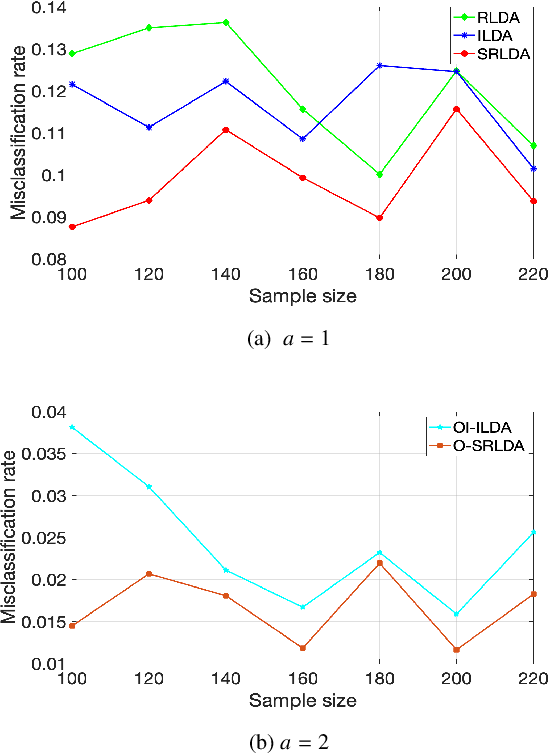
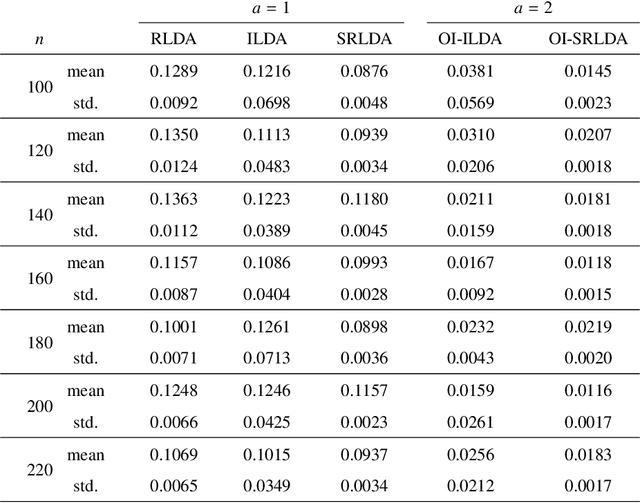
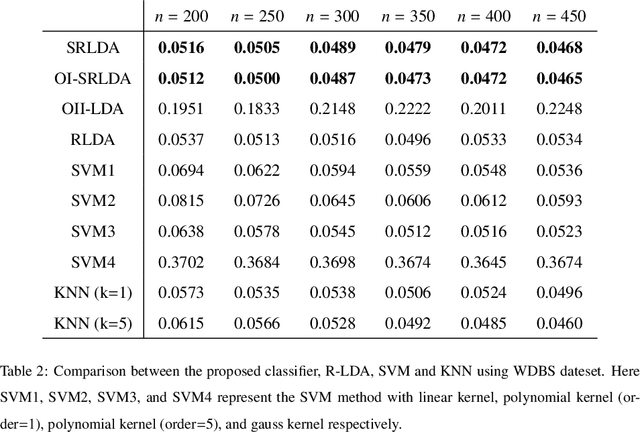
In this paper, we propose an improved linear discriminant analysis, called spectrally-corrected and regularized linear discriminant analysis (SCRLDA). This method integrates the design ideas of the sample spectrally-corrected covariance matrix and the regularized discriminant analysis. The SCRLDA method is specially designed for classification problems under the assumption that the covariance matrix follows a spiked model. Through the real and simulated data analysis, it is shown that our proposed classifier outperforms the classical R-LDA and can be as competitive as the KNN, SVM classifiers while requiring lower computational complexity.