 Add to Chrome
 Add to Firefox
 Add to Edge
Exponential quantum advantage in processing massive classical data
Apr 08, 2026
Broadly applicable quantum advantage, particularly in classical data processing and machine learning, has been a fundamental open problem. In this work, we prove that a small quantum computer of polylogarithmic size can perform large-scale classification and dimension reduction on massive classical data by processing samples on the fly, whereas any classical machine achieving the same prediction performance requires exponentially larger size. Furthermore, classical machines that are exponentially larger yet below the required size need superpolynomially more samples and time. We validate these quantum advantages in real-world applications, including single-cell RNA sequencing and movie review sentiment analysis, demonstrating four to six orders of magnitude reduction in size with fewer than 60 logical qubits. These quantum advantages are enabled by quantum oracle sketching, an algorithm for accessing the classical world in quantum superposition using only random classical data samples. Combined with classical shadows, our algorithm circumvents the data loading and readout bottleneck to construct succinct classical models from massive classical data, a task provably impossible for any classical machine that is not exponentially larger than the quantum machine. These quantum advantages persist even when classical machines are granted unlimited time or if BPP=BQP, and rely only on the correctness of quantum mechanics. Together, our results establish machine learning on classical data as a broad and natural domain of quantum advantage and a fundamental test of quantum mechanics at the complexity frontier.

Towards sample-optimal learning of bosonic Gaussian quantum states
Mar 18, 2026Continuous-variable systems enable key quantum technologies in computation, communication, and sensing. Bosonic Gaussian states emerge naturally in various such applications, including gravitational-wave and dark-matter detection. A fundamental question is how to characterize an unknown bosonic Gaussian state from as few samples as possible. Despite decades-long exploration, the ultimate efficiency limit remains unclear. In this work, we study the necessary and sufficient number of copies to learn an $n$-mode Gaussian state, with energy less than $E$, to $\varepsilon$ trace distance with high probability. We prove a lower bound of $Ω(n^3/\varepsilon^2)$ for Gaussian measurements, matching the best known upper bound up to doubly-log energy dependence, and $Ω(n^2/\varepsilon^2)$ for arbitrary measurements. We further show an upper bound of $\widetilde{O}(n^2/\varepsilon^2)$ given that the Gaussian state is promised to be either pure or passive. Interestingly, while Gaussian measurements suffice for nearly optimal learning of pure Gaussian states, non-Gaussian measurements are provably required for optimal learning of passive Gaussian states. Finally, focusing on learning single-mode Gaussian states via non-entangling Gaussian measurements, we provide a nearly tight bound of $\widetildeΘ(E/\varepsilon^2)$ for any non-adaptive schemes, showing adaptivity is indispensable for nearly energy-independent scaling. As a byproduct, we establish sharp bounds on the trace distance between Gaussian states in terms of the total variation distance between their Wigner distributions, and obtain a nearly tight sample complexity bound for learning the Wigner distribution of any Gaussian state to $\varepsilon$ total variation distance. Our results greatly advance quantum learning theory in the bosonic regimes and have practical impact in quantum sensing and benchmarking applications.
Generative quantum advantage for classical and quantum problems
Sep 10, 2025Recent breakthroughs in generative machine learning, powered by massive computational resources, have demonstrated unprecedented human-like capabilities. While beyond-classical quantum experiments can generate samples from classically intractable distributions, their complexity has thwarted all efforts toward efficient learning. This challenge has hindered demonstrations of generative quantum advantage: the ability of quantum computers to learn and generate desired outputs substantially better than classical computers. We resolve this challenge by introducing families of generative quantum models that are hard to simulate classically, are efficiently trainable, exhibit no barren plateaus or proliferating local minima, and can learn to generate distributions beyond the reach of classical computers. Using a $68$-qubit superconducting quantum processor, we demonstrate these capabilities in two scenarios: learning classically intractable probability distributions and learning quantum circuits for accelerated physical simulation. Our results establish that both learning and sampling can be performed efficiently in the beyond-classical regime, opening new possibilities for quantum-enhanced generative models with provable advantage.
Predicting adaptively chosen observables in quantum systems
Oct 20, 2024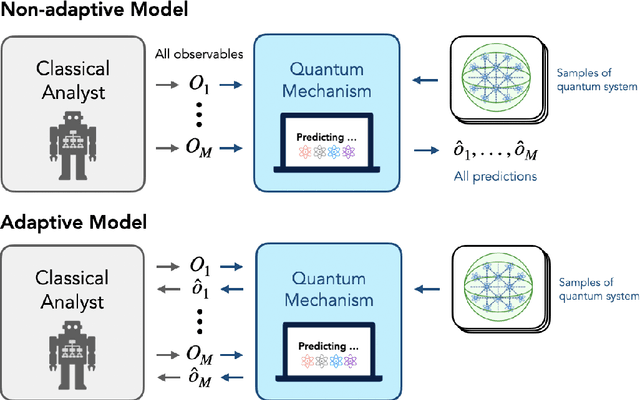
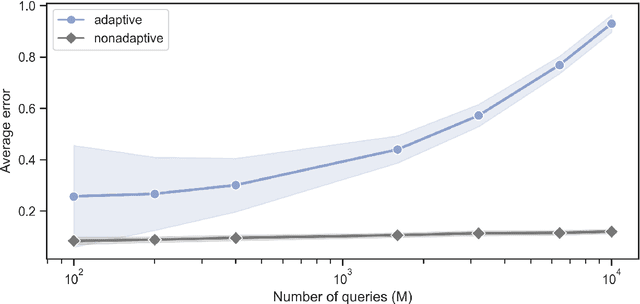
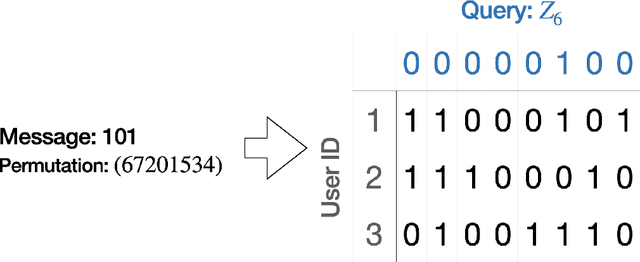
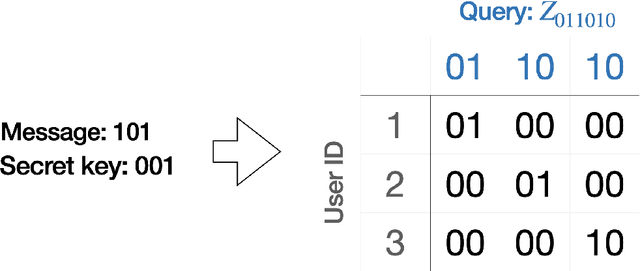
Recent advances have demonstrated that $\mathcal{O}(\log M)$ measurements suffice to predict $M$ properties of arbitrarily large quantum many-body systems. However, these remarkable findings assume that the properties to be predicted are chosen independently of the data. This assumption can be violated in practice, where scientists adaptively select properties after looking at previous predictions. This work investigates the adaptive setting for three classes of observables: local, Pauli, and bounded-Frobenius-norm observables. We prove that $\Omega(\sqrt{M})$ samples of an arbitrarily large unknown quantum state are necessary to predict expectation values of $M$ adaptively chosen local and Pauli observables. We also present computationally-efficient algorithms that achieve this information-theoretic lower bound. In contrast, for bounded-Frobenius-norm observables, we devise an algorithm requiring only $\mathcal{O}(\log M)$ samples, independent of system size. Our results highlight the potential pitfalls of adaptivity in analyzing data from quantum experiments and provide new algorithmic tools to safeguard against erroneous predictions in quantum experiments.
How to Construct Random Unitaries
Oct 14, 2024The existence of pseudorandom unitaries (PRUs) -- efficient quantum circuits that are computationally indistinguishable from Haar-random unitaries -- has been a central open question, with significant implications for cryptography, complexity theory, and fundamental physics. In this work, we close this question by proving that PRUs exist, assuming that any quantum-secure one-way function exists. We establish this result for both (1) the standard notion of PRUs, which are secure against any efficient adversary that makes queries to the unitary $U$, and (2) a stronger notion of PRUs, which are secure even against adversaries that can query both the unitary $U$ and its inverse $U^\dagger$. In the process, we prove that any algorithm that makes queries to a Haar-random unitary can be efficiently simulated on a quantum computer, up to inverse-exponential trace distance.
Predicting quantum channels over general product distributions
Sep 05, 2024We investigate the problem of predicting the output behavior of unknown quantum channels. Given query access to an $n$-qubit channel $E$ and an observable $O$, we aim to learn the mapping \begin{equation*} \rho \mapsto \mathrm{Tr}(O E[\rho]) \end{equation*} to within a small error for most $\rho$ sampled from a distribution $D$. Previously, Huang, Chen, and Preskill proved a surprising result that even if $E$ is arbitrary, this task can be solved in time roughly $n^{O(\log(1/\epsilon))}$, where $\epsilon$ is the target prediction error. However, their guarantee applied only to input distributions $D$ invariant under all single-qubit Clifford gates, and their algorithm fails for important cases such as general product distributions over product states $\rho$. In this work, we propose a new approach that achieves accurate prediction over essentially any product distribution $D$, provided it is not "classical" in which case there is a trivial exponential lower bound. Our method employs a "biased Pauli analysis," analogous to classical biased Fourier analysis. Implementing this approach requires overcoming several challenges unique to the quantum setting, including the lack of a basis with appropriate orthogonality properties. The techniques we develop to address these issues may have broader applications in quantum information.
Certifying almost all quantum states with few single-qubit measurements
Apr 10, 2024
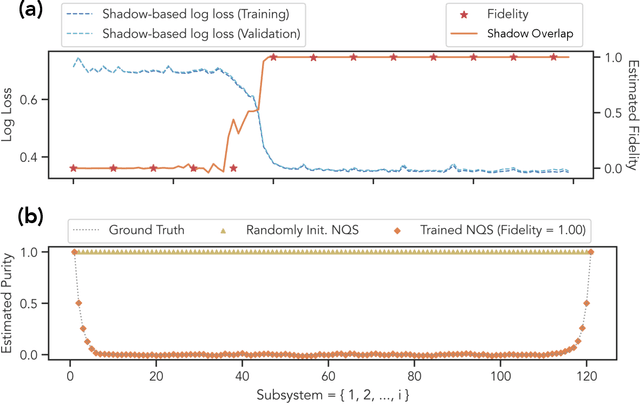


Certifying that an n-qubit state synthesized in the lab is close to the target state is a fundamental task in quantum information science. However, existing rigorous protocols either require deep quantum circuits or exponentially many single-qubit measurements. In this work, we prove that almost all n-qubit target states, including those with exponential circuit complexity, can be certified from only O(n^2) single-qubit measurements. This result is established by a new technique that relates certification to the mixing time of a random walk. Our protocol has applications for benchmarking quantum systems, for optimizing quantum circuits to generate a desired target state, and for learning and verifying neural networks, tensor networks, and various other representations of quantum states using only single-qubit measurements. We show that such verified representations can be used to efficiently predict highly non-local properties that would otherwise require an exponential number of measurements. We demonstrate these applications in numerical experiments with up to 120 qubits, and observe advantage over existing methods such as cross-entropy benchmarking (XEB).
Learning shallow quantum circuits
Jan 18, 2024


Despite fundamental interests in learning quantum circuits, the existence of a computationally efficient algorithm for learning shallow quantum circuits remains an open question. Because shallow quantum circuits can generate distributions that are classically hard to sample from, existing learning algorithms do not apply. In this work, we present a polynomial-time classical algorithm for learning the description of any unknown $n$-qubit shallow quantum circuit $U$ (with arbitrary unknown architecture) within a small diamond distance using single-qubit measurement data on the output states of $U$. We also provide a polynomial-time classical algorithm for learning the description of any unknown $n$-qubit state $\lvert \psi \rangle = U \lvert 0^n \rangle$ prepared by a shallow quantum circuit $U$ (on a 2D lattice) within a small trace distance using single-qubit measurements on copies of $\lvert \psi \rangle$. Our approach uses a quantum circuit representation based on local inversions and a technique to combine these inversions. This circuit representation yields an optimization landscape that can be efficiently navigated and enables efficient learning of quantum circuits that are classically hard to simulate.
Learning quantum states and unitaries of bounded gate complexity
Oct 30, 2023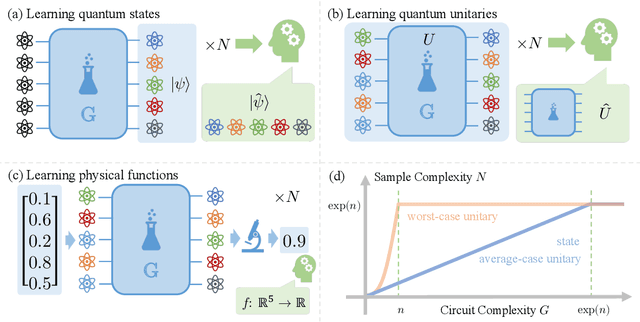

While quantum state tomography is notoriously hard, most states hold little interest to practically-minded tomographers. Given that states and unitaries appearing in Nature are of bounded gate complexity, it is natural to ask if efficient learning becomes possible. In this work, we prove that to learn a state generated by a quantum circuit with $G$ two-qubit gates to a small trace distance, a sample complexity scaling linearly in $G$ is necessary and sufficient. We also prove that the optimal query complexity to learn a unitary generated by $G$ gates to a small average-case error scales linearly in $G$. While sample-efficient learning can be achieved, we show that under reasonable cryptographic conjectures, the computational complexity for learning states and unitaries of gate complexity $G$ must scale exponentially in $G$. We illustrate how these results establish fundamental limitations on the expressivity of quantum machine learning models and provide new perspectives on no-free-lunch theorems in unitary learning. Together, our results answer how the complexity of learning quantum states and unitaries relate to the complexity of creating these states and unitaries.
Tight bounds on Pauli channel learning without entanglement
Sep 23, 2023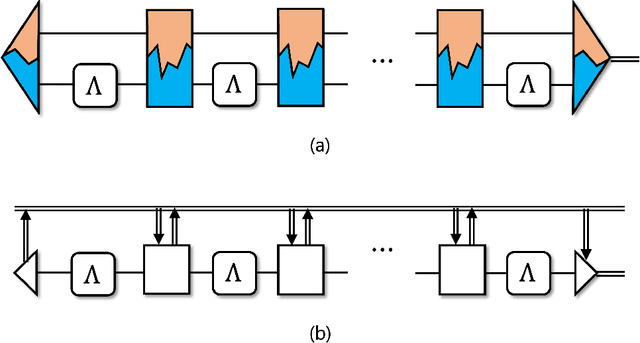
Entanglement is a useful resource for learning, but a precise characterization of its advantage can be challenging. In this work, we consider learning algorithms without entanglement to be those that only utilize separable states, measurements, and operations between the main system of interest and an ancillary system. These algorithms are equivalent to those that apply quantum circuits on the main system interleaved with mid-circuit measurements and classical feedforward. We prove a tight lower bound for learning Pauli channels without entanglement that closes a cubic gap between the best-known upper and lower bound. In particular, we show that $\Theta(2^n\varepsilon^{-2})$ rounds of measurements are required to estimate each eigenvalue of an $n$-qubit Pauli channel to $\varepsilon$ error with high probability when learning without entanglement. In contrast, a learning algorithm with entanglement only needs $\Theta(\varepsilon^{-2})$ rounds of measurements. The tight lower bound strengthens the foundation for an experimental demonstration of entanglement-enhanced advantages for characterizing Pauli noise.