 Add to Chrome
 Add to Firefox
 Add to Edge
Exponential quantum advantage for learning signals with a single qubit
Aug 13, 2026
Quantum technology has the potential to transform scientific discovery, but quantum advantages often require processing capabilities well beyond the reach of experimental platforms. We show that coupling a single controllable qubit to an otherwise conventional sensor can exponentially reduce the number of measurements required to learn classical signals. These rigorous quantum advantages apply to fundamental sensing tasks, including learning Fourier coefficients, extracting temporal correlations from time-varying signals, and estimating transformations of physical observables. Using a superconducting cavity--qubit architecture, we experimentally demonstrate $10^7$-fold reductions in the number of measurements required for Fourier-amplitude and time-varying signal learning. Our $\textit{quantum feature sensing}$ algorithms further enable orders-of-magnitude improvements in simulations of weak-signal dark matter detection and wireless communication applications. These quantum advantages are derived from Quantum Phase-Space Inference (Q$Ψ$), a unifying theory of quantum-enhanced experiments that simultaneously converts a set of experimental objectives and constraints into tight lower bounds and optimal quantum-enhanced learning algorithms while producing a certificate of quantum advantage. Q$Ψ$ extends beyond the regimes captured by quantum Fisher information and provides a framework for systematically identifying rigorous quantum advantages in practical experimental tasks. Together, our results establish that near-term quantum technology can exponentially enhance our ability to learn from classical signals.

Noisy Quantum Learning Theory
Dec 11, 2025We develop a framework for learning from noisy quantum experiments, focusing on fault-tolerant devices accessing uncharacterized systems through noisy couplings. Our starting point is the complexity class $\textsf{NBQP}$ ("noisy BQP"), modeling noisy fault-tolerant quantum computers that cannot, in general, error-correct the oracle systems they query. Using this class, we show that for natural oracle problems, noise can eliminate exponential quantum learning advantages of ideal noiseless learners while preserving a superpolynomial gap between NISQ and fault-tolerant devices. Beyond oracle separations, we study concrete noisy learning tasks. For purity testing, the exponential two-copy advantage collapses under a single application of local depolarizing noise. Nevertheless, we identify a setting motivated by AdS/CFT in which noise-resilient structure restores a quantum learning advantage in a noisy regime. We then analyze noisy Pauli shadow tomography, deriving lower bounds that characterize how instance size, quantum memory, and noise control sample complexity, and design algorithms with parametrically similar scalings. Together, our results show that the Bell-basis and SWAP-test primitives underlying most exponential quantum learning advantages are fundamentally fragile to noise unless the experimental system has latent noise-robust structure. Thus, realizing meaningful quantum advantages in future experiments will require understanding how noise-robust physical properties interface with available algorithmic techniques.
Learning quantum states and unitaries of bounded gate complexity
Oct 30, 2023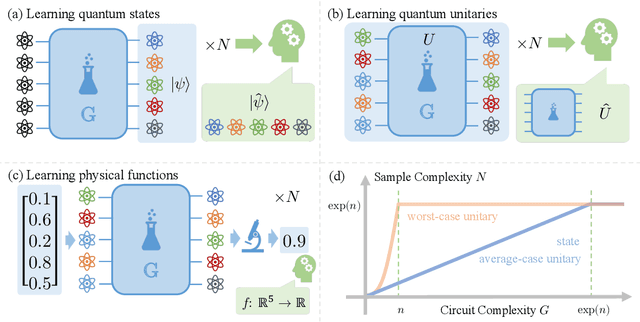

While quantum state tomography is notoriously hard, most states hold little interest to practically-minded tomographers. Given that states and unitaries appearing in Nature are of bounded gate complexity, it is natural to ask if efficient learning becomes possible. In this work, we prove that to learn a state generated by a quantum circuit with $G$ two-qubit gates to a small trace distance, a sample complexity scaling linearly in $G$ is necessary and sufficient. We also prove that the optimal query complexity to learn a unitary generated by $G$ gates to a small average-case error scales linearly in $G$. While sample-efficient learning can be achieved, we show that under reasonable cryptographic conjectures, the computational complexity for learning states and unitaries of gate complexity $G$ must scale exponentially in $G$. We illustrate how these results establish fundamental limitations on the expressivity of quantum machine learning models and provide new perspectives on no-free-lunch theorems in unitary learning. Together, our results answer how the complexity of learning quantum states and unitaries relate to the complexity of creating these states and unitaries.