 Add to Chrome
 Add to Firefox
 Add to Edge
Are We Making Progress in Multimodal Domain Generalization? A Comprehensive Benchmark Study
May 07, 2026
Despite the growing popularity of Multimodal Domain Generalization (MMDG) for enhancing model robustness, it remains unclear whether reported performance gains reflect genuine algorithmic progress or are artifacts of inconsistent evaluation protocols. Current research is fragmented, with studies varying significantly across datasets, modality configurations, and experimental settings. Furthermore, existing benchmarks focus predominantly on action recognition, often neglecting critical real-world challenges such as input corruptions, missing modalities, and model trustworthiness. This lack of standardization obscures a reliable assessment of the field's advancement. To address this issue, we introduce MMDG-Bench, the first unified and comprehensive benchmark for MMDG, which standardizes evaluation across six datasets spanning three diverse tasks: action recognition, mechanical fault diagnosis, and sentiment analysis. MMDG-Bench encompasses six modality combinations, nine representative methods, and multiple evaluation settings. Beyond standard accuracy, it systematically assesses corruption robustness, missing-modality generalization, misclassification detection, and out-of-distribution detection. With 7, 402 neural networks trained in total across 95 unique cross-domain tasks, MMDG-Bench yields five key findings: (1) under fair comparisons, recent specialized MMDG methods offer only marginal improvements over ERM baseline; (2) no single method consistently outperforms others across datasets or modality combinations; (3) a substantial gap to upper-bound performance persists, indicating that MMDG remains far from solved; (4) trimodal fusion does not consistently outperform the strongest bimodal configurations; and (5) all evaluated methods exhibit significant degradation under corruption and missing-modality scenarios, with some methods further compromising model trustworthiness.

Balancing Multimodal Domain Generalization via Gradient Modulation and Projection
Mar 15, 2026Multimodal Domain Generalization (MMDG) leverages the complementary strengths of multiple modalities to enhance model generalization on unseen domains. A central challenge in multimodal learning is optimization imbalance, where modalities converge at different speeds during training. This imbalance leads to unequal gradient contributions, allowing some modalities to dominate the learning process while others lag behind. Existing balancing strategies typically regulate each modality's gradient contribution based on its classification performance on the source domain to alleviate this issue. However, relying solely on source-domain accuracy neglects a key insight in MMDG: modalities that excel on the source domain may generalize poorly to unseen domains, limiting cross-domain gains. To overcome this limitation, we propose Gradient Modulation Projection (GMP), a unified strategy that promotes balanced optimization in MMDG. GMP first decouples gradients associated with classification and domain-invariance objectives. It then modulates each modality's gradient based on semantic and domain confidence. Moreover, GMP dynamically adjusts gradient projections by tracking the relative strength of each task, mitigating conflicts between classification and domain-invariant learning within modality-specific encoders. Extensive experiments demonstrate that GMP achieves state-of-the-art performance and integrates flexibly with diverse MMDG methods, significantly improving generalization across multiple benchmarks.
Towards Multimodal Domain Generalization with Few Labels
Feb 26, 2026Multimodal models ideally should generalize to unseen domains while remaining data-efficient to reduce annotation costs. To this end, we introduce and study a new problem, Semi-Supervised Multimodal Domain Generalization (SSMDG), which aims to learn robust multimodal models from multi-source data with few labeled samples. We observe that existing approaches fail to address this setting effectively: multimodal domain generalization methods cannot exploit unlabeled data, semi-supervised multimodal learning methods ignore domain shifts, and semi-supervised domain generalization methods are confined to single-modality inputs. To overcome these limitations, we propose a unified framework featuring three key components: Consensus-Driven Consistency Regularization, which obtains reliable pseudo-labels through confident fused-unimodal consensus; Disagreement-Aware Regularization, which effectively utilizes ambiguous non-consensus samples; and Cross-Modal Prototype Alignment, which enforces domain- and modality-invariant representations while promoting robustness under missing modalities via cross-modal translation. We further establish the first SSMDG benchmarks, on which our method consistently outperforms strong baselines in both standard and missing-modality scenarios. Our benchmarks and code are available at https://github.com/lihongzhao99/SSMDG.
Prompt-Guided Generation of Structured Chest X-Ray Report Using a Pre-trained LLM
Apr 17, 2024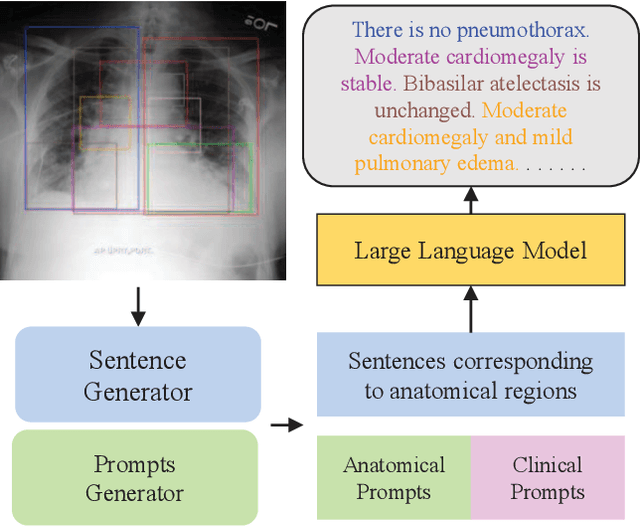
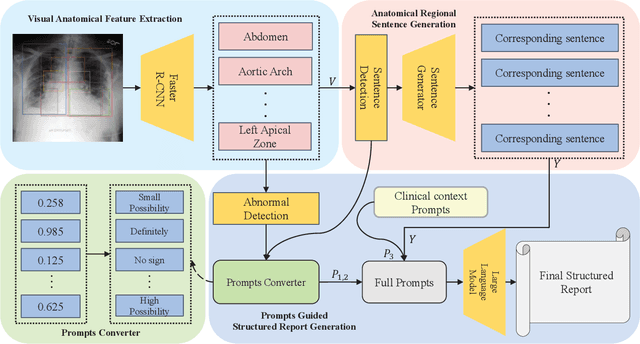
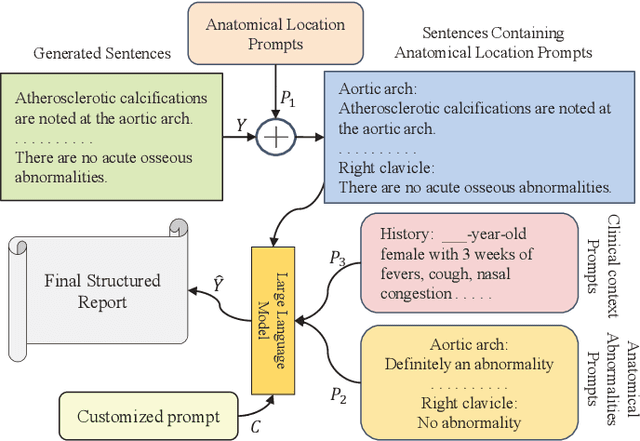
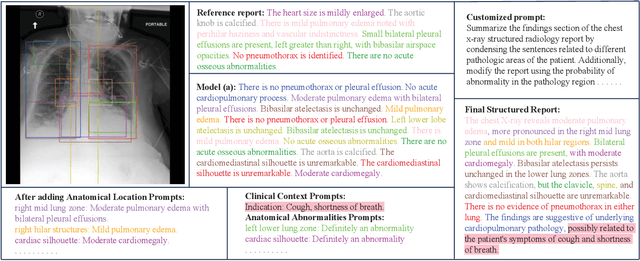
Medical report generation automates radiology descriptions from images, easing the burden on physicians and minimizing errors. However, current methods lack structured outputs and physician interactivity for clear, clinically relevant reports. Our method introduces a prompt-guided approach to generate structured chest X-ray reports using a pre-trained large language model (LLM). First, we identify anatomical regions in chest X-rays to generate focused sentences that center on key visual elements, thereby establishing a structured report foundation with anatomy-based sentences. We also convert the detected anatomy into textual prompts conveying anatomical comprehension to the LLM. Additionally, the clinical context prompts guide the LLM to emphasize interactivity and clinical requirements. By integrating anatomy-focused sentences and anatomy/clinical prompts, the pre-trained LLM can generate structured chest X-ray reports tailored to prompted anatomical regions and clinical contexts. We evaluate using language generation and clinical effectiveness metrics, demonstrating strong performance.
PE: A Poincare Explanation Method for Fast Text Hierarchy Generation
Mar 25, 2024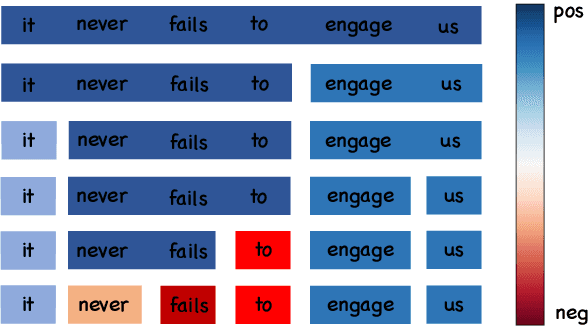
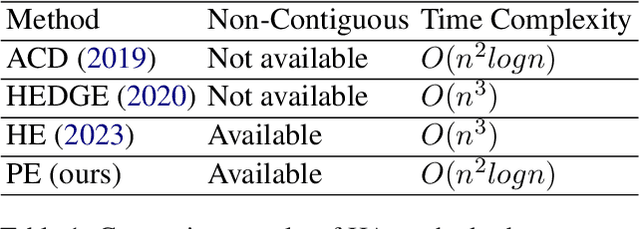
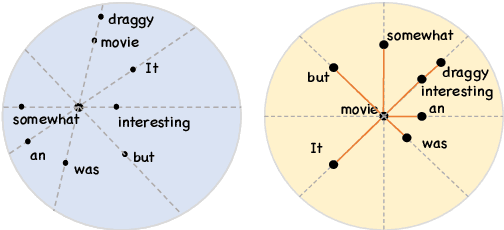
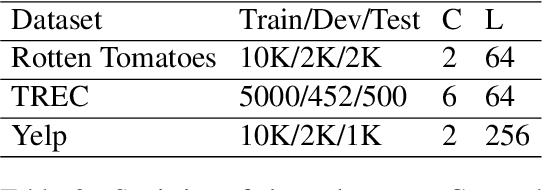
The black-box nature of deep learning models in NLP hinders their widespread application. The research focus has shifted to Hierarchical Attribution (HA) for its ability to model feature interactions. Recent works model non-contiguous combinations with a time-costly greedy search in Eculidean spaces, neglecting underlying linguistic information in feature representations. In this work, we introduce a novel method, namely Poincar\'e Explanation (PE), for modeling feature interactions using hyperbolic spaces in an $O(n^2logn)$ time complexity. Inspired by Poincar\'e model, we propose a framework to project the embeddings into hyperbolic spaces, which exhibit better inductive biases for syntax and semantic hierarchical structures. Eventually, we prove that the hierarchical clustering process in the projected space could be viewed as building a minimum spanning tree and propose a time efficient algorithm. Experimental results demonstrate the effectiveness of our approach.