 Add to Chrome
 Add to Firefox
 Add to Edge
Achieving $\widetilde{O}(1/ε)$ Sample Complexity for Bilinear Systems Identification under Bounded Noises
Mar 21, 2026
This paper studies finite-sample set-membership identification for discrete-time bilinear systems under bounded symmetric log-concave disturbances. Compared with existing finite-sample results for linear systems and related analyses under stronger noise assumptions, we consider the more challenging bilinear setting with trajectory-dependent regressors and allow marginally stable dynamics with polynomial mean-square state growth. Under these conditions, we prove that the diameter of the feasible parameter set shrinks with sample complexity $\widetilde{O}(1/ε)$. Simulation supports the theory and illustrates the advantage of the proposed estimator for uncertainty quantification.

PE: A Poincare Explanation Method for Fast Text Hierarchy Generation
Mar 25, 2024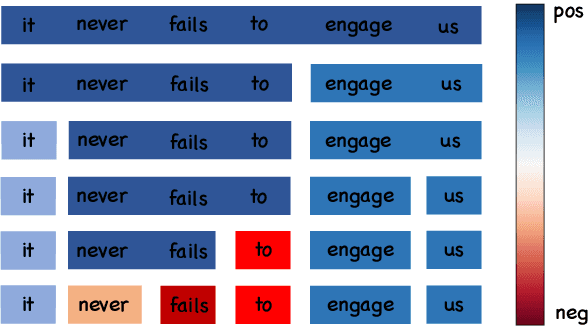
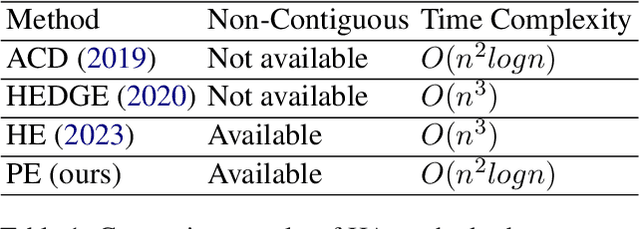
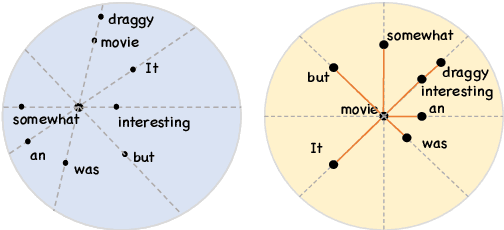
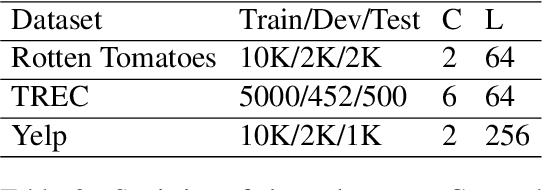
The black-box nature of deep learning models in NLP hinders their widespread application. The research focus has shifted to Hierarchical Attribution (HA) for its ability to model feature interactions. Recent works model non-contiguous combinations with a time-costly greedy search in Eculidean spaces, neglecting underlying linguistic information in feature representations. In this work, we introduce a novel method, namely Poincar\'e Explanation (PE), for modeling feature interactions using hyperbolic spaces in an $O(n^2logn)$ time complexity. Inspired by Poincar\'e model, we propose a framework to project the embeddings into hyperbolic spaces, which exhibit better inductive biases for syntax and semantic hierarchical structures. Eventually, we prove that the hierarchical clustering process in the projected space could be viewed as building a minimum spanning tree and propose a time efficient algorithm. Experimental results demonstrate the effectiveness of our approach.