 Add to Chrome
 Add to Firefox
 Add to Edge
Astraea: A State-Aware Scheduling Engine for LLM-Powered Agents
Dec 16, 2025
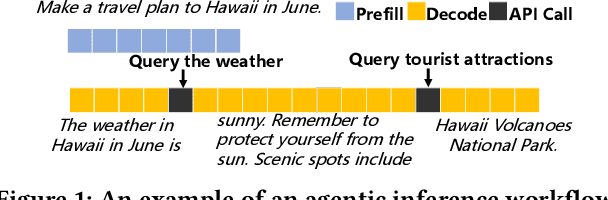
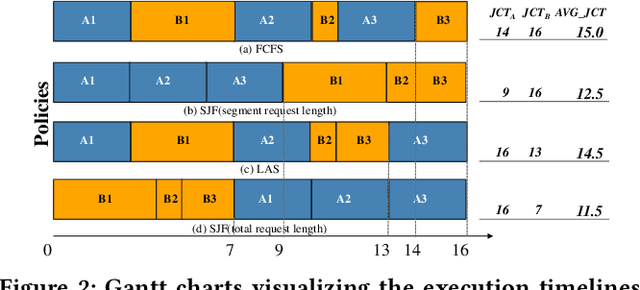
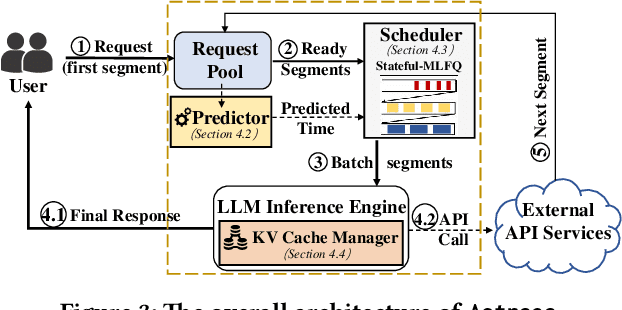
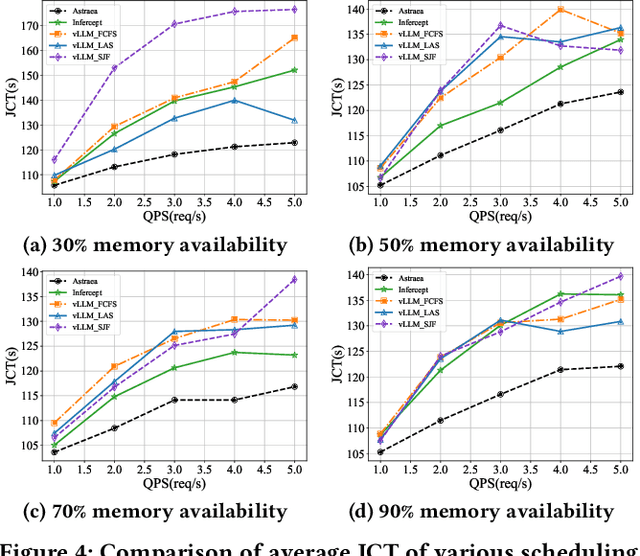
Large Language Models (LLMs) are increasingly being deployed as intelligent agents. Their multi-stage workflows, which alternate between local computation and calls to external network services like Web APIs, introduce a mismatch in their execution pattern and the scheduling granularity of existing inference systems such as vLLM. Existing systems typically focus on per-segment optimization which prevents them from minimizing the end-to-end latency of the complete agentic workflow, i.e., the global Job Completion Time (JCT) over the entire request lifecycle. To address this limitation, we propose Astraea, a service engine designed to shift the optimization from local segments to the global request lifecycle. Astraea employs a state-aware, hierarchical scheduling algorithm that integrates a request's historical state with future predictions. It dynamically classifies requests by their I/O and compute intensive nature and uses an enhanced HRRN policy to balance efficiency and fairness. Astraea also implements an adaptive KV cache manager that intelligently handles the agent state during I/O waits based on the system memory pressure. Extensive experiments show that Astraea reduces average JCT by up to 25.5\% compared to baseline methods. Moreover, our approach demonstrates strong robustness and stability under high load across various model scales.

Real-Time Neural-Enhancement for Online Cloud Gaming
Jan 12, 2025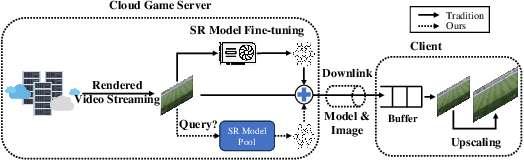

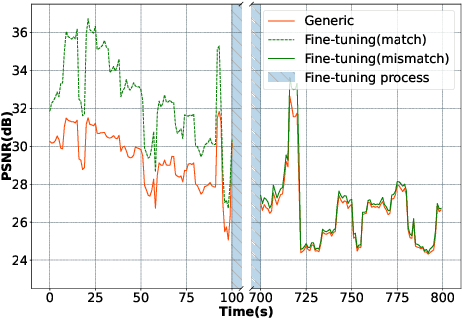
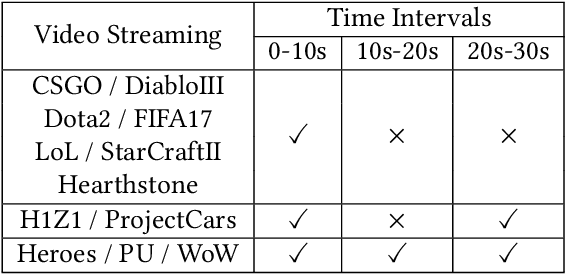
Online Cloud gaming demands real-time, high-quality video transmission across variable wide-area networks (WANs). Neural-enhanced video transmission algorithms employing super-resolution (SR) for video quality enhancement have effectively challenged WAN environments. However, these SR-based methods require intensive fine-tuning for the whole video, making it infeasible in diverse online cloud gaming. To address this, we introduce River, a cloud gaming delivery framework designed based on the observation that video segment features in cloud gaming are typically repetitive and redundant. This permits a significant opportunity to reuse fine-tuned SR models, reducing the fine-tuning latency of minutes to query latency of milliseconds. To enable the idea, we design a practical system that addresses several challenges, such as model organization, online model scheduler, and transfer strategy. River first builds a content-aware encoder that fine-tunes SR models for diverse video segments and stores them in a lookup table. When delivering cloud gaming video streams online, River checks the video features and retrieves the most relevant SR models to enhance the frame quality. Meanwhile, if no existing SR model performs well enough for some video segments, River will further fine-tune new models and update the lookup table. Finally, to avoid the overhead of streaming model weight to the clients, River designs a prefetching strategy that predicts the models with the highest possibility of being retrieved. Our evaluation based on real video game streaming demonstrates River can reduce redundant training overhead by 44% and improve the Peak-Signal-to-Noise-Ratio by 1.81dB compared to the SOTA solutions. Practical deployment shows River meets real-time requirements, achieving approximately 720p 20fps on mobile devices.